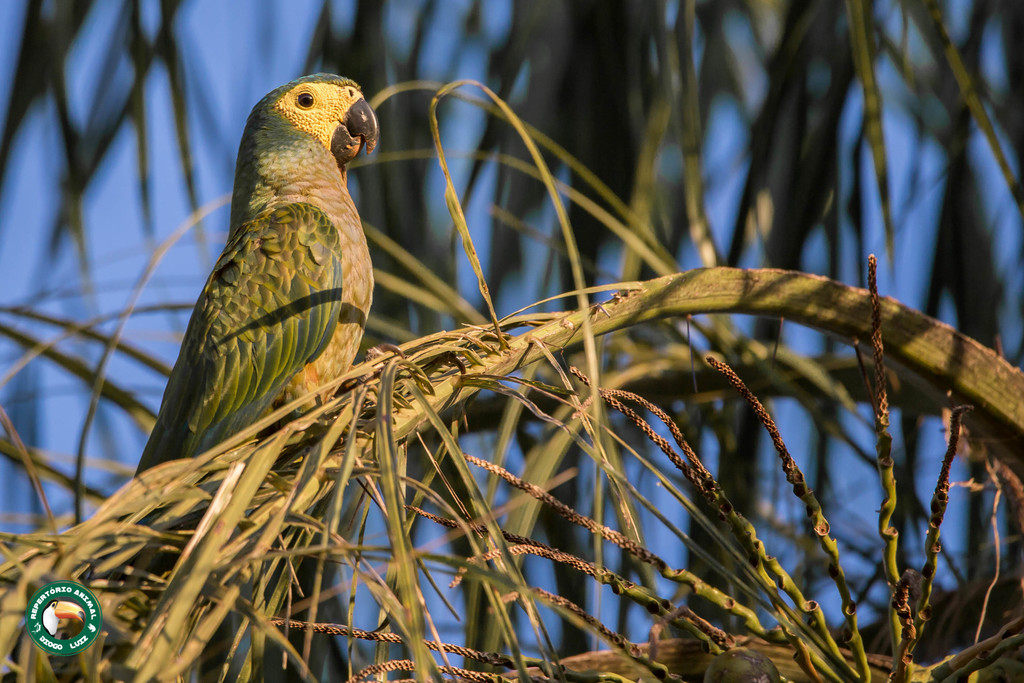
Red-bellied Macaw
The red-bellied macaw (Orthopsittaca manilatus), also known as Guacamaya manilata, is a medium-sized, mostly green parrot, a member of a group of large Neotropical parrots known as macaws. It is the largest of what are commonly called "mini-macaws". The belly has a large maroon patch which gives the species its name. It is endemic to tropical Amazonian South America (as well as the Caribbean island of Trinidad), from Colombia south to Amazonian Peru and Bolivia, and central Brazil as far as the northwestern cerrado. Its habitat is moriche (or buriti) palm (Mauritia flexuosa) swamp forests and sandy savannahs with palm groves. They are critically dependent on the Moriche palm for roosting, feeding and nesting. Although the bird is locally common, in places it has been adversely affected by clearing of the palms for use as posts, or to allow cattle ranching; also by capture for the pet trade. Not to be confused with the African red-bellied parrot (Poicephalus rufiventris), a similarly named smaller parrot. == Taxonomy == The red-bellied macaw was described by the French polymath Georges-Louis Leclerc, Comte de Buffon in 1780 in his Histoire Naturelle des Oiseaux from a specimen collected in Cayenne, French Guiana. The bird was…
Viruá National Park
Brazil
+103 birds+14 mammals
Where granite inselbergs rise dramatically from the Amazon’s northern fringe, a 3,651-square-kilometre wilderness unfolds across Roraima State. This Category II […]
VIEW NATIONAL PARKBrasília National Park
Plano Piloto, Brazil
+122 birds+30 mammals
Where granite escarpments rise above the cerrado grasslands of central Brazil, a vast sanctuary unfolds across 1,077 square kilometres of […]
VIEW NATIONAL PARKSerra do Divisor National Park
Brazil
+132 birds+30 mammals
Where the Ucayali River carves its ancient path through northwestern Brazil, rainforest canopy rises in unbroken waves across nearly 27,000 […]
VIEW NATIONAL PARKBahuaja Sonene National Park
San Pedro de Putina Punco, Peru
+132 birds+30 mammals
Where granite ridges rise above the confluence of Peru’s Río Heath and Río Tambopata, one of the Amazon’s most pristine […]
VIEW NATIONAL PARKNo community photos yet. Log in to add the first one.
No community observations of this species yet.