Identification
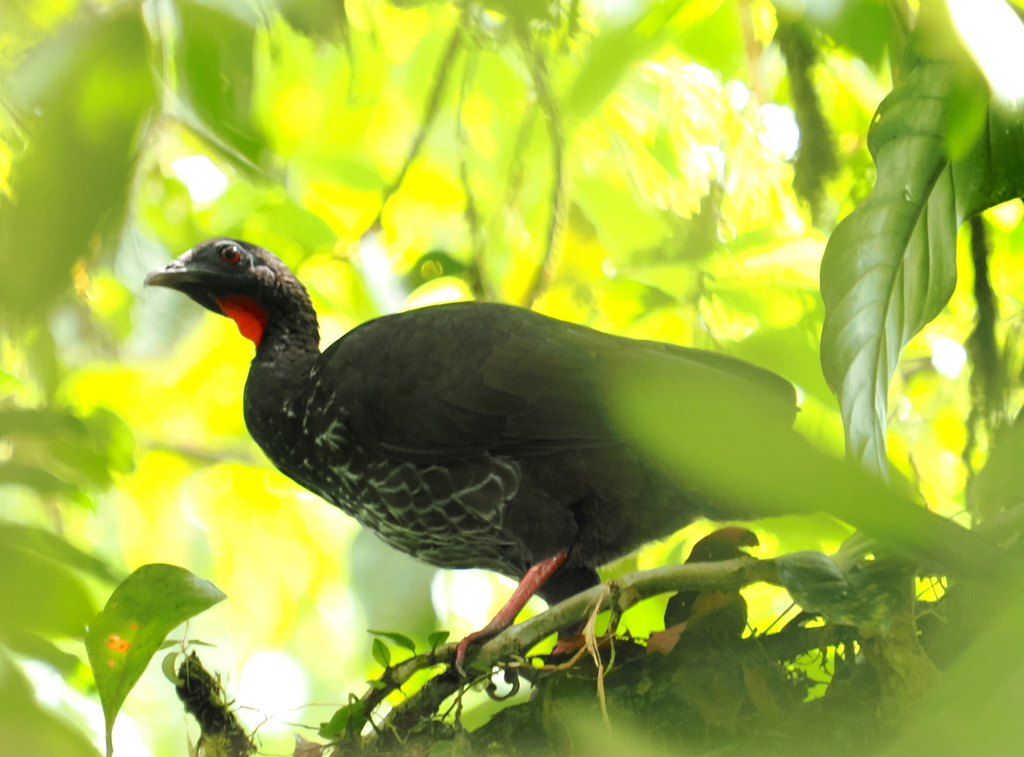
The Baudó guan is a structurally typical member of the guan family, standing approximately 65 cm (26 inches) tall. Its body is predominantly dark brown, with regular small white patches adorning the breast and neck. The head and neck display slightly darker, greyish-brown plumage that makes these white markings more prominent. A distinctive feature that separates this species from all other guans in its South American region is its plain head—all other guans of the same genus possess pale head markings. Both the legs and dewlap are red, though the dewlap is notably brighter and more visible than the legs.
Range & Habitat
The Baudó guan is restricted to the humid forests of the west Andean foothills in western Colombia and northwestern Ecuador, found on the lower slopes and at the base of these mountains. There are no confirmed recent records of the species south of Pichincha in Ecuador. Regrettably, its range and population have declined significantly in recent years, with large sections of its distribution in the Chocó region already lost to habitat destruction. Based on 2002 estimates, the population at one Ecuadorian site was calculated between 2,500 and 7,500 adult individuals, with extrapolations from transects conducted between 1997 and 2006 suggesting a global population of 7,000–21,000 mature individuals.
Behaviour & Diet
The Baudó guan is highly vocal, particularly around dawn when it produces far-carrying guttural bawling calls described as "waou"—its territorial call. When alarmed by human presence, the bird emits low, soft, and prolonged rising whistles to warn companions. A rarely heard alarm call—"konh-konh-konh-konh," repeated several times—is shared with other Penelope species. The guan forages for fruits in the upper strata of humid forests, typically in smaller groups rather than large flocks.
Best Time & Places to See It
Dawn is the optimal time to locate this species, as territorial calls are most prominent during early morning hours. The bird's presence in the west Andean foothills of western Colombia and northwestern Ecuador makes these regions the primary destinations for observation. However, potential visitors should note that many areas inhabited by the species remain poorly surveyed. Conservation efforts are currently focused on implementing population monitoring programs and habitat surveys, particularly in poorly protected regions of Nariño and Esmeraldas, which may help identify the most reliable viewing locations.
Photography Tips
Photographers should visit during dawn hours when the Baudó guan is most vocal and active. The bird's dark brown plumage and white breast patches offer good contrast for photography, particularly when the greyish-brown head and neck are illuminated, making the white patching more visible. The red dewlap and legs provide striking color accents. Patience and knowledge of humid forest habitats in the Colombian and Ecuadorian Andes are essential, as this is an endangered species with a declining population that requires careful, respectful approach.