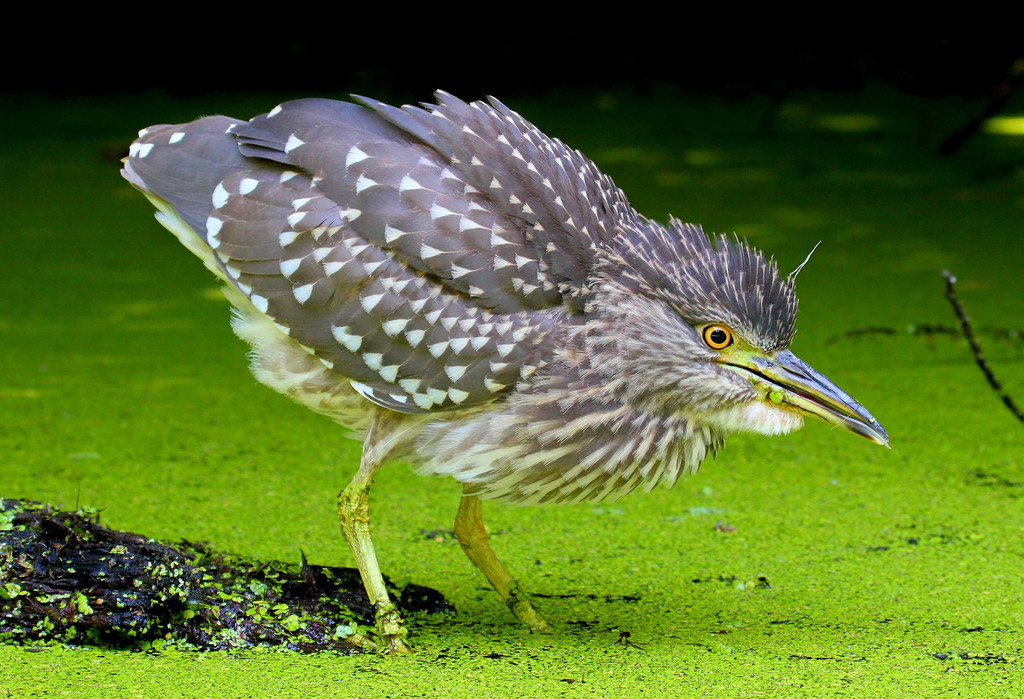
Identification
The black-crowned night heron is a stocky, medium-sized heron with a distinctive appearance that sets it apart from its taller cousins. Adults are unmistakable: they sport a glossy black crown and back, contrasting sharply with white or grey underparts and pale grey wings. The most striking features are their bright red eyes and short yellow legs. During the breeding season, adults develop one to eight long, slender white plumes extending from the back of the head, which they raise during courtship and greeting displays. For a brief period at the start of nesting season, their legs flush bright salmon-pink and the bare skin around their eyes turns blue—a spectacular seasonal transformation.
Immature birds are quite different and often confuse observers. They wear dull grey-brown plumage adorned with numerous pale "teardrop" spots on their heads, wings, and backs, with streaked, paler underparts. Young birds have orange eyes and duller yellowish-green legs. Unlike adults, they lack the characteristic head plumes. The black-crowned night heron has a notably hunched resting posture, but when hunting, it extends its relatively short neck and looks more like typical wading birds. Males are slightly larger than females, though the sexes otherwise resemble one another.
Range & Habitat
This adaptable species enjoys a vast global distribution across Europe, Asia, Africa, North America, and South America. Four subspecies are recognized, each occupying different regions: the nominate subspecies ranges across Eurasia, Africa, and Madagascar to East Asia; the North American subspecies extends from southern Canada through Central America to northern Argentina and Chile, and into Hawaii; and two additional subspecies occupy southernmost South America and the Falkland Islands respectively.
Black-crowned night herons favour fresh and salt-water wetlands, nesting in colonies on stick platforms built in trees or on protected ground such as islands and reedbeds. They are migratory in northern regions—European birds winter in Africa (with some remaining in southern Spain), Asian populations move to southern Asia, and North American birds migrate to Mexico, the southern United States, Central America, and the West Indies—but remain year-round residents elsewhere, even in cold Patagonia. Remarkably resilient in urban environments, they thrive in city wetlands and waterways, including Oakland's Lake Merritt, where they are celebrated as the city's official bird.
Behaviour & Diet
Black-crowned night herons are highly vocal birds, particularly in their breeding colonies, where they produce loud calls commonly transcribed as "quok" or "woc." They are crepuscular hunters, most active during dawn and dusk, which aligns with their nocturnal lifestyle and gives them their common name. Their stocky build and shorter bill, legs, and neck represent adaptations distinct from the typical heron body plan—features that suit their hunting style and ecological niche. During courtship at the nesting season, they perform elaborate displays, erecting their head plumes and transforming their facial coloration to attract mates.
Colonies are the centre of their social life, with birds laying three to eight eggs in their stick nests. The young are extremely noisy, adding to the cacophony of established breeding sites. Their success in colonizing diverse habitats from rural wetlands to urban waterways demonstrates their dietary flexibility and hunting prowess.
Best Time & Places to See It
Timing your search for this nocturnal hunter is key to success. Visit wetlands during dawn or dusk when these birds are most active. Their migratory patterns vary by region: in the Northern Hemisphere, spring and summer offer the best viewing during breeding season, while autumn and winter are optimal in wintering grounds. Year-round residents in warmer regions can be found throughout the calendar.
Look for colonies near trees overlooking freshwater marshes, lakeshores, and coastal wetlands. Major populations inhabit San Francisco Bay, particularly Oakland's Lake Merritt, while European populations breed across the continent. Botanical gardens and zoo grounds occasionally host breeding colonies, such as the long-established population at Washington, D.C.'s National Zoo. Local birdwatching guides and wetland visitor centres can direct you to active colonies in your chosen region.
Photography Tips
Photographing black-crowned night herons requires patience and timing. The dramatic contrast between their black crowns and white bodies creates striking compositions, especially when head plumes are erected. Shoot during golden hour—dawn and dusk—when these birds are most active and light is most flattering. Use a telephoto lens to maintain distance from colonies and avoid disturbance; these are sensitive birds during breeding season.
Look for opportunities to capture the vibrant red eyes, and if you time your visit during early breeding season, try to photograph the unusual bright salmon-pink leg colouration and blue facial skin. Immature birds offer different photographic challenges and rewards—the pale teardrop markings on their darker plumage create interesting textural compositions. Approach colonies quietly and slowly to maximise your chances, and remember that colony sites are best visited during breeding season when birds are most engaged and visible.