Identification
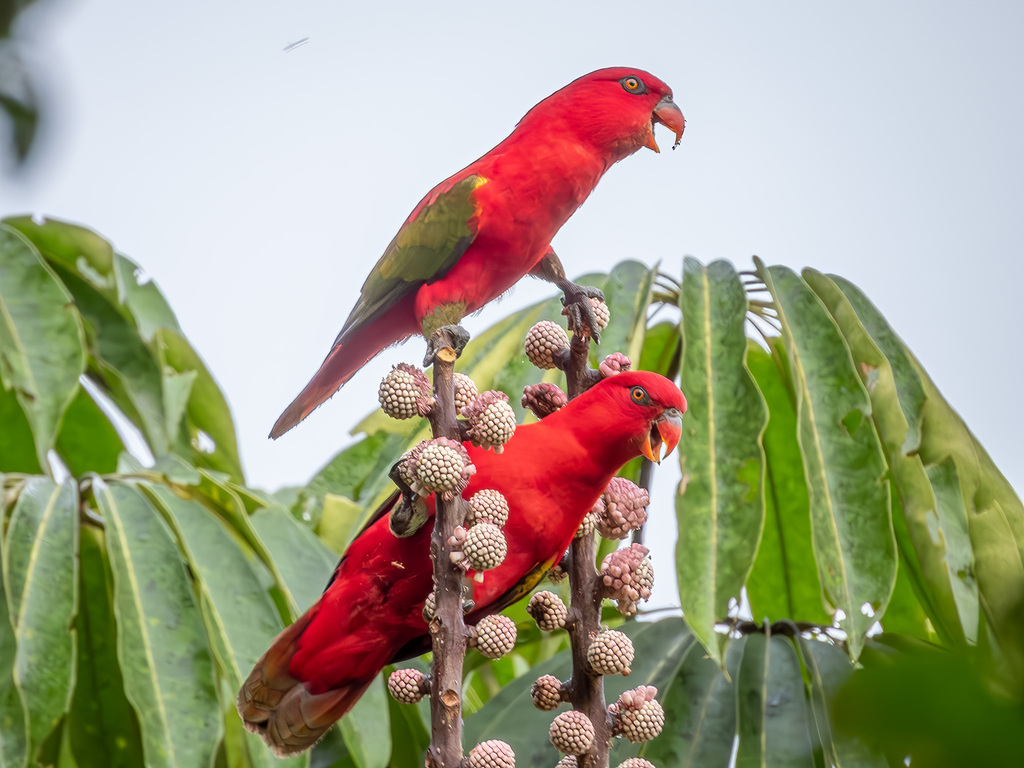
The chattering lory is a striking medium-sized parrot measuring 30 cm (12 in) in length. Its plumage is predominantly red, with a distinctive all-red head that makes it instantly recognizable in the forest canopy. The bird's orange beak contrasts sharply against its crimson head, while distinctive grey eyerings and orange-red irises give it an intense, alert expression. The wings are mainly green with a bright yellow angle, and the thighs are also green, creating a beautiful colour contrast. The tail is tipped with dark green, and the legs are dark grey. Depending on the subspecies, some individuals may display a yellow area on the back—most notably in the yellow-backed lory (L. g. flavopalliatus)—though this feature is not present in all birds.
Range & Habitat
The chattering lory is endemic to North Maluku, Indonesia, where it inhabits forested regions across several islands in the Maluku archipelago. Three subspecies are recognized, each occupying distinct island groups: the nominate subspecies is found on Halmahera, Widi, and Ternate Islands; the yellow-backed lory occurs on Kasiruta, Bacan, Obi, and Mandiole Islands; and a third subspecies inhabits Morotai and Rau Islands. This parrot is a true forest dweller, preferring the canopy and mid-storey levels where it finds food and shelter among dense vegetation.
Behaviour & Diet
The chattering lory lives up to its name with loud, distinctive vocalizations that echo through the forest. The species is primarily frugivorous, feeding on the fruits and seeds found in its forest habitat. Like many lorikeets, it is highly social and active, moving through the canopy with agility and energy. The bird's lively personality and vocal nature make it conspicuous to observers, despite its forest dwelling habits. Unfortunately, the chattering lory is considered vulnerable, with the primary threat to its survival being trapping for the international cage-bird trade, which has significantly impacted wild populations.
Best Time & Places to See It
To observe chattering lories in their natural habitat, travel to North Maluku, Indonesia, particularly to forested areas on Halmahera or the other island groups where the species occurs. The best approach is to visit protected forest areas where the birds are least disturbed. Early morning hours are typically productive for birdwatching, when the parrots are most active and vocal as they forage in the canopy. Listen carefully for their characteristic loud calls, which will often lead you to flocks moving through the treetops.
Photography Tips
The chattering lory's bright red and green plumage offers excellent photographic potential against the forest canopy. Position yourself in clearings or along forest edges where overhead light is better and the bird's colours are most vivid. A telephoto lens (at least 400-600mm) is essential for capturing detailed shots from a distance without disturbing the birds. The best images are obtained during early morning light when the parrots are most active. Be patient and allow time to locate feeding flocks by listening for their loud calls; the reward is photographs of one of Indonesia's most colourful and charismatic forest parrots.