Identification
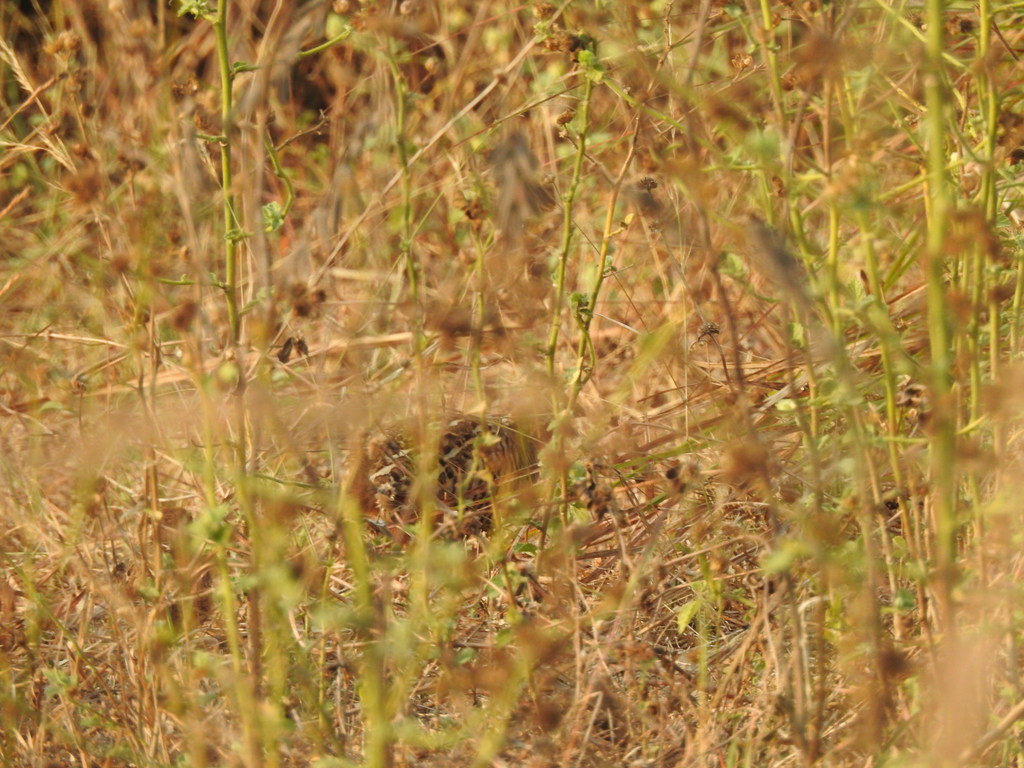
The jungle bush quail is a diminutive member of the pheasant family, measuring just 15–18 cm in length and weighing a mere 57–82 g. The species displays striking sexual dimorphism that aids identification. Males feature brown upperparts with blackish and buff markings, offset by whitish underparts with bold black barring. The face is distinctively dark reddish-brown with a prominent buffy-white moustachial stripe and a supercilium that turns whitish toward the back of the neck. Females present a softer appearance with pinkish-brown underparts, more uniform wings, and duller moustachial stripes. Juveniles resemble females but bear whitish streaks on the head and breast. The jungle bush quail is unlikely to be confused with other quail genera, though it may occasionally be mistaken for the rock bush quail, which shows less sexual dimorphism and has a shorter, whiter eyestripe.
Range & Habitat
Native to the Indian subcontinent, the jungle bush quail is found throughout peninsular India, from Gujarat and Odisha in the north to the Kashmir foothills, as well as across Sri Lanka. An introduced population exists on the island of Réunion. The species historically occurred in Nepal but has not been recorded there since the 19th century. It inhabits dry areas with shrubby or rocky cover, thriving in habitats ranging from thin grasslands to dense deciduous forests. The species occurs at elevations up to 1,200 m, though in the Western Ghats and southern India it reaches elevations up to 1,500 m.
Behaviour & Diet
The jungle bush quail is a gregarious species, typically foraging in small flocks of 6–25 birds. It feeds primarily on seeds and small insects. The species is generally non-migratory across most of its range. Its advertising call is a harsh, rhythmic chee-chee-chuck, chee-chee-chuck, reminiscent of a quarrelling black drongo. When flocks become separated, birds reassemble using low whistling calls of tiri-tiri-tiri or whi-whi-whi-whi-whi. Groups may also produce burbling or grating notes that quicken into a frenzy, along with low chuckles when flushed and harsh alarm calls.
Best Time & Places to See It
Breeding occurs from the end of the rains through the cold season, with timing varying across the species' range. Birds nest in shallow scrapes among cover, laying clutches of 4–8 eggs. The female alone incubates the eggs. Look for jungle bush quails in dry, scrubby habitats throughout peninsular India and Sri Lanka. Early morning or late afternoon visits to suitable grassland or deciduous forest edges offer the best chance of encountering small flocks. The species' large range and stable population mean it is relatively widespread throughout its native range.
Photography Tips
Photographing jungle bush quails presents a rewarding challenge. These small, ground-dwelling birds are most active during early morning and late afternoon hours. Focus on dry, open areas with scattered shrubby cover where flocks are likely to forage. The striking sexual dimorphism makes this species particularly photogenic—males' bold black barring and distinctive facial markings contrast beautifully with females' softer coloration. Be patient and move slowly to avoid flushing birds. The species' tendency to remain in small groups means that locating one flock increases the likelihood of multiple photo opportunities. Overcast conditions can help reveal the subtle plumage details that distinguish this quail from similar species.