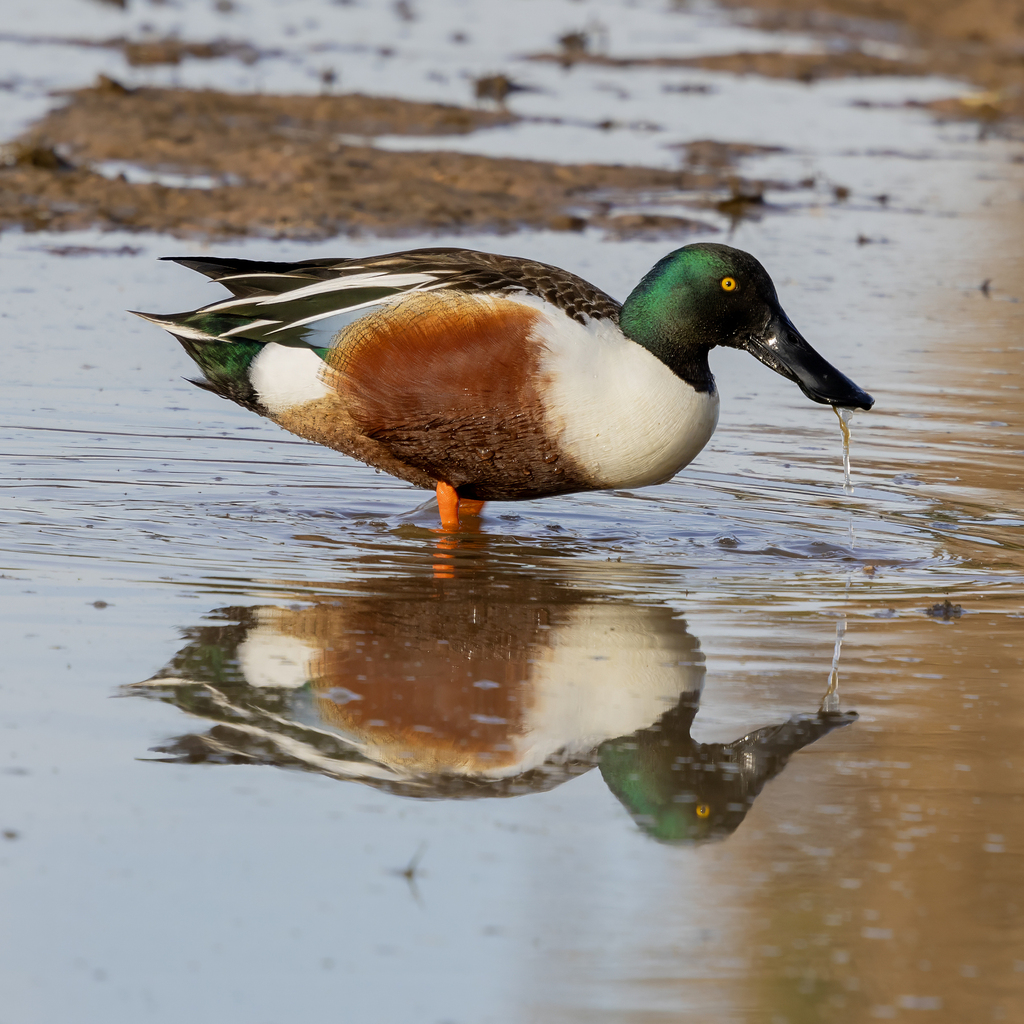
Identification
The northern shoveler is unmistakable thanks to its large, spatulated bill—the feature from which its name derives. Breeding males are striking, with an iridescent dark green head (appearing black at distance or in poor light), a white breast, and chestnut belly and flanks. In flight, they reveal pale blue forewing feathers separated from a green speculum by a white border. Early autumn males display a distinctive white crescent on each side of the face. Females are dull, mottled brown like female mallards, but are easily distinguished by their long, broad bill, which is grey tinged with orange on the cutting edge and lower mandible. Both sexes have bright orange-red legs. Northern shovelers measure 44–52 cm in length with a wingspan of 70–84 cm and typically weigh 500–800 g. In nonbreeding eclipse plumage, males resemble females but retain their pale blue forewing.
Range & Habitat
This common and widespread duck breeds across large areas of northern Europe, the Palearctic, and most of North America—including the southern edge of Hudson Bay westward and south to the Great Lakes, Colorado, Nevada, and Oregon. Northern shovelers winter in southern Europe, the Indian subcontinent, Southeast Asia, Central America, the Caribbean, and northern South America, making them rare vagrants to Australia. Those wintering in the Indian subcontinent undertake a remarkable journey over the Himalayas, often pausing in wetlands just south of the mountain range.
The species inhabits open wetlands such as wet grasslands and marshes with emergent vegetation. They show a marked preference for mud-bottomed marshes rich in invertebrates. In Great Britain, around 1,300–1,450 pairs breed, particularly in southern and eastern England around locations like the Ouse Washes, the Humber, and the North Kent Marshes. They breed across most of Ireland and are increasingly recognized as more common and widespread there than previously thought.
Behaviour & Diet
Northern shovelers are specialized foragers, feeding by dabbling and swinging their bills side to side to strain food from the water. Their highly specialized, wide, flat bills are equipped with well-developed lamellae—small, comb-like structures that function like sieves, allowing them to skim crustaceans and plankton from the water's surface. This specialization gives them a feeding advantage over other dabbling ducks and reduces competition for food resources.
Shovelers prefer to nest in grassy areas away from open water, constructing shallow ground depressions lined with vegetation and down. Hens typically lay about nine eggs. Drakes are highly territorial during breeding season and defend their mates from competitors; elaborate courtship displays involving a dozen or more males pursuing a single hen are not uncommon. Despite their stocky appearance, shovelers are nimble fliers. This is a fairly quiet species; males produce a clunking call while females have a mallard-like quack.
Best Time & Places to See It
In North America, northern shovelers are present year-round across their breeding range, with winter birds found south of a line from Washington to Idaho and from New Mexico east to Kentucky, also along the Eastern Seaboard as far north as Massachusetts. In Great Britain and Ireland, they are best seen during winter months, when they are more numerous than breeding birds. The Ouse Washes, the Humber, and the North Kent Marshes are reliable locations in England, while they occur in smaller numbers in Scotland and western England.
Photography Tips
The northern shoveler's distinctive large bill and colorful plumage make it a rewarding photographic subject. Breeding males are most visually striking, with their iridescent green heads and contrasting white and chestnut underparts. Capture them in flight to showcase their pale blue forewing feathers and white border separating the speculum. Early autumn provides the bonus of the white facial crescent. Photograph them in their preferred habitat of open marshes and wet grasslands at dawn or dusk when light is optimal. Their nibble flight and dabbling behavior offer dynamic shooting opportunities, particularly when multiple males are engaged in courtship displays.