Identification
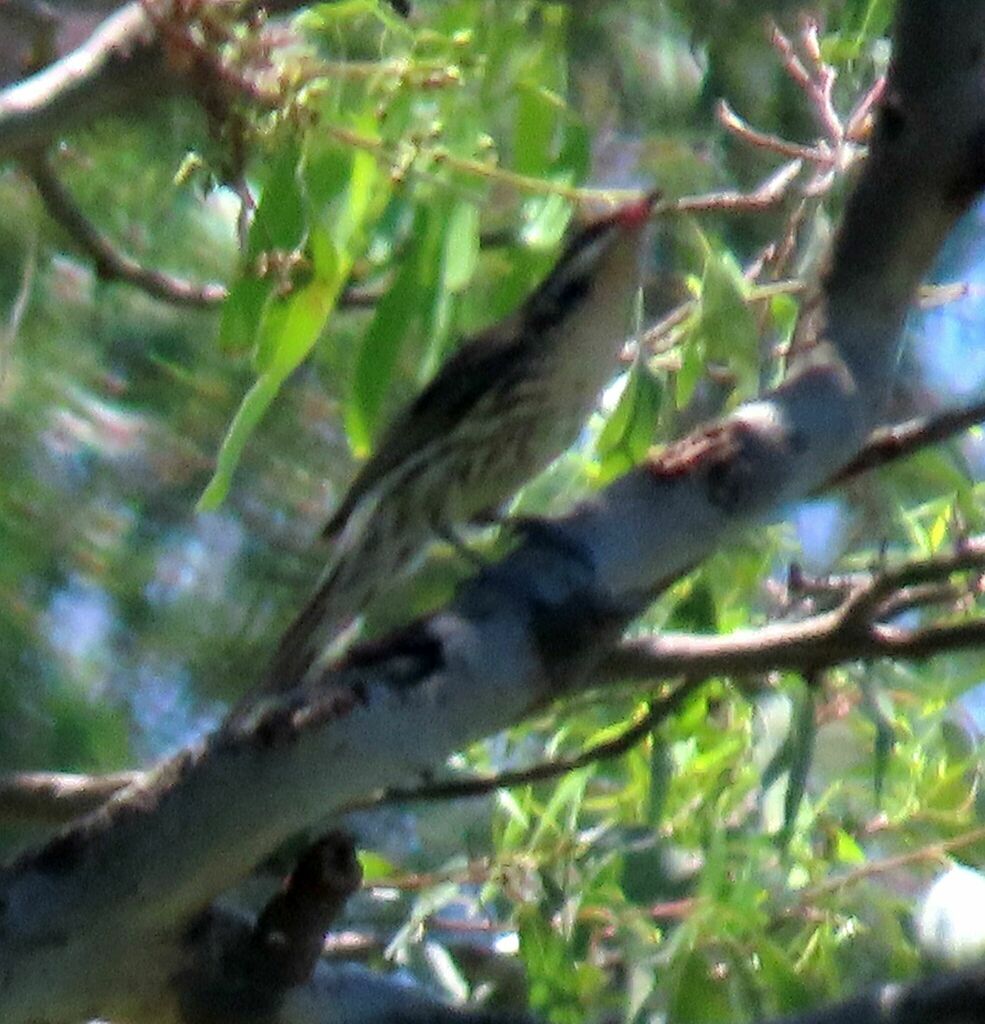
The spiny-cheeked honeyeater is one of Australia's larger honeyeaters, measuring 22 to 27 centimeters in length and weighing around 52 grams. Its most distinctive features are the characteristic dark stripe running through the eye to the ear coverts and the speckled, dark grey-brown crown. The cheeks are predominantly white in adults with grey or brown streaking, though juveniles display a more pronounced yellow cheek sash. The long, straight bill is black-tipped with fleshy red or pink colouring toward the chin, making it stand out among other honeyeaters.
The breast and underparts are creamy-white with browny streaks, and the throat typically displays a light brown or cinnamon tone. The wings and tail are mottled olive-brown to grey with white edges, and the white tail-feather tips are visible in flight. Some regional variation exists—notably birds on the Mornington Peninsula have darker bellies than populations elsewhere. Juveniles have brown irises and paler facial skin on the bill compared to adults.
Range & Habitat
This species is endemic to Australia and found across most of the continent, except for Tasmania, the far north-western tropics, the southeastern coast east of the Great Dividing Range, and the far south-west of Western Australia. They do occur on Kangaroo Island in South Australia. While somewhat nomadic in northern Australia, southern populations tend to be resident year-round and are considered common throughout their range.
Spiny-cheeked honeyeaters favour sparse, woody tree environments and hummock grasslands including beach spinifex and porcupine grass in arid outback regions. They adapt readily to scattered and open woodlands, shrubland, and managed pastures with grasses, sedges, and rushes. Coastal populations inhabit tea tree environments along foreshores, and they occasionally venture into mangroves and orchards. This adaptability to diverse dry and semi-arid habitats makes them widespread across the continent.
Behaviour & Diet
These birds are notably sociable, aggressive, and often observed foraging in large flocks. Unlike many honeyeaters with specialist diets, the spiny-cheeked honeyeater is an opportunistic feeder with diverse tastes. Studies show that nectar comprises approximately 38% of their diet, with insects, small lizards, spiders, and larvae making up significant portions. They are primarily frugivorous, with fruit accounting for around 25% of their overall diet. The birds adjust their feeding preferences seasonally, favouring nectar abundance in winter and spring while relying more heavily on insects during other periods.
Breeding occurs throughout the year, with 75% of eggs found between late August and mid-November in eastern populations. Both parents participate in raising young, feeding them dark-coloured scale insect larvae in November and December, and later shifting to available berries. Nests are distinctive deep cup-shaped structures suspended hammock-like between branches, woven from grass, spider silk, and spider egg-sacs, and lined with soft materials like possum fur.
Best Time & Places to See It
The spiny-cheeked honeyeater is common throughout its Australian range, making it a reliable sighting for travellers exploring inland and coastal regions. They are present year-round in southern populations, though breeding activity peaks from late August through mid-November in eastern areas. Coastal locations like the Mornington Peninsula in Victoria offer good viewing opportunities, particularly in tea tree environments along the foreshore. The birds' sociable nature and tendency to forage in flocks make them relatively easy to locate once you know their preferred habitats.
Search sparse woodlands, hummock grasslands, and shrubland areas across inland Australia. In arid regions, focus on scattered Acacia trees and surrounding grasses where flocks congregate to feed. Managed pastures and orchards also attract these birds regularly. Early morning hours typically offer the best viewing and photography opportunities when birds are most active.
Photography Tips
The spiny-cheeked honeyeater's striking facial markings—the dark eye-stripe, white cheeks, and distinctive bill colouration—make it a rewarding subject for close-up photography. Position yourself to capture the characteristic head pattern and the long straight bill with its red-pink base and black tip. Frame shots that showcase the creamy-white breast with its fine browny streaking and the cinnamon throat colouration.
The birds' habit of foraging in flocks provides opportunities for dynamic group shots, though individual portraits best reveal field-guide details. Look for birds perched in sparse woodland where natural light filtering through scattered trees creates flattering illumination. Capture them feeding on flowering plants or fruit-bearing shrubs to document their opportunistic feeding behaviour. Morning light on coastal populations in tea tree habitats can produce particularly striking images that highlight their plumage variation and colouration.