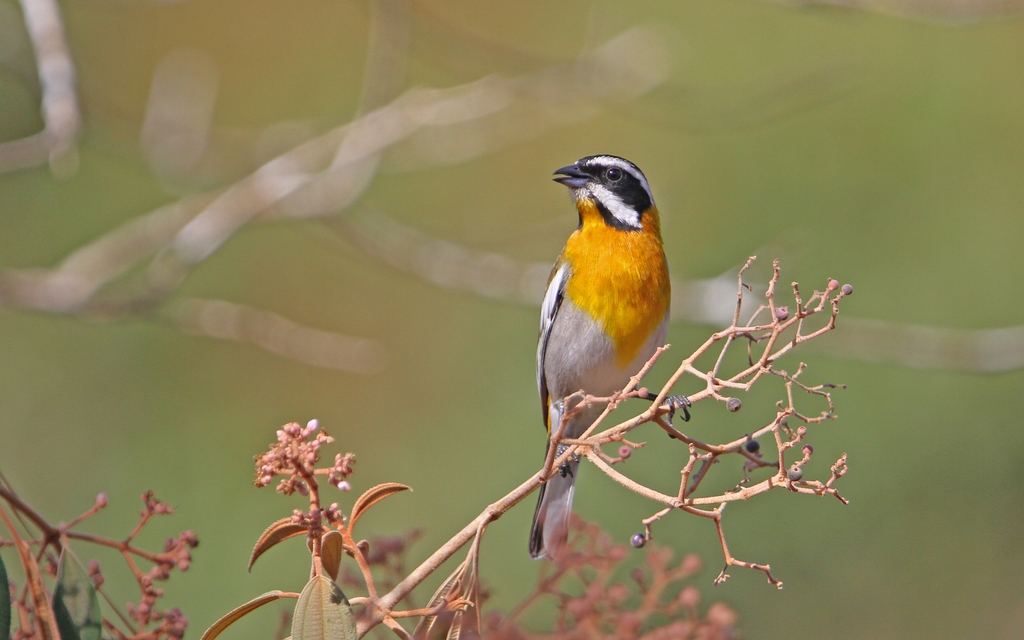
The western spindalis (Spindalis zena) is a songbird species. It was formerly considered conspecific with the other three species of Spindalis, with the common name stripe-headed tanager. == Taxonomy == The western spindalis was formally described in 1758 by the Swedish naturalist Carl Linnaeus in the tenth edition of his Systema Naturae. He placed it with the finches in the genus Fringilla and coined the binomial name Fringilla zena. Linnaeus based his account on "The Bahama Finch" that had been described and illustrated in 1730 by the English naturalist Mark Catesby in his book The Natural History of Carolina, Florida and the Bahama Islands. Linnaeus specified the type locality as southern America but this was restricted in 1936 by the Austrian ornithologist Carl Eduard Hellmayr to New Providence in the Bahamas. The western spindalis is now one of the four species placed in the genus Spindalis that was introduced in 1837 by William Jardine and Prideaux John Selby. The specific epithet zena is from Ancient Greek ζηνα/zēna or ζηνη/zēnē, a type of finch, probably the European goldfinch. Five subspecies are recognised: S. z. townsendi Ridgway, 1887 – north Bahamas S. z. zena (Linnaeus, 1758) – central, south Bahamas S. z.…