Identification
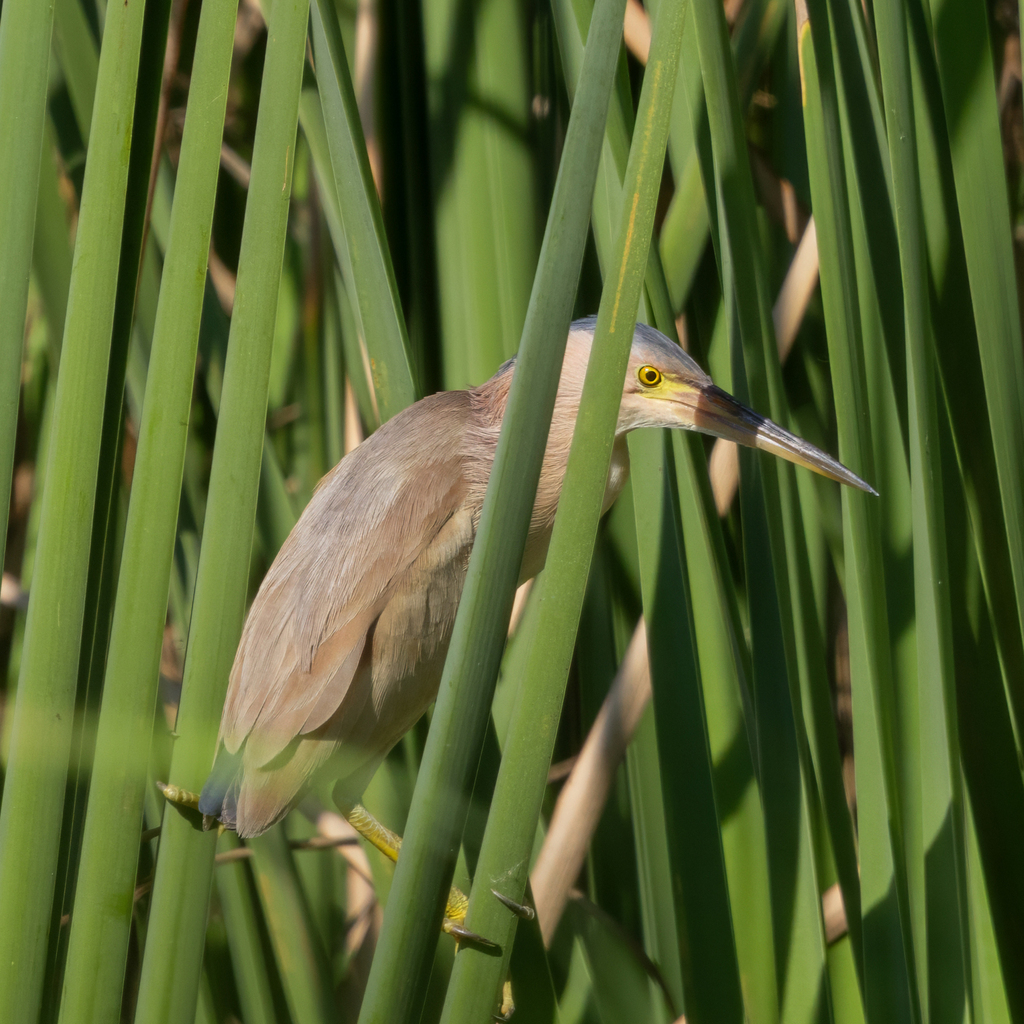
The yellow bittern is a compact heron at just 36 to 38 centimetres in length, making it one of the smaller members of its family. It is characterized by short, yellow-green legs, an ivory bill (darker on the upper ridge), and distinctive yellow irises that give the species its name. The tail is notably short and black.
Males are striking, with a dark cap contrasting against a chestnut head and neck, while the body is uniformly dull yellow above and buff below. Females are more subtly marked, with streaked caps, necks, and breasts, a rufous hindneck and upper back, and streaked dark red-brown and buff underparts. Juveniles resemble females but are more boldly streaked, with brown heads and backs mottled with buff.
Range & Habitat
The yellow bittern is an Old World species with a distribution spanning the northern Indian subcontinent eastward through the Russian Far East, Japan, and Indonesia. Mainly resident throughout its range, northern populations undertake short-distance migrations. Vagrants have occasionally been recorded as far afield as Alaska.
This species is strictly tied to freshwater environments, inhabiting marshes and swamps where it nests in small constructed platforms of reeds or twigs built within reed beds or in trees and shrubs adjacent to or overhanging water.
Behaviour & Diet
Yellow bitterns are opportunistic foragers with a varied diet. They feed on insects, fish, amphibians, crustaceans, and molluscs, hunting within the dense vegetation of their wetland homes.
During breeding season, females lay clutches of four to six pale blue-green eggs in their reed or twig nests, demonstrating the species' commitment to freshwater reed beds and adjacent vegetation as essential breeding habitat.
Best Time & Places to See It
The yellow bittern's resident status across most of its Asian range means it can be encountered year-round in suitable habitat, though northern populations may be absent during winter months. Visitors to marshes and swamps across the Indian subcontinent, Russia's Far East, Japan, and Indonesia offer the best opportunities for encounters.
The species' preference for dense reed beds and vegetation means patient observation in suitable wetlands during early morning or dusk—when bitterns are most active—offers the best chance of sightings.
Photography Tips
Photographing yellow bitterns requires patience and stealth, as they are secretive birds that favour dense cover. Position yourself near reed beds and swamps at dawn or dusk when activity peaks, and use a telephoto lens to maintain distance without disturbing the bird.
The subtle plumage differences between males and females, and the distinctive yellow irises and short stature, make this species rewarding to photograph despite its elusive nature. Patient waiting in good habitat is more effective than active searching through dense vegetation.