Agile Gibbon
Identification
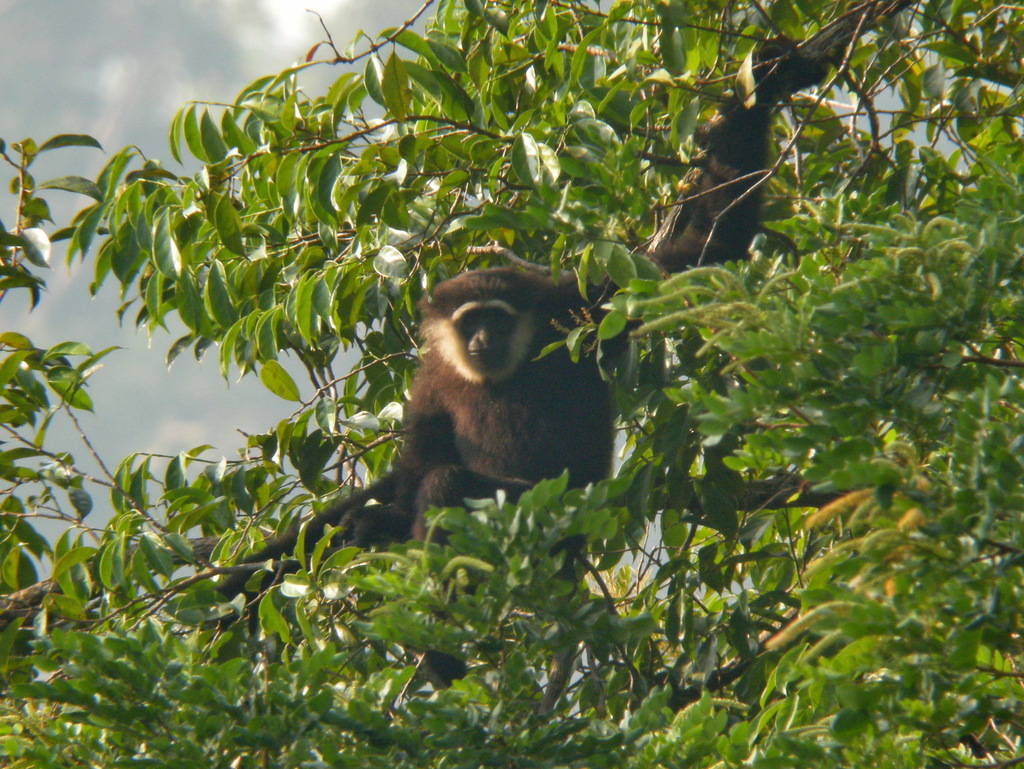
The agile gibbon, also known as the black-handed gibbon, is a small primate weighing 4 to 6 kg on average, with a head and body length of 44–63.5 cm. Like all gibbons, it is tailless. Its fur varies in colour from black to red-brown, with a distinctive white brow. Males are slightly larger than females and can be identified by their white or light-grey cheeks, making them easier to distinguish in the field.
Range & Habitat
The agile gibbon is native to Indonesia, particularly on the island of Sumatra, and also occurs in Malaysia and southern Thailand. On Sumatra, the species is found southeast of Lake Toba and the Singkil River, while populations exist in a small area on the Malay Peninsula and in south Thailand near the Malaysian border. The species is predominantly arboreal, living high in rainforest canopies and only rarely descending to the ground.
Behaviour & Diet
True to its name, the agile gibbon is an acrobatic brachiator, swinging rapidly through the forest canopy on its long arms with impressive agility. Like all gibbons, it is strictly monogamous, living in pairs that maintain and vigorously defend defined territories through animated visual displays and distinctive songs. The diet is primarily frugivorous, though the species also consumes leaves, flowers, and insects to supplement its intake.
Females give birth to a single offspring after a seven-month gestation period. Young gibbons are weaned at around 2 years of age and remain with their family group until reaching full maturity at approximately 8 years old, when they disperse to seek mates and establish their own territories.
Best Time & Places to See It
The agile gibbon's arboreal nature and preference for dense rainforest canopy make it a challenging species to observe. Early morning is typically the best time for encounters, as gibbons are most vocal and active at dawn. The best opportunities for sightings are in protected rainforest areas within its range on Sumatra, the Malay Peninsula, and southern Thailand, though viewing requires patience and skill in locating animals high in the treetops.
Photography Tips
Photographing agile gibbons presents significant challenges due to their arboreal habits and rapid movement through the canopy. A telephoto lens is essential for capturing distant subjects in the treetops. Early morning light is preferable for photography, and patience is crucial—spend time listening for the species' distinctive territorial songs, which can help locate family groups. Shutter speeds should be fast enough to freeze the animals' dynamic brachiating movements.
Penang National Park
Balik Pulau, Malaysia
+125 birds+30 mammals
Granite peaks rise abruptly from the Andaman Sea where tropical rainforest clings to steep slopes in one of Malaysia’s oldest […]
VIEW NATIONAL PARKKerinci Seblat National Park
Kerinci, Indonesia
+60 birds+30 mammals
Where rainforest canopies surge across volcanic highlands and misty valleys plunge between soaring peaks, one of Southeast Asia’s most biodiverse […]
VIEW NATIONAL PARKNo community photos yet. Log in to add the first one.
No community observations of this species yet.