Asian Small-clawed Otter
Identification
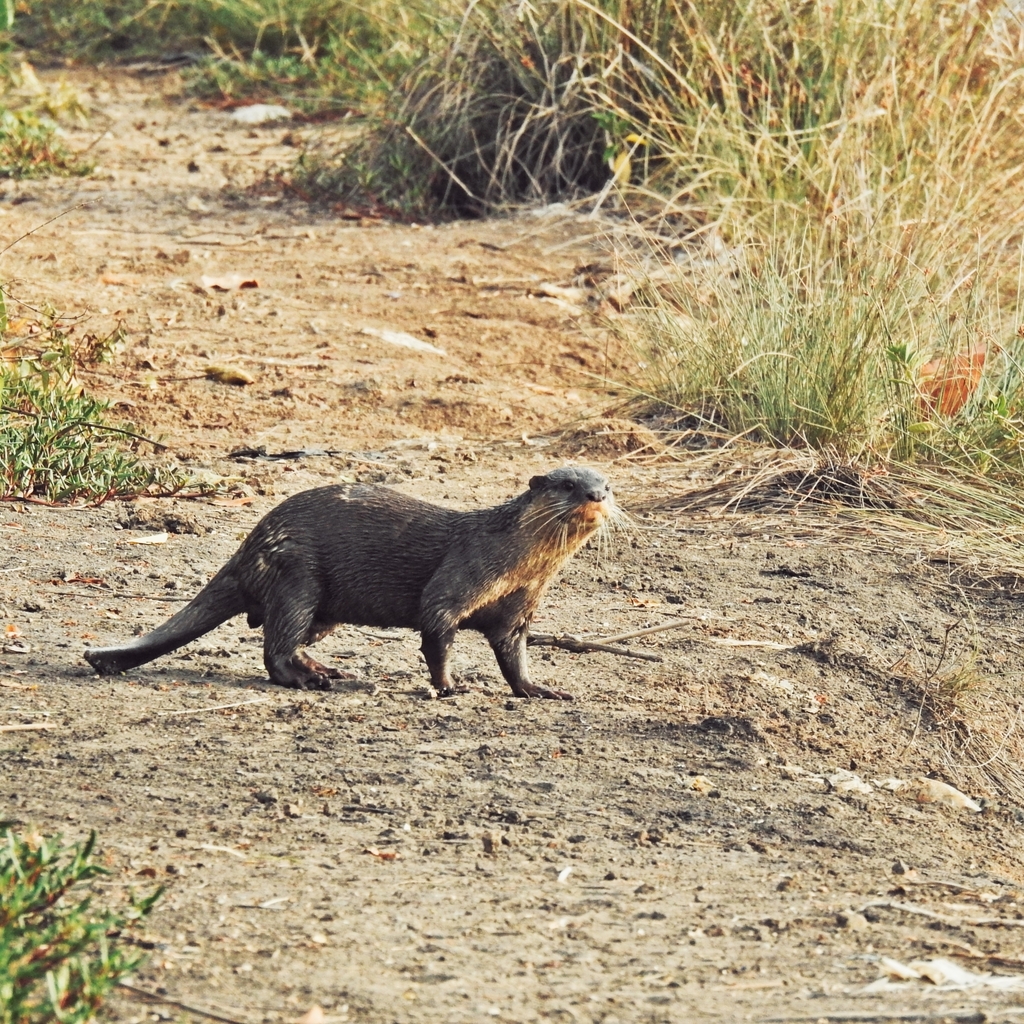
The Asian small-clawed otter is the smallest otter species, with a total body length of 730 to 960 mm and a maximum weight of 3.5 kg. Its most distinctive feature is its short claws that do not extend beyond the pads of its webbed digits—indeed, claws may be almost absent in some individuals. The species has deep brown fur with a rufous tinge on the back, but is considerably paler below. Its face is characteristically marked with whitish cheeks, upper lip, chin, and throat contrasting against brown sides of the neck and head.
Structurally, this otter has a short skull with a rounded naked rhinarium and long coarse whiskers on its muzzle. Its small, oval ears are inconspicuous, and its eyes are positioned toward the front of the head. The tapering tail is thick and muscular, particularly at the base, and measures more than half the body length. The webbed paws are narrow with short digits webbed to the last joint, and the plantar pads are longer than wide.
Range & Habitat
Native to South and Southeast Asia, the Asian small-clawed otter's range extends from parts of India through Southeast Asia, including the islands of Sumatra, Java, Borneo, and Palawan. It occurs in Indian states including West Bengal, Assam, Arunachal Pradesh, Odisha, Karnataka, and the Nilgiri and Palni hills of Tamil Nadu, where it inhabits shallow mountain creeks at elevations up to 2,000 m. Recent records confirm its presence in far-western Nepal.
This species favours freshwater wetlands such as swamps, meandering rivers, irrigated rice fields, and mountain creeks, as well as coastal habitats including estuaries, coastal lagoons, tidal pools, and mangrove forests. In West Java, it frequents slow-flowing irrigation channels and pond areas surrounded by sheltering vegetation.
Behaviour & Diet
The Asian small-clawed otter is mostly active after dark and is a social animal, living in groups of up to 15 individuals. In the Bangladesh Sundarbans, group sizes ranged from one to 12 individuals. Group members communicate using 12 or more distinct calls, including yelps and whimpers, and will scream to rally help when disturbed. When swimming on the surface, they row with their forelimbs and paddle with their hind limbs; when diving, they undulate their bodies and tails, reaching speeds of 0.7–1.2 m/s.
This otter feeds on molluscs, crabs, and other small aquatic animals. Wild otters have been observed smearing their spraint at latrine sites using their hind feet and tails—a behaviour that likely facilitates social ties among group members and serves as territorial marking. They rest on grassy or sandy banks.
Best Time & Places to See It
Since the Asian small-clawed otter is mostly active after dark, early morning and dusk offer the best opportunities for observation. The Bangladesh Sundarbans is a documented location where multiple individuals have been recorded. In India, wetland areas and mountain creeks in West Bengal, Assam, Arunachal Pradesh, and the Nilgiri and Palni hills of Tamil Nadu are promising destinations. West Java's irrigated landscapes and mangrove areas also support populations.
This species is listed as Vulnerable on the IUCN Red List and is threatened by habitat loss, pollution, and hunting in some areas, making sightings increasingly precious. Patient observation near water courses at dawn or dusk, particularly around latrine sites where the otters congregate, offers the best chance of encounters.
Photography Tips
Photographing this diminutive otter requires patience and discretion. Since they are mostly nocturnal or crepuscular, plan your visits for early morning or late afternoon when light is still available but the otters are most active. Position yourself quietly near water courses, particularly at known latrine sites, allowing the animals to approach naturally. A telephoto lens will prove essential given their small size and wariness.
Watch for their characteristic swimming behaviour—surface rowing with forelimbs and tail undulation when diving—to anticipate photo opportunities. The whitish facial markings provide good contrast for portraits, while their interactions within family groups offer compelling behavioural shots. The mangrove and wetland habitats they favour can provide atmospheric backgrounds that complement portraits of these charismatic but elusive otters.
Hat Noppharat Thara-Mu Ko Phi Phi National Park
Ao Nang, Thailand
+127 birds+21 mammals
Limestone cliffs plunge into emerald waters where mangrove forests crown the shoreline and coral gardens flourish beneath transparent shallows. This […]
VIEW NATIONAL PARKKaziranga National Park
Kohora, India
+129 birds+30 mammals
Dawn breaks over the floodplains of the Brahmaputra, where tall grasslands stretch endlessly beneath monsoon-heavy skies. This sprawling wilderness of […]
VIEW NATIONAL PARKBako National Park
Kuching, Malaysia
+112 birds+18 mammals
Weathered sandstone cliffs rise dramatically from the South China Sea, their ochre faces sculpted by millennia of wind and tide […]
VIEW NATIONAL PARKPenang National Park
Balik Pulau, Malaysia
+125 birds+30 mammals
Granite peaks rise abruptly from the Andaman Sea where tropical rainforest clings to steep slopes in one of Malaysia’s oldest […]
VIEW NATIONAL PARKTaman Negara Bukit Lambir National Park
Miri, Malaysia
+137 birds+15 mammals
Rainforest cascades down sandstone ridges where crystal streams carve through ancient geology, creating a landscape of profound biological richness in […]
VIEW NATIONAL PARKNo community photos yet. Log in to add the first one.
No community observations of this species yet.