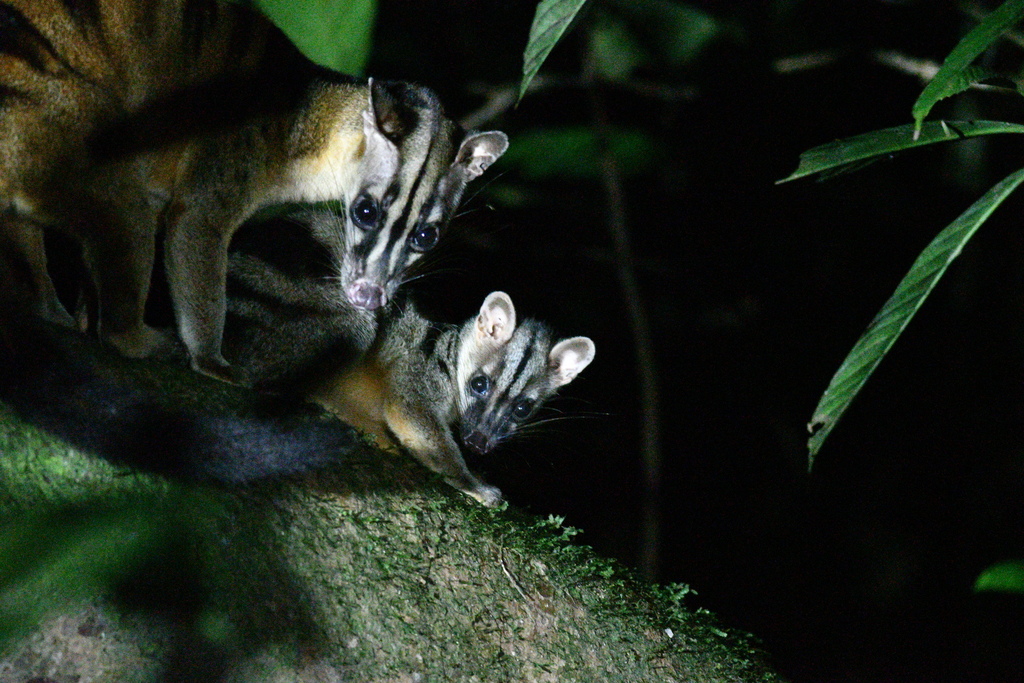
Banded Palm Civet
The banded palm civet (Hemigalus derbyanus), also called the banded civet, is a viverrid native to Indomalaya. They primarily inhabit lowland conifer habitat, which is under threat from encroaching human activity. It is estimated the population of the banded palm civet has decreased by around 30% in just three generations. Banded palm civets are usually approximately the size of a domestic cat; their fur is pale but with dark bands on the back. They are believed to be closely related to Hose's palm civets, which are similar in appearance and distribution. The banded palm civet is the only species in its genus, first scientifically described in 1837. The species comprises four subspecies, distributed across Indonesia and Southeast Asia. Two of the subspecies diverged from each other as long ago as 2.7 million years. Banded palm civets are affected by a variety of parasites, such as nematodes, and are primarily carnivorous, eating small animals such as rodents and bugs. They have sensitive hairs on their paws which help them to detect potential prey. == Classification == The genus Hemigalus was named and first described in 1837 by Claude Jourdan who had a skin and skeleton of one zoological specimen at his…
No community photos yet. Log in to add the first one.
No community observations of this species yet.