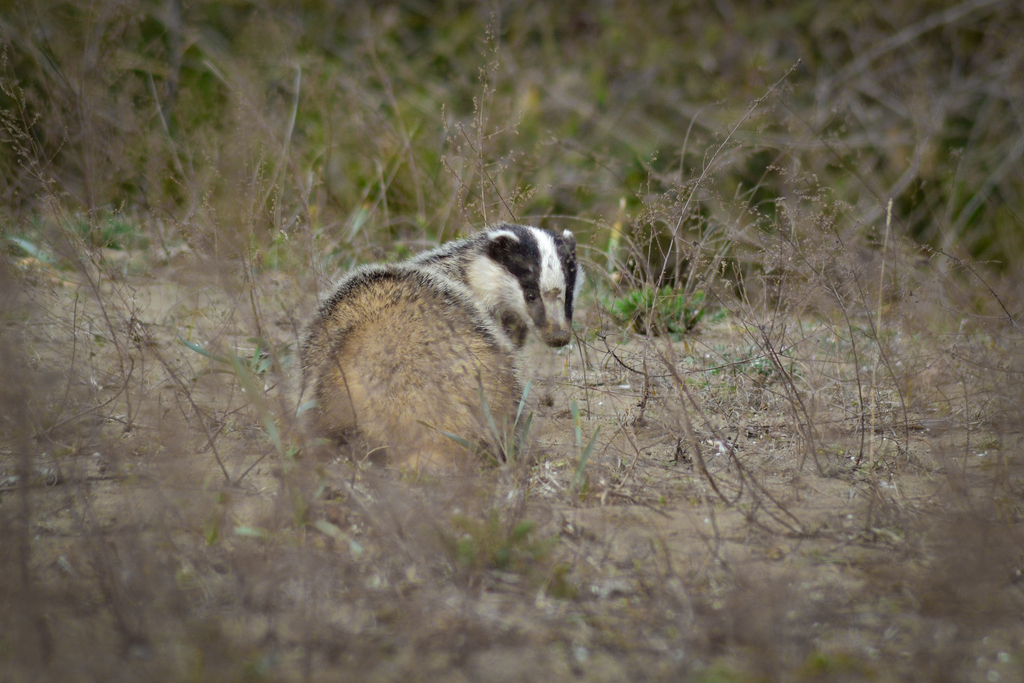
Caucasian Badger
The Caucasian badger (Meles canescens) or Southwest Asian badger is a species of badger native to Western Asia and some islands in the Mediterranean Sea. == Taxonomy == The Caucasian badger was formerly thought to be a subspecies of the European badger (M. meles), along with the other subspecies also classified within it. However, a 2013 study found significant genetic divergence between both species. It is thought that both diverged during the Pleistocene, between 2.37 million years ago to 450,000 years ago. The American Society of Mammalogists recognises it as a distinct species. == Description == This species is smaller than the European badger, with a dirty-greyish back and brown highlights; its head is identical to the European badger, though with weaker crests; its upper molars are elongated in a similar way as the Asian badger's. Its fur can be distinguished from the Asian and Japanese badgers by its facial mask, which resembles that of the European badger. == Distribution == The Caucasian badger ranges from Anatolia north to the Caucasus Mountains, south to the Levant and west-central Iran, and east through the Tian Shan mountains. It also occurs on the Mediterranean islands of Crete and Rhodes. The boundary of…
Trialeti Planned National Park
Tbisi, Georgia
+130 birds+21 mammals
Where limestone plateaus rise above the Caucasian foothills, a mosaic of oak forests, alpine meadows, and beech woodlands creates one […]
VIEW NATIONAL PARKSarakinikou National Park
Chania Regional Unit, Greece
+134 birds+4 mammals
Where limestone cliffs plunge toward turquoise waters and endemic Mediterranean scrub clings to rocky slopes, Greece’s most dramatic coastal wilderness […]
VIEW NATIONAL PARKSamaria National Park
Chania Regional Unit, Greece
+138 birds+12 mammals
Where granite gorges plunge nearly a kilometer into the Cretan landscape, a dramatic wilderness unfolds across 4,850 hectares of Crete’s […]
VIEW NATIONAL PARKNo community photos yet. Log in to add the first one.
No community observations of this species yet.