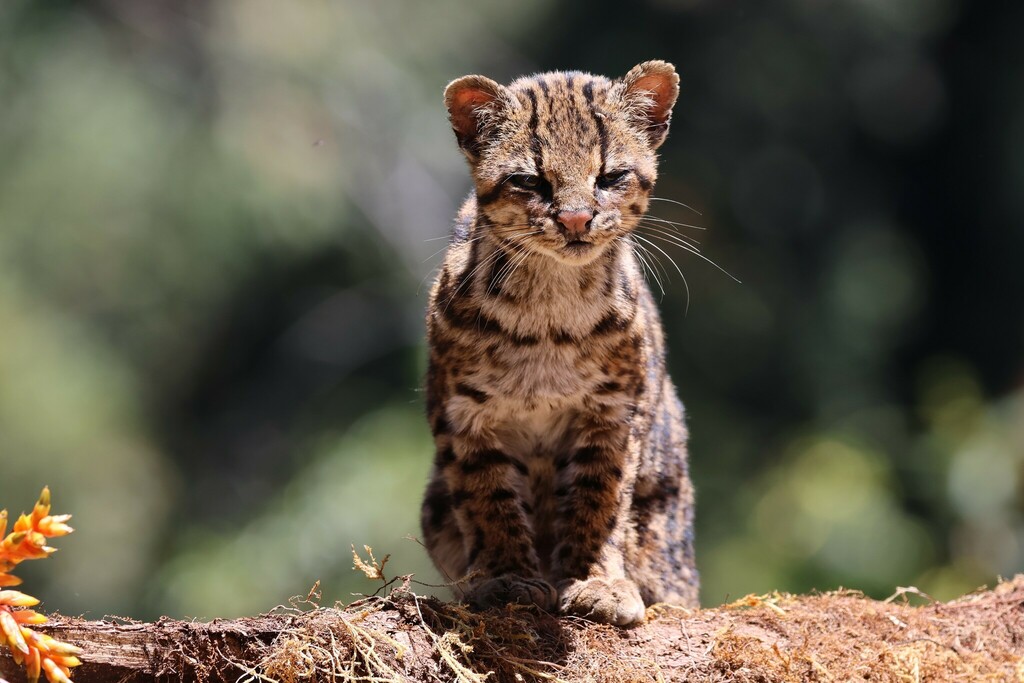
Clouded Oncilla
Identification
The clouded oncilla is a diminutive spotted cat with a head and body length of 41 to 54 centimetres and a tail of 24.5 to 34 centimetres, weighing on average 2.27 kilograms. Its most distinctive features are its soft fur coat in shades of red, orange, gray, and yellow, marked with irregular "cloudy" or "nebulous" rosettes that occasionally coalesce into bands reminiscent of ocelots. Southernmost populations may display rounder rosettes. The species has short, round ears, a long bushy tail with bold black blotching and banding, and notably large paws relative to its size. The eyes are larger than those of other tiger cats, though smaller than the margay's. A striking characteristic is that melanistic (dark) specimens occur frequently, accounting for 6.5% to 32% of recorded sightings depending on region, with Costa Rica showing the highest frequency at 32%.
Range & habitat
The clouded oncilla is sparsely distributed across Central and South America, ranging from the forests of Costa Rica and Panama through the Andes mountains to northwestern Argentina. The species is specialist inhabitant of cloud forests, typically dwelling between 1,500 and 3,000 metres above sea level where cool, misty conditions prevail. Nearly half of the species' remaining range occurs within Colombia. Sadly, the species has experienced catastrophic habitat loss, with a 2024 analysis revealing a 50.4% reduction in range over recent decades, shrinking from 824,923 to 409,371 square kilometres, primarily driven by climate change and deforestation.
Behaviour & diet
The clouded oncilla is a nocturnal hunter with a particularly interesting temporal behaviour—it is "lunar phobic," meaning it actively avoids foraging during bright moonlit nights. This preference for hunting in darkness allows it to target small rodents, reptiles, and ground-dwelling birds that are similarly active after sunset and before sunrise. The species appears to employ temporal segregation as a strategy to minimize conflicts with competing predators, including dogs, weasels, tayras, and other cat species. Unlike the closely related northern and southern tiger cats, the clouded oncilla possesses a remarkable climbing ability and has been observed ascending upside-down for short distances, though it cannot rotate its ankle joints.
Best time & places to see it
Finding a clouded oncilla in the field is a considerable challenge due to its small size, nocturnal habits, and preference for remote cloud forest elevations. The species is most active during nighttime hours, particularly during darker lunar phases. Andean cloud forests in Colombia—which hold nearly half the species' range—represent the most likely locations for encounters, though spotting one remains rare. The species' secretive nature and ongoing habitat loss make sightings precious opportunities for dedicated naturalists and researchers.
Photography tips
Photographing clouded oncillas demands specialized equipment and patience. Night vision or infrared camera traps set in cloud forest habitat between 1,500 and 3,000 metres elevation offer the best chance of documentation. Wide-aperture lenses and high ISO settings are essential for capturing images in low-light conditions. Focus on ground level and dense vegetation where this terrestrial hunter stalks its prey. The species' soft fur texture, striking rosette patterns, and distinctive bushy tail should be priority subjects. Given the species' rarity and threatened status, ethical wildlife photography practices that minimize disturbance are paramount.
Arenal Volcano National Park
Peñas Blancas, Costa Rica
+131 birds+30 mammals
Where a perfect cone of dark basalt rises 1,633 metres above rainforest canopy, Costa Rica’s most iconic volcano commands a […]
VIEW NATIONAL PARKSangay National Park
Cebadas, Ecuador
+39 birds+7 mammals
Where the eastern slopes of the Ecuadorian Andes plummet toward the Amazon basin, a landscape of startling contrasts unfolds across […]
VIEW NATIONAL PARKLlanganates National Park
Tena, Ecuador
+12 birds+9 mammals
Where mist-shrouded páramo plateaus rise above impenetrable cloud forest, Ecuador’s Llanganates unfolds as a realm of profound isolation and vertical […]
VIEW NATIONAL PARKCajas National Park
Cuenca, Ecuador
+100 birds+10 mammals
Where granite peaks pierce the Andean cloud forest between 3,150 and 4,450 meters, more than 270 glacial lakes catch the […]
VIEW NATIONAL PARKNatural Farallones de Cali National Park
Buenaventura, Colombia
+12 birds+26 mammals
Where the western cordillera plunges toward the Pacific, a landscape of dramatic escarpments and misty cloud forest unfolds across nearly […]
VIEW NATIONAL PARKNatural Nevado del Huila National Park
Planadas, Colombia
+32 birds+2 mammals
Where glacier-fed torrents carve through Andean wilderness, Colombia’s high-altitude treasure spans 3,023 square kilometers of vertical drama. The snow-capped summit […]
VIEW NATIONAL PARKNo community photos yet. Log in to add the first one.
No community observations of this species yet.