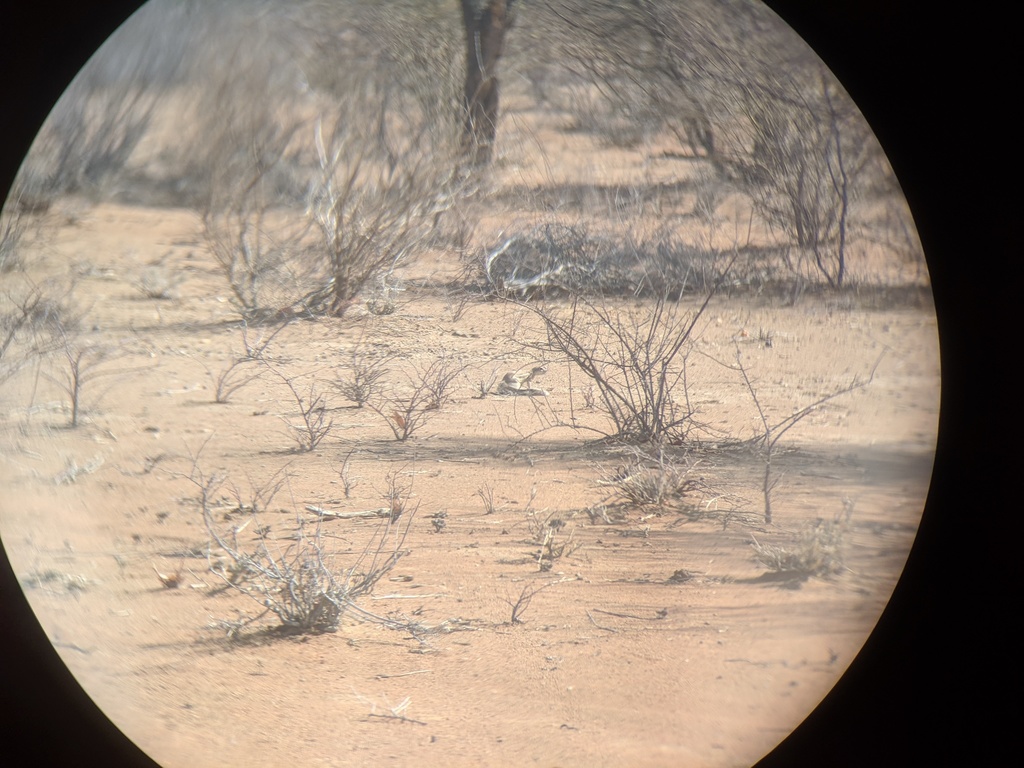
Damara Ground Squirrel
Identification
The Damara ground squirrel is a large-bodied rodent with distinctive markings that make it recognizable across its arid range. It measures 23 to 29 cm in head and body length, with a tail of 21 to 28 cm and weighs between 490 to 710 grams. The most striking features are its pale cinnamon-brown fur on the back contrasting sharply with white underparts, eye-rings, and face markings. A conspicuous white stripe runs from the shoulders to the hips, and the characteristic bushy tail displays white hairs with three black stripes.
The Damara ground squirrel is closely related to the Cape ground squirrel, and the two species can be difficult to distinguish in the field. However, Geosciurus princeps is typically slightly larger on average, though body size overlap exists between the two species. A reliable distinguishing feature is the colour of the incisors: the Damara ground squirrel has yellow to orange incisors, whereas the Cape ground squirrel's are white. The small, rounded ears and black skin beneath the fur are also characteristic features of this species.
Range & Habitat
The Damara ground squirrel is endemic to the arid southwestern corner of southern Africa, with a restricted distribution spanning from southern Angola through western Namibia and into western South Africa. The species occupies a narrow band across this region, with its southern limit reaching as far as Richtersveld National Park. This squirrel is specifically adapted to the sparse, semi-desert environments of this region.
Within its range, the Damara ground squirrel favours areas with sparse vegetation cover, where it constructs its burrow systems. The species is well-suited to the harsh, dry conditions characteristic of southwestern African arid zones, making it a specialist of these challenging desert and semi-desert habitats.
Behaviour & Diet
The Damara ground squirrel is strictly diurnal, remaining active only during daylight hours. The species exhibits a solitary or semi-social lifestyle: adult females may live alone or form small family groups, while males are predominantly solitary. Unlike their closest relatives, the Cape ground squirrels, Damara ground squirrels are notably less social and do not display play behaviours, allogrooming, or other complex social interactions.
These squirrels are active foragers that may range up to 1 kilometre from their home burrow during the day in search of food. Their burrow systems serve as crucial refuges in the exposed landscape and are constructed in areas where vegetation cover is minimal.
Best Time & Places to See It
The Damara ground squirrel is best observed during daylight hours, as the species is strictly diurnal and will be active throughout the day. Your best opportunities lie within the southwestern arid region of Angola, Namibia, and South Africa, particularly around Richtersveld National Park at the southern extent of their range. Look for them in sparse, semi-desert habitats where burrow systems are visible.
Early morning and late afternoon are often productive times, when temperatures are moderate and foraging activity peaks. Patience and careful scanning of open ground will reward observant visitors to their arid homeland.
Photography Tips
Photographing the Damara ground squirrel requires patience and an understanding of their behavioural patterns. Since they are strictly diurnal and range up to 1 kilometre from their burrows, positioning yourself near active burrow systems during daylight hours increases your chances of encounters. The contrasting colours of cinnamon-brown back, white underparts, and distinctive shoulder-to-hip stripe photograph well in the clear desert light characteristic of their range.
Use a telephoto lens to maintain distance while capturing detail, particularly the striking facial markings and the elegant bushy tail with its three black stripes. The harsh shadows of arid environments can be managed by shooting during early morning or late afternoon light, which will enhance the texture of their short fur and emphasize their distinctive white markings against the natural background.
Dorob National Park
Henties Bay, Namibia
+118 birds+30 mammals
Where the Skeleton Coast’s haunting dunes surrender to gravel plains and rocky outcrops, an extraordinary expanse of Namibian wilderness unfolds […]
VIEW NATIONAL PARKNamib-Naukluft National Park
Namibia
+119 birds+30 mammals
Where rust-coloured dunes rise like frozen waves against an impossibly blue sky, Africa’s oldest desert unfolds across nearly 95,000 square […]
VIEW NATIONAL PARKNo community photos yet. Log in to add the first one.
No community observations of this species yet.