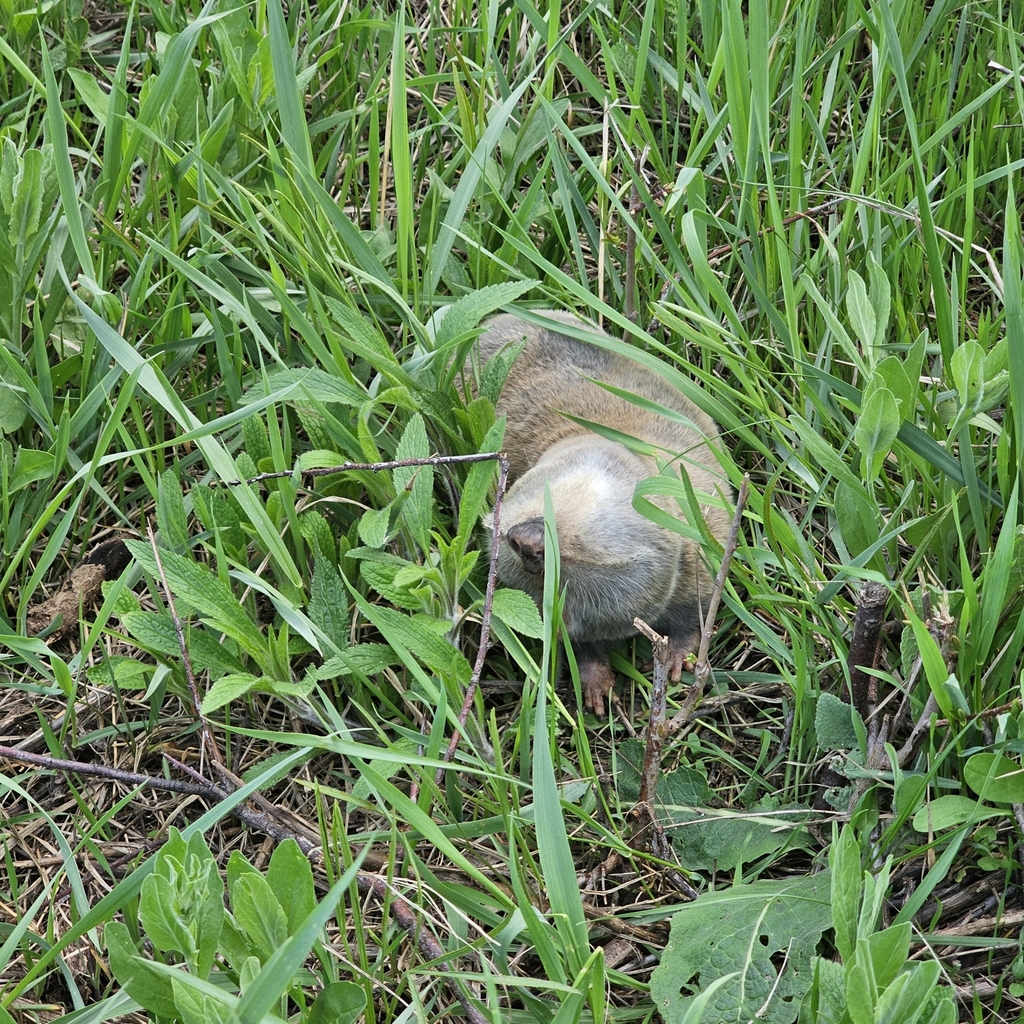
Greater Blind Mole-rat
Identification
The greater blind mole-rat is a highly specialized burrowing rodent that is entirely tailless and completely blind. Its most striking feature is its prominent pair of incisor teeth, which it uses not for feeding primarily, but as its main digging tool. The eyes are entirely non-functional, covered by a membrane of skin beneath which atrophied lens cells and a vestigial retinal layer remain—a remarkable adaptation to its subterranean lifestyle. The fur is typically greyish but can vary considerably in colour depending on the soil conditions of its habitat.
This stocky rodent can reach up to 31 centimetres in length and weigh as much as 570 grams, making it a substantial presence in the underground ecosystem despite its hidden lifestyle. Unlike true moles, its paws are unmodified and play no role in excavation; all tunnelling work is performed by those powerful incisor teeth.
Range & Habitat
The greater blind mole-rat is found exclusively in Russia and Ukraine, with a distribution centred on the steppes. Its range extends across southern Russia between the Dnieper and Volga rivers, stretching northwards to the Oryol to Kursk railway line and southwards into the North Caucasus region. In Ukraine, populations inhabit the steppes where conditions are suitable.
This species shows a strong preference for lowland habitats with black earth soil, actively avoiding sandy or loamy substrates. It inhabits natural steppes and forest steppes, but has also adapted well to human-modified landscapes including agricultural land, plantations, orchards and gardens—where it can sometimes become a pest due to its root-feeding habits.
Behaviour & Diet
The greater blind mole-rat is a strictly fossorial species that spends virtually its entire life underground, emerging only when young animals disperse to establish new territories—a period of extreme vulnerability. It is solitary by nature, tolerating other individuals only during the breeding season. Being totally blind, it navigates and hunts entirely through other senses, relying on touch and likely vibration detection in the soil.
As a herbivore, it feeds on plant roots including those of dandelions, umbellifers, chicory and tree seedlings, accessing them from beneath the soil surface. Remarkably, it is a food-storage specialist, gathering and hoarding excess provisions in its burrow system, sometimes accumulating as much as 14 kilograms of food. Breeding occurs once annually, with litters of two to five young typically born in March.
Best Time & Places to See It
Observing a living greater blind mole-rat in the wild is extraordinarily difficult, as the species remains underground except during juvenile dispersal. The species is generally common throughout its range but patchily distributed, making prediction of locations uncertain. Any sightings would most likely occur accidentally during agricultural work or construction in suitable steppe habitats in southern Russia or Ukraine, particularly during spring when juveniles may be moving through unfamiliar terrain.
Photography Tips
Photographing this species presents a significant challenge due to its cryptic, subterranean existence. Museum specimens or captive individuals represent the most practical subjects for photographers. If field observation occurs, photograph any visible burrow systems and surface disturbances rather than expecting to capture the animal itself. Success depends heavily on luck and local knowledge of active populations.
No community photos yet. Log in to add the first one.
No community observations of this species yet.