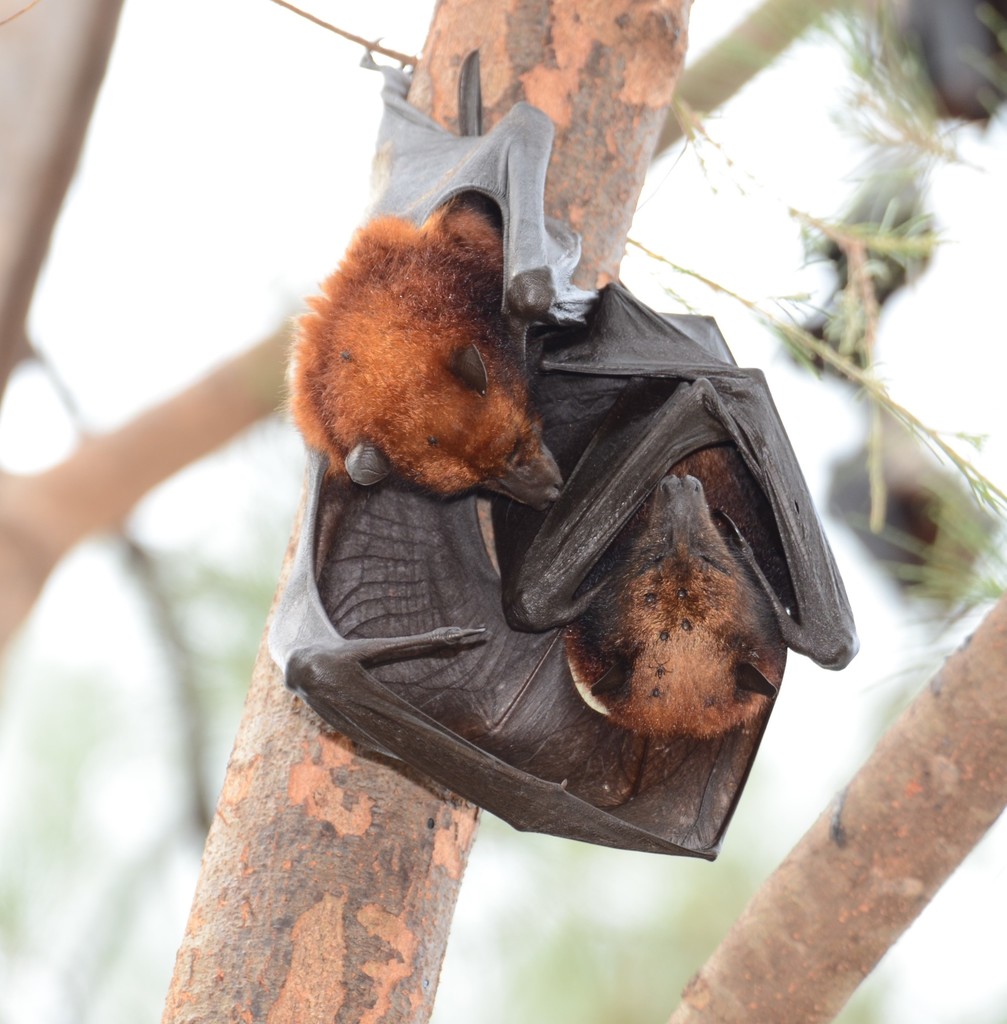
Island Flying Fox
Identification
The island flying fox is a highly variable bat in colouration, which can make identification challenging across its wide range. The head is typically dark brown, though it may be yellowish-brown or notably paler in the eastern portions of its distribution. The back is tawny-brown, while the underparts range through various shades of buff. The ears are partially furred, and the distinctive black wing membranes contrast sharply with the body. Fur length varies across the body, being short on the back and medium-length on the underparts. A useful diagnostic feature separates this species from the similar Ryukyu flying fox: the island flying fox has bare tibiae (legs), whereas its congener's are covered in fur.
Range & Habitat
The island flying fox inhabits the Indo-Pacific region, with a distribution encompassing India, Indonesia, Malaysia, the Maldives, Myanmar, Papua New Guinea, the Philippines, the Solomon Islands, Thailand and Vietnam. Its range includes numerous island groups such as the Maldives, Andaman Islands, Nicobar Islands, and Melanesia. These bats are found at altitudes up to approximately 900 metres. In much of their range, they exhibit a distinctive commuting behaviour: they roost in small outlying islands during the day but fly to larger bodies of land each night to forage, making them predictable in their movements across the landscape.
Behaviour & Diet
Island flying foxes are predominantly frugivorous, feeding mainly on the fruit of native and introduced trees, supplemented with flowers and nectar. Their diet is remarkably diverse and includes pawpaws, mangos, jambul, bananas, figs, kapok tree flowers, banyan flowers and fruits, and cultivated crops—making them occasional agricultural pests. These bats are voracious feeders, consuming approximately half their body weight daily. Sexual maturity is reached at about one year of age, and breeding seasons vary by location with a gestation period of roughly 200 days. Females typically give birth to a single pup, which is weaned at six weeks but remains dependent on its mother for a further four months. While twins are exceptionally rare in this species, two instances have been documented.
Best Time & Places to See It
Island flying foxes are generally abundant across their range and can be observed in many locations throughout the Indo-Pacific. Their predictable commuting behaviour between island roosts and mainland foraging grounds makes them relatively accessible for observation. Notable populations exist in the Philippines, including in the urban town of Miagao on Panay Island, where more than 5,000 individuals were recorded in March 2025, offering excellent opportunities for naturalists visiting the region. Observing them during their evening emergence from roosts or early morning returns provides the best viewing opportunities.
Photography Tips
Photographers seeking to capture island flying foxes should position themselves along known commuting routes between roosts and foraging areas, particularly during dawn and dusk when activity peaks. The bats' black wing membranes and variable fur colouration provide striking contrast in photographs, especially when backlit during flight. Patient observation at known roosting sites, particularly on smaller islands, may yield close-up portraits of hanging individuals. A fast shutter speed and high ISO will be necessary for capturing these swift, aerial subjects in low-light conditions typical of dawn and dusk activity periods.
Mu Ko Similan National Park
Thailand
+30 birds+5 mammals
Where granite monoliths thrust from turquoise waters, an archipelago of nine pristine islands creates one of Southeast Asia’s most dramatic […]
VIEW NATIONAL PARKKhao Laem Ya-Mu Ko Samet National Park
Mueang Rayong District, Thailand
+132 birds+30 mammals
Where limestone cliffs plunge into crystalline waters and coastal forests merge with rocky outcrops, a mosaic of Thailand’s most pristine […]
VIEW NATIONAL PARKAketajawe Lolobata National Park
Halmahera Timur, Indonesia
+109 birds+7 mammals
Where rugged volcanic plateaus rise above the Halmahera seascape, one of Indonesia’s most biodiverse reserves sprawls across nearly 14,000 square […]
VIEW NATIONAL PARKNo community photos yet. Log in to add the first one.
No community observations of this species yet.