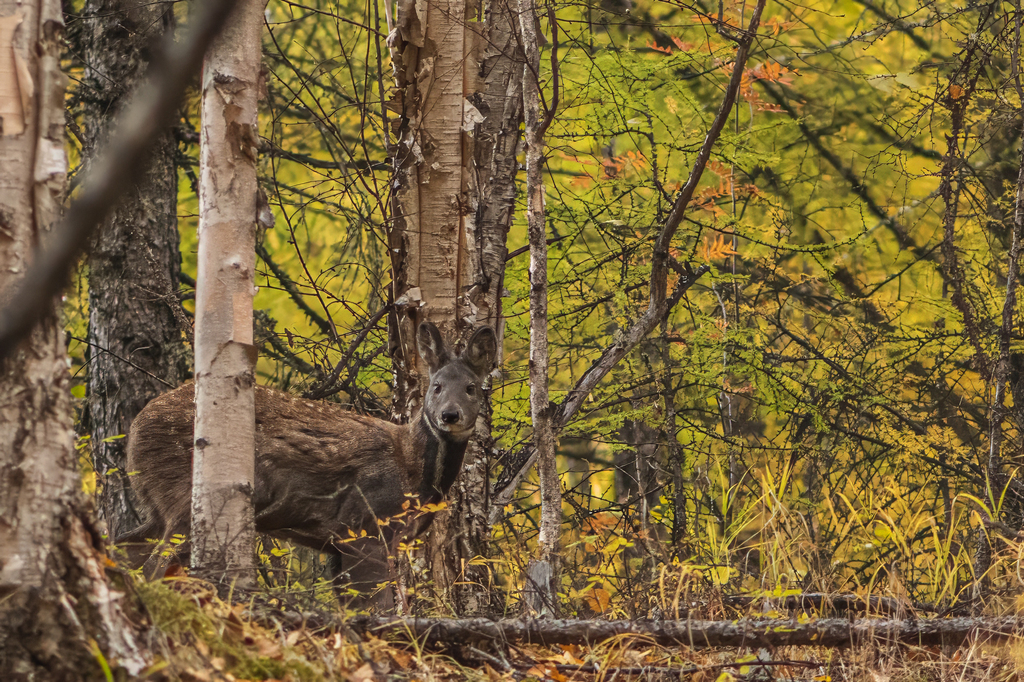
Siberian Musk-deer
Identification
The Siberian musk deer is a small, striking ungulate instantly recognizable by its distinctive tusks and kangaroo-like face. Males display elongated tusks in place of antlers, growing these impressive teeth during breeding season to compete with rivals and attract females. Longer, stronger tusks signal better genes and produce healthier offspring, making them a key attraction for potential mates. Adults are compact animals, weighing between 7–17 kg, allowing them remarkable agility in their rocky mountain terrain.
Range & Habitat
The Siberian musk deer inhabits the mountain forests of Northeast Asia, with populations scattered across southern Siberia, Mongolia, Inner Mongolia, Manchuria, and the Korean peninsula. Several recognized subspecies occupy distinct regions, from the Russian Far East to isolated populations on Sakhalin Island. These deer prefer mountainous taiga environments and shrub-covered slopes at altitudes exceeding 2,600 metres, where rocky crevices and crags provide essential refuge from numerous predators including snow leopards, Amur leopards, wolves, and bears.
Behaviour & Diet
Largely nocturnal, musk deer are solitary and territorial animals that mark their ranges through distinctive behaviour. They gather fallen branches, tree trunks, and plant stems, arranging them in circles while performing olfactory examinations—a ritualistic warning to other deer. Defecation also serves as territorial marking in both claimed and unclaimed areas. These herbivores are specialists in digestion, preferring easily digestible foods rich in protein and low in fibre, particularly lichens, which comprise 99% of their winter diet, supplemented by pine needles, leaves, and tree bark.
Best Time & Places to See It
Siberian musk deer are most commonly encountered in the taiga of southern Siberia, though populations persist in Mongolia and northeastern regions. Their nocturnal habits and preference for remote, high-altitude mountain terrain make them challenging to observe. Winter months are particularly difficult for viewing, as deer concentrate on lichen-rich areas. The most reliable opportunities occur in protected reserves and conservation areas across Russia and Mongolia, where habitat protection measures are actively restoring populations that have declined dramatically due to poaching pressure.
Photography Tips
Photographing Siberian musk deer requires patience and preparation for mountain conditions at high altitudes. Plan expeditions during late spring through early autumn when access to remote taiga is most feasible. Night photography equipment will prove essential given their nocturnal behaviour, though dawn and dusk periods may offer opportunities. Focus on capturing the distinctive tusks and facial features that define this species. Work with local guides familiar with terrain and deer movements, and prioritize minimal disturbance—these vulnerable animals are already stressed by poaching pressure, and photography ethics demand that conservation concerns come first.
Baikal National Park
Ольхонский район, Russia
+124 birds+27 mammals
Where ancient mountains plunge into Earth’s deepest freshwater lake, a landscape of dramatic contrasts unfolds across the southern shores of […]
VIEW NATIONAL PARKKhoridol Saridag National Park
Khatgal, Mongolia
+90 birds+21 mammals
Where granite peaks thrust skyward across Mongolia’s remote southeastern reaches, a landscape of raw geological drama unfolds. Deep river gorges […]
VIEW NATIONAL PARKNo community photos yet. Log in to add the first one.
No community observations of this species yet.