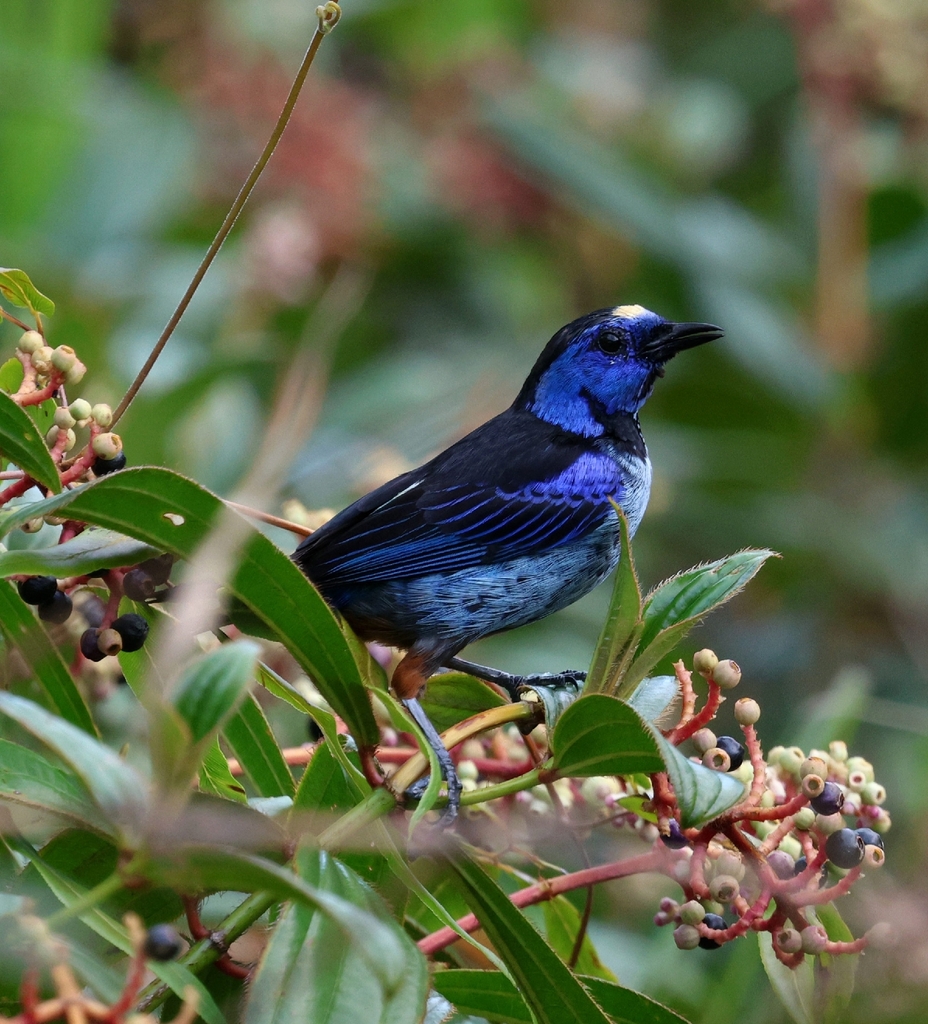
Opal-rumped Tanager
The opal-rumped tanager (Tangara velia) is a species of bird in the family Thraupidae. It is found in the Amazon and Atlantic Forest of South America. The population of the Atlantic Forest has a far paler chest than the other populations, and has often been considered a separate species as the silvery-breasted tanager (Tangara cyanomelas). Today most authorities treat it as a subspecies of the opal-rumped tanager. == Taxonomy == In 1743 the English naturalist George Edwards included an illustration and a description of the opal-rumped tanager in his A Natural History of Uncommon Birds. He used the English name "Red-belly'd Blue-bird". Edwards based his hand-coloured etching on a specimen owned by the Duke of Richmond that had been collected in Suriname. When in 1758 the Swedish naturalist Carl Linnaeus updated his Systema Naturae for the tenth edition, he placed the opal-rumped tanager with the wagtails in the genus Motacilla. Linnaeus included a brief description, coined the binomial name Motacilla velia, and cited Edwards' work. Linnaeus provided no explanation for the specific epithet; it is perhaps a misprint for the Ancient Greek elea, a small bird mentioned by Aristotle. The opal-rumped tanager is now placed in the genus Tangara that…
Yasuní National Park
Aguarico, Ecuador
+132 birds+30 mammals
Where the Napo and Curaray rivers carve through Ecuador’s vast Amazonian lowlands, one of Earth’s most biodiverse terrestrial ecosystems sprawls […]
VIEW NATIONAL PARKNatural Serranía de los Churumbelos National Park
Santa Rosa, Colombia
+145 birds+15 mammals
Where the Andes’ western cordillera surrenders to the Pacific watershed, a fortress of granite peaks and cloud-draped valleys rises across […]
VIEW NATIONAL PARKAnavilhanas National Park
Brazil
+132 birds+30 mammals
Where the Rio Negro braids into a labyrinth of islands and waterways, one of the Amazon’s most pristine archipelagos unfolds […]
VIEW NATIONAL PARKNo community photos yet. Log in to add the first one.
No community observations of this species yet.