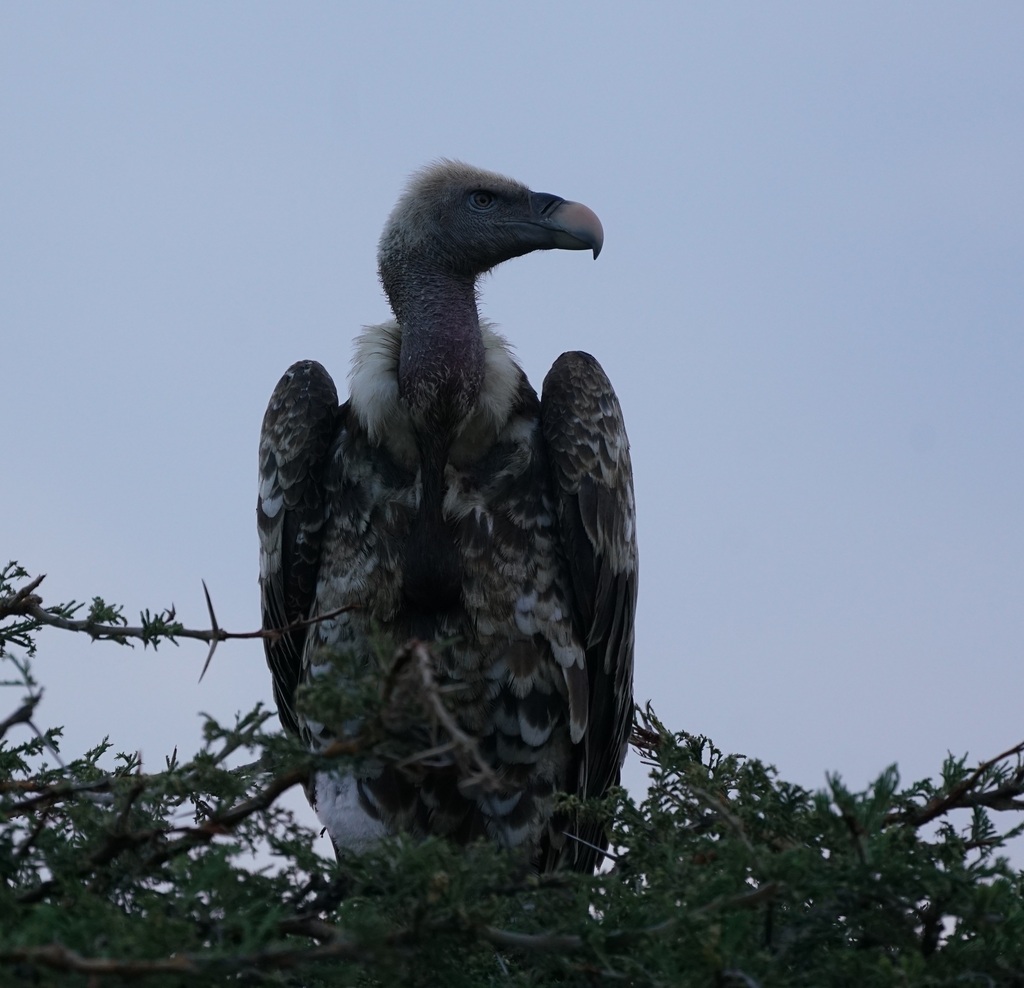
Rüppell’s Vulture
Identification
Rüppell's vulture is a very large vulture, noticeably outsizing the closely related white-backed vulture. Adults measure 85 to 103 cm in length with a wingspan of 2.26 to 2.6 m and weigh between 6.4 and 9 kg. Both sexes are identical in appearance: mottled brown or black overall with a whitish-brown underbelly and thin, dirty-white fluff covering the head and neck. A distinctive white collar marks the base of the neck, while the eye is yellow or amber and the crop patch is deep brown. The head lacks feathers—an adaptation that prevents excessive mess when feeding inside carcasses.
Silent as a rule, these vultures become vocal at their nest and when gathered at a carcass, where they squeal considerably. They are powerful and specialized feeders, with backward-pointing spikes on the tongue to help remove meat from bone, allowing them to exploit even the hide and bones of a carcass after softer parts are consumed.
Range & Habitat
Rüppell's vulture is mainly native to the Sahel region and East Africa, where it is a resident species. In Morocco, tagged populations have been observed overwintering. Since 1992, the species has been occurring as a vagrant in Spain and Portugal, with annual records since 1997, mainly in the Cádiz and Strait of Gibraltar area and occasionally further north.
Behaviour & Diet
Rüppell's vultures are strictly carrion feeders known to follow game herds on seasonal migrations and feed in large numbers at carcasses, usually alongside other Old World vulture species. They will consume animals killed by predators as well as those that have died from injuries, disease, or old age. Cruising at 35 km/h, these birds fly for 6–7 hours daily and can reach speeds up to 45 km/h during cross-country flight and 70–85 km/h during glides. They commonly fly at altitudes as high as 6,000 m and possess a specialized hemoglobin variant that allows efficient oxygen absorption despite the low partial pressure of the upper troposphere.
Rüppell's vultures are monogamous, forming lifelong breeding pairs that work together to build stick-and-grass nests on cliff faces. In key breeding areas, they nest in large colonies containing hundreds of pairs. Both parents incubate their single egg for 55 days and tend the chick for about 150 days until fledging. Young remain dependent on their parents until the next breeding season, learning to find and compete for food during this period.
Best Time & Places to See It
The Sahel region and East Africa remain the primary strongholds for observing this species. In Morocco, where Rüppell's vultures are resident, they can be seen year-round. Those seeking to encounter vagrants in Europe may have opportunities in Spain and Portugal, particularly in the Cádiz and Strait of Gibraltar area, with sightings most likely from 1997 onward.
Photography Tips
The sheer size and impressive wingspan of Rüppell's vulture make it a rewarding photographic subject. Its distinctive white collar, pale head, and mottled plumage provide good identifying features in the frame. Watch for them soaring at high altitudes in thermal updrafts, where they can be spotted against the sky. Carcass sites where multiple vultures gather offer opportunities to capture their behavior and compare them with other vulture species. Early morning thermals are often optimal for capturing birds in flight.
Serengeti National Park
Tanzania
+131 birds+30 mammals
Dawn breaks over an endless golden savanna where acacia-studded plains stretch to distant volcanic highlands, their slopes cloaked in montane […]
VIEW NATIONAL PARKKidepo Valley National Park
Uganda
+133 birds+29 mammals
Where granite peaks rise above sweeping savanna and acacia woodlands meet riverine forests, one of Africa’s most remote wilderness sanctuaries […]
VIEW NATIONAL PARKMurchison Falls National Park
Uganda
+129 birds+30 mammals
Where the Victoria Nile surges through a narrow rocky chasm and plummets 43 metres in a thunderous cascade, Uganda’s oldest […]
VIEW NATIONAL PARKTsavo East National Park
Athi ward, Kenya
+132 birds+30 mammals
Dawn breaks over one of Africa’s most expansive wilderness areas, where volcanic outcrops pierce the savanna and the Galana River […]
VIEW NATIONAL PARKTsavo West National Park
Mwatate, Kenya
+132 birds+30 mammals
Where volcanic rock formations pierce the savanna and sulfurous springs bubble beneath rust-coloured earth, Kenya’s southwestern wilderness reveals itself in […]
VIEW NATIONAL PARKAmboseli National Park
Etonet/Lenkism ward, Kenya
+124 birds+30 mammals
Dawn breaks over a vast volcanic plain where Mount Kilimanjaro dominates the horizon, its snow-capped peak floating above the Tanzanian […]
VIEW NATIONAL PARKTarangire National Park
Tanzania
+124 birds+30 mammals
Where acacia woodlands meet vast plains and the Tarangire River cuts a lifeline through Tanzania’s heartland, one of Africa’s most […]
VIEW NATIONAL PARKNgorongoro Conservation Area
Tanzania
+123 birds+30 mammals
Where the East African plateau drops away into a vast amphitheatre of volcanic splendour, a 600-square-kilometre caldera cradles one of […]
VIEW WILDLIFE MANAGEMENT AREASerra de Mariola Nature Park
Bocairent, Spain
+95 birds+13 mammals
Where limestone ridges claw skyward across the inland Valencia region, a landscape of dramatic contrasts unfolds across 225 square kilometers. […]
VIEW NATURE RESERVEEstrecho Nature Park
Pedro Valiente, Spain
+135 birds+23 mammals
Where Mediterranean pine forests meet wind-sculpted coastal cliffs, one of Europe’s most dynamic ecological crossroads unfolds across the Strait of […]
VIEW NATURAL PARKAbijata-Shalla Lakes National Park
Ethiopia
+135 birds+22 mammals
Where two soda lakes mirror the Ethiopian highlands, a landscape of stark volcanic beauty unfolds across the Rift Valley floor. […]
VIEW NATIONAL PARKBale Mountains National Park
Ethiopia
+126 birds+29 mammals
Where volcanic plateaus rise above 4,000 meters and alpine meadows give way to Afromontane forest, one of Africa’s most pristine […]
VIEW NATIONAL PARKMago National Park
Ethiopia
+69 birds+10 mammals
Where the Omo River carves its path through the volcanic highlands of southwestern Ethiopia, a wilderness of startling contrasts unfolds. […]
VIEW NATIONAL PARKAwash National Park
Didiga, Ethiopia
+134 birds+29 mammals
Where the Ethiopian Rift Valley carves through volcanic plateaus, a ribbon of riverine forest winds through acacia scrubland and grassland, […]
VIEW NATURAL PARKSimien Mountains National Park
Debark, Ethiopia
+61 birds+13 mammals
Where granite escarpments plunge thousands of metres into misty valleys, the Ethiopian highlands reveal a landscape of almost mythical drama. […]
VIEW NATIONAL PARKNo community photos yet. Log in to add the first one.
No community observations of this species yet.