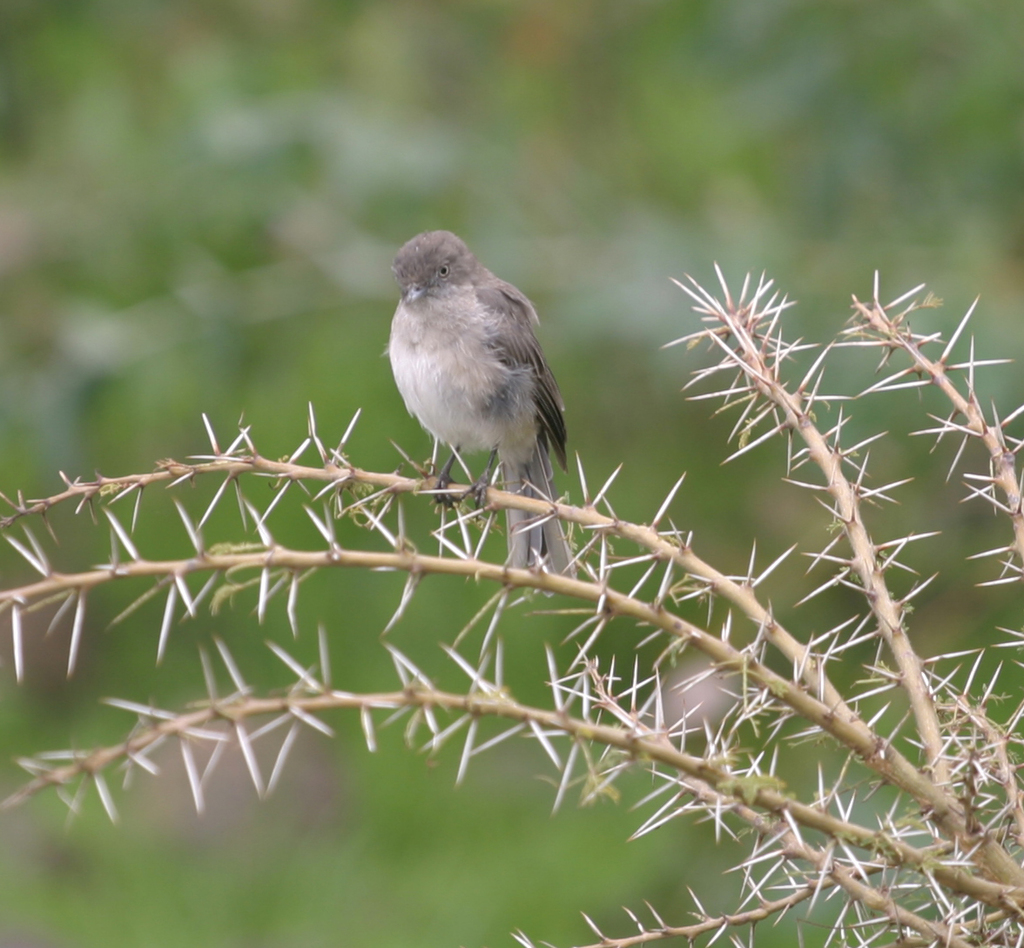
Abyssinian Slaty Flycatcher
Photo © Oleg Kosterin
Photo © Oleg Kosterin — CC BY 4.0 — Source: iNaturalist photo #104436997The Abyssinian slaty flycatcher (Melaenornis chocolatinus), also known as Abyssinian flycatcher, Abyssinian black flycatcher or Abyssinian chocolate flycatcher, is a species of bird in the family Muscicapidae, the Old World flycatchers. It is often placed in the genus Dioptrornis. It is native to Africa, where it occurs in Eritrea and Ethiopia. == Description == The Abyssinian slaty flycatcher is a rather dingy, undistinguished grey brown bird which normally perches with the typical vertical posture of an Old World flycatcher. It has a yellow eye set in a plain brownish face, the upperparts are dark sooty brown and the underparts are buff brown. It measures 15–16 cm (5.9–6.3 in) in length and weights 20–25 g (0.71–0.88 oz). === Voice === It makes various "tseep" calls and has a harsh chiiering alarm call. == Distribution and subspecies == There are two currently recognised subspecies of Abyssinian slaty flycatcher and they are listed below with their distributions: Melaenornis chocolatinus chocolatinus (Rüppell, 1840): central Eritrea and north and central Ethiopia. Melaenornis chocolatinus reichenowi (Neumann, 1902): western Ethiopia. == Habitat == The Abyssinian slaty flycatcher occurs in mid to high altitude forest, woodland edges, clearings, in agricultural land and in suburbs, where it can be…
Abijata-Shalla Lakes National Park
Ethiopia
+438 birds+7 mammals
Two crater lakes of contrasting chemistry define this remote corner of Ethiopia's Rift Valley, where soda lakes and freshwater basins create a mosaic of distinct aquatic…
VIEW NATIONAL PARKBale Mountains National Park
Ethiopia
+397 birds+20 mammals
Where the Ethiopian highlands rise above 4,000 metres, the Bale Mountains create a landscape of stunning ecological extremes—from afroalpine grasslands swept by wind and mist to…
VIEW NATIONAL PARKAwash National Park
Didiga, Ethiopia
+473 birds+23 mammals
Where the Ethiopian Rift Valley carves through volcanic plateaus, a ribbon of riverine forest winds through acacia scrubland and grassland, creating a mosaic of habitats that…
VIEW NATURAL PARKSimien Mountains National Park
Debark, Ethiopia
+120 birds+9 mammals
Where granite escarpments plunge thousands of metres into misty valleys, the Ethiopian highlands reveal a landscape of almost mythical drama. These volcanic plateaus, carved by ancient…
VIEW NATIONAL PARKYabelo Wildlife Sanctuary
Bedewera, Ethiopia
+359 birds+5 mammals
Where acacia woodlands meet volcanic plateaus in southern Ethiopia, a landscape of austere beauty unfolds across nearly 2,500 square kilometers. Yabelo Wildlife Sanctuary sprawls across semi-arid…
VIEW WILDLIFE SANCTUARYNo community photos yet. Log in to add the first one.
No community observations of this species yet.