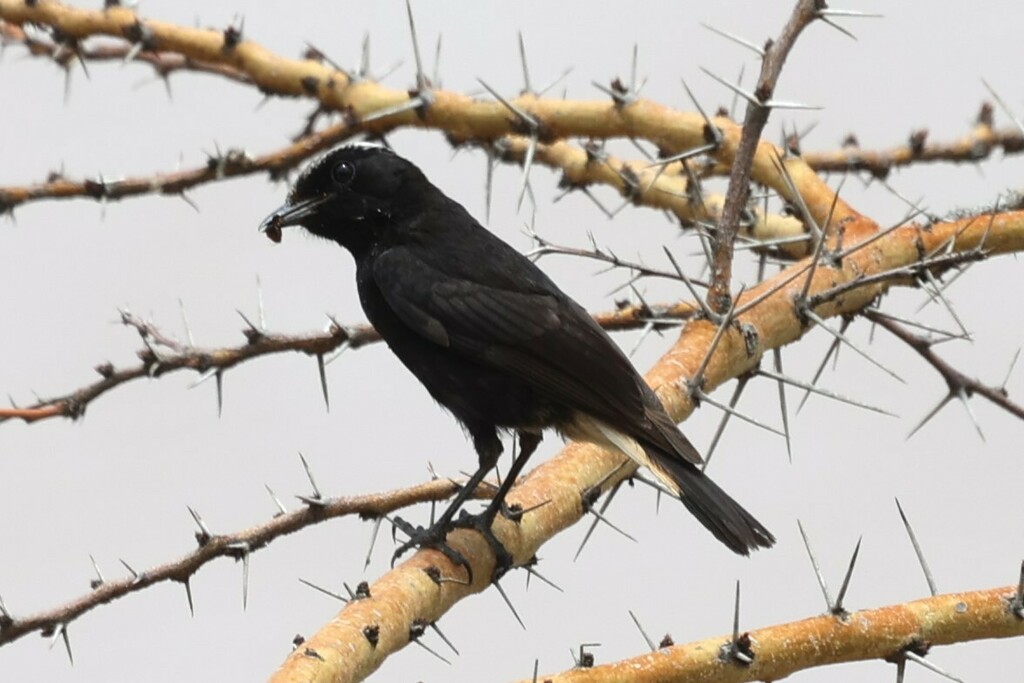
Abyssinian Wheatear
Photo © Tommy Andriollo
Photo © Tommy Andriollo — CC BY 4.0 — Source: iNaturalist photo #442104725Identification
The Abyssinian wheatear is a dark wheatear displaying marked sexual dichromatism. Males are considerably darker than females, featuring black upperparts, throat and breast with a grey cap streaked in darker tones. The belly colour varies geographically and individually from white to black. Females are mainly dark brown with heavy streaking on their paler breast and belly. Both sexes share distinctive buff under tail coverts and a characteristic black inverted T-pattern on the tail against a buff background, most conspicuous in flight. The nominate subspecies measures 14 cm in length.
Three subspecies occur across the range, each with subtle variations. The nominate O. l. lugubris exhibits a greyish-brown crown and variable white on the underparts. O. l. schalowi is slightly larger with browner upperparts and a buff-orange lower belly. O. l. vauriei shows a pale greyish-white crown with a blackish forehead and white to orange-buff rump and upper tail coverts. Female plumage varies by subspecies, with vauriei females notably paler than their schalowi counterparts.
Range & Habitat
This species is endemic to northeastern Africa, ranging from Eritrea and northwestern Somalia south to northeastern Tanzania. The nominate subspecies occurs in Eritrea, Ethiopia and northwestern Somalia, whilst O. l. schalowi inhabits the highlands of southern Kenya and northern Tanzania. O. l. vauriei is restricted to eastern Somalia. These subspecies maintain largely disjunct ranges across this broad distribution.
Abyssinian wheatears favour rocky terrain interspersed with scattered trees and bushes, occupying a range of elevations and topographies throughout their range. They frequent rocky valleys, volcanic hills, cliff faces and stone-studded hillsides where suitable rocky perches and nesting crevices are available.
Behaviour & Diet
Outside the breeding season, Abyssinian wheatears are solitary birds, though they form pairs during breeding. They are notably unafraid of humans and habitually perch conspicuously on rocks, boulders and shrubs. These birds may become inactive and seek shelter during the heat of midday. Their diet comprises mainly invertebrates, which they capture by dropping from perches or foraging on the ground. They supplement their diet with fruit, particularly berries when available.
Breeding occurs from early spring through late summer, with timing varying by latitude: March to August in Ethiopia and Eritrea, April and May in Somalia, April to July in the Kenyan Great Rift Valley, and March in northern Tanzania. Males attract females through upright posturing with raised heads, hopping around the female with drooping, quivering wings interspersed with swift chases. Females construct loose cup nests of grass and plant material lined with moss or mammal hair, typically placed in rock crevices or holes up to 45 cm deep. These birds are double-brooded, with clutches of 5 to 6 eggs per brood. The species is largely resident, though O. l. vauriei shows post-breeding migration to lower altitudes between June and January.
Best Time & Places to See It
Abyssinian wheatears are present year-round throughout their Ethiopian, Eritrean and Kenyan ranges, making them accessible to travellers across most seasons. However, O. l. vauriei disappears from eastern Somalia between June and January, so timing matters for seeing this subspecies. The breeding season (March to August in much of the range) offers the best opportunities for observing males in display and pair interactions.
Rocky upland habitats throughout Ethiopia, Eritrea, southern Kenya and northern Tanzania provide the most reliable viewing locations. The bird's preference for perching openly on rocks and its lack of wariness towards humans make it relatively straightforward to locate and observe once you reach suitable habitat. Look for them in volcanic hill country, on cliff faces and rocky slopes with scattered vegetation.
Photography Tips
The Abyssinian wheatear's habit of perching prominently on rocks and boulders offers excellent photographic opportunities. Males in breeding plumage provide striking contrast between jet-black upperparts and grey caps, while the sexual dichromatism between males and females creates compositional variety. Position yourself to capture the distinctive black inverted T-pattern on the tail, which is best seen when the bird is in flight or raising its tail.
Early morning and late afternoon light will enhance the subtle grey tones of the male's crown and highlight the texture of rocky perches. Since these birds may shelter during midday heat, plan photography sessions for cooler hours. The birds' openness to human approach allows for relatively close, detailed shots, making it possible to capture fine plumage detail. Capture behavioural sequences during the breeding season to document the males' characteristic upright displays with drooping wings.
Serengeti National Park
Tanzania
+558 birds+57 mammals
Across Tanzania's northern plateau, where volcanic soils meet acacia woodland and open grassland, unfolds one of Earth's most dynamic ecosystems. The Serengeti National Park sprawls across…
VIEW NATIONAL PARKArusha National Park
Tanzania
+555 birds+16 mammals
Where the slopes of Mount Mawenzi rise above the Arusha region, a compact yet ecologically rich national park unfolds across montane forest, moorland, and alpine zones.…
VIEW NATIONAL PARKTarangire National Park
Tanzania
+527 birds+50 mammals
Acacia woodland and grassland sweep across the Manyara Region where the Tarangire River carves through low hills and volcanic soils, creating one of East Africa's most…
VIEW NATIONAL PARKNgorongoro Conservation Area
Tanzania
+626 birds+55 mammals
Volcanic calderas and open grassland dominate this high plateau in northern Tanzania, where the landscape rises above 2,000 metres and ancient geological forces have shaped both…
VIEW WILDLIFE MANAGEMENT AREAAbijata-Shalla Lakes National Park
Ethiopia
+438 birds+7 mammals
Two crater lakes of contrasting chemistry define this remote corner of Ethiopia's Rift Valley, where soda lakes and freshwater basins create a mosaic of distinct aquatic…
VIEW NATIONAL PARKBale Mountains National Park
Ethiopia
+397 birds+20 mammals
Where the Ethiopian highlands rise above 4,000 metres, the Bale Mountains create a landscape of stunning ecological extremes—from afroalpine grasslands swept by wind and mist to…
VIEW NATIONAL PARKAwash National Park
Didiga, Ethiopia
+473 birds+23 mammals
Where the Ethiopian Rift Valley carves through volcanic plateaus, a ribbon of riverine forest winds through acacia scrubland and grassland, creating a mosaic of habitats that…
VIEW NATURAL PARKSimien Mountains National Park
Debark, Ethiopia
+120 birds+9 mammals
Where granite escarpments plunge thousands of metres into misty valleys, the Ethiopian highlands reveal a landscape of almost mythical drama. These volcanic plateaus, carved by ancient…
VIEW NATIONAL PARKLake Nakuru National Park
Nakuru West, Kenya
+494 birds+32 mammals
Alkaline waters ringed by acacia woodland and grassland create one of East Africa's most distinctive wetland ecosystems, where the interplay of geology and climate sustains a…
VIEW NATIONAL PARKAberdare National Park
Mweiga ward, Kenya
+394 birds+30 mammals
Where the central highlands of Kenya rise to their elemental grandeur, the Aberdare range unfolds across Nyeri County as a montane stronghold of cool, misty forest…
VIEW NATIONAL PARKHell’s Gate National Park
Olkaria ward, Kenya
+388 birds+18 mammals
Volcanic scarps and geothermal vents dominate the floor of Hell's Gate, where the East African Rift has carved a dramatic gorge through crystalline rock formations. The…
VIEW NATIONAL PARKNo community photos yet. Log in to add the first one.
No community observations of this species yet.