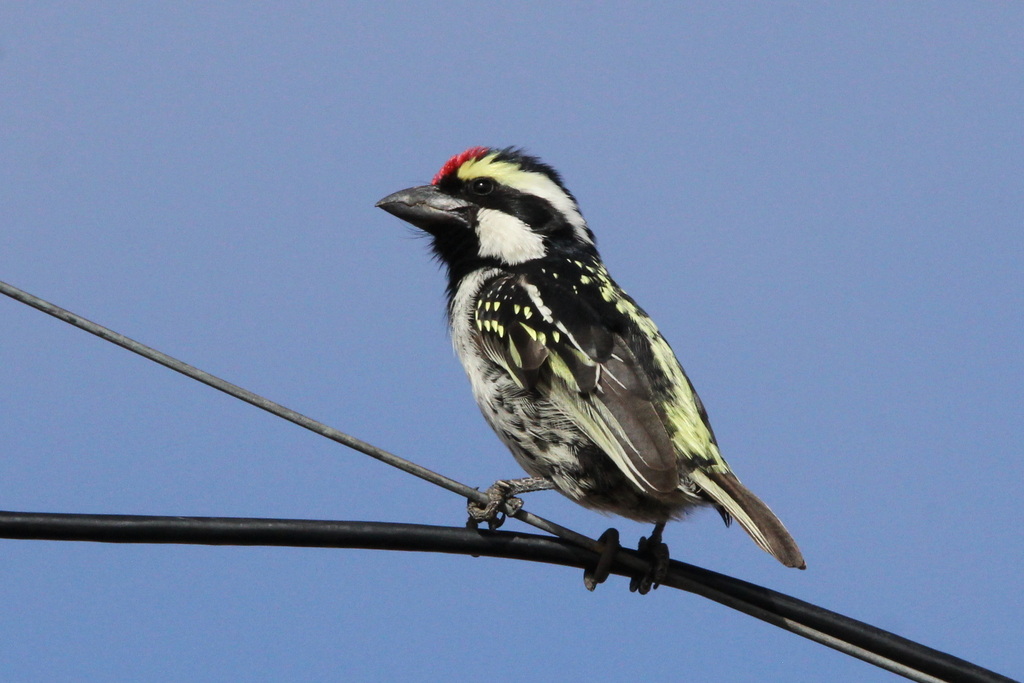
Acacia Pied Barbet
Photo © Svyatoslav Knyazev
Photo © Svyatoslav Knyazev — CC BY 4.0 — Source: iNaturalist photo #624561327Identification
The Acacia Pied Barbet is a striking small bird with distinctive black-and-white striped head markings and a bright red forecrown. The pale yellow superciliary stripe runs above the eye, contrasting sharply with the dark brown eyes. A bold black bib marks the chin, while the breast and underparts vary by subspecies: the western T. l. centralis shows white underparts, the nominate southern race displays dusky streaking, and the eastern T. l. affinis appears more yellowish. The sexes are similar, though juveniles lack the red forehead mark and show more streaked plumage. The bird has blackish legs and feet and dark brown eyes.
Range & Habitat
This southern African specialist inhabits semi-arid savanna, grassland, and fynbos, increasingly adapting to agricultural areas and urban gardens. Found across Angola, Botswana, Eswatini, Lesotho, Mozambique, Namibia, South Africa, Zambia, and Zimbabwe, the species has expanded its range into areas previously unreachable, following the introduction of Australian Acacia species and other alien vegetation into bordering regions. Three subspecies are recognized, each occupying distinct geographic ranges across this distribution.
Behaviour & Diet
The Acacia Pied Barbet is a sedentary but fairly restless species, typically seen in pairs or singly. Like other barbets and woodpeckers, it drills cavities into dead wood for nesting, laying two to four eggs between August and April, with both sexes sharing incubation duties. Its flight is fast and direct. The species is omnivorous, taking fruit from Ficus, Searsia, and Phoenix reclinata palms, as well as consuming Aloe nectar and insects, making it an opportunistic forager adapted to variable semi-arid conditions.
Best Time & Places to See It
The breeding season from August to April offers the best opportunity to locate this species, as nesting activity and territorial behavior make birds more conspicuous. Search semi-arid savannas, thornbush areas, and increasingly in gardens and agricultural lands throughout its southern African range. Urban and suburban gardens in South Africa and neighboring countries have become reliable locations as the species adapts to human-modified landscapes.
Photography Tips
The striking head pattern—with contrasting red, black, and white markings—makes this barbet highly photogenic. Early morning light will emphasize the pale superciliary stripe and red forecrown. Look for birds at flowering Aloe plants or fruiting trees such as Ficus where they feed predictably. The bird's tendency to perch openly while foraging offers good opportunities for close portraits. Its fast, direct flight requires quick reflexes, so practice tracking for flight shots in woodland and savanna habitats.
Addo Elephant National Park
Agulhas National Park
Augrabies Falls National Park
Bontebok National Park
Bwabwata National Park
Camdeboo National Park
Chobe National Park
Dorob National Park
Etosha National Park
Nothing matches these filters.
No community photos yet. Log in to add the first one.
No community observations of this species yet.