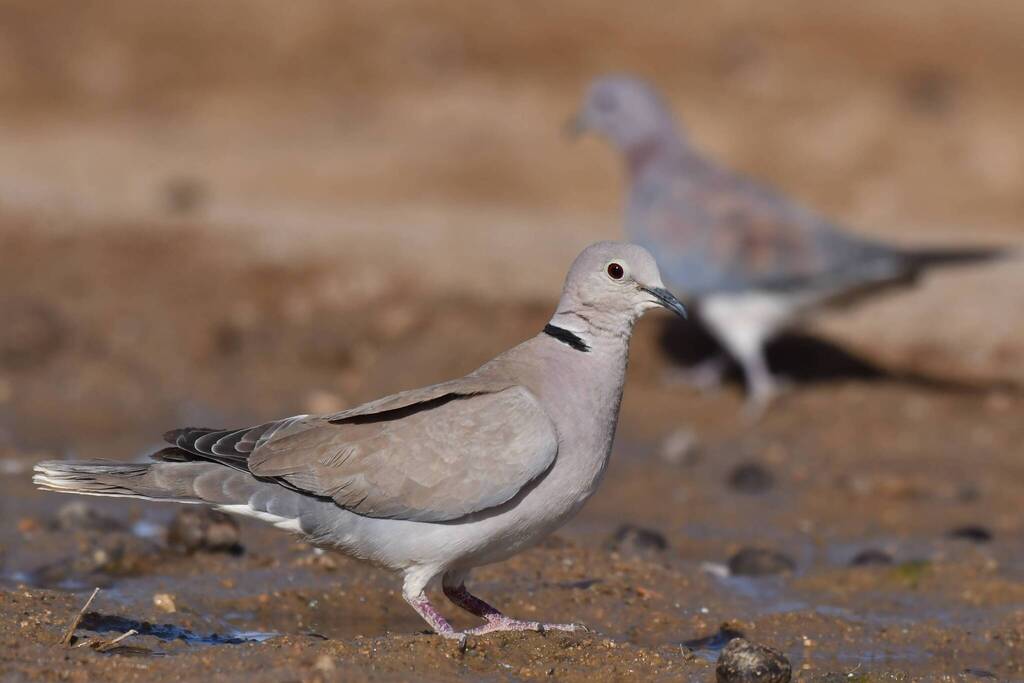
African Collared Dove
Photo © Mourad Harzallah
Photo © Mourad Harzallah — CC BY 4.0 — Source: iNaturalist photo #612185256Identification
The African collared dove is a compact dove measuring around 26 cm (10 in) in length and weighing 130–166 g. Its most distinctive features are its soft coloration and delicate proportions. The upper body, from shoulders to tail, displays a pale greyish-brown plumage, with a subtle bluish tinge along the wing edge. The flight feathers are notably darker, appearing nearly black in contrast. The head, neck, and breast are suffused with a warm pinkish tone, gradually shading to white on the chin and belly. There is no visible sexual dimorphism, making males and females indistinguishable in the field.
Range & Habitat
The African collared dove inhabits the Sahel region and northern parts of the Horn of Africa, with its range extending into southwestern Arabia. Two subspecies are recognized, though genetic differences between them are minimal. The nominate subspecies, Streptopelia roseogrisea roseogrisea, is found across the African Sahel just south of the Sahara Desert, extending east to north-central Sudan. The darker subspecies arabica ranges from northeast Sudan through Eritrea and Somalia to southwestern Arabia.
Despite living in arid lands, African collared doves are strongly dependent on water sources and are consistently found in their vicinity. This water dependency shapes their distribution and makes them predictable in otherwise sparse landscapes.
Behaviour & Diet
The African collared dove feeds primarily on grass seeds and other plant material, supplementing its diet with berries, insects, and snails. This omnivorous approach allows flexibility in food sourcing across varying seasonal conditions in semi-arid regions.
This species holds particular significance in avian domestication history. It is the wild ancestor of the domestic Barbary dove, a relationship that has been scientifically established. The increase in the range of colours available in Barbary doves during the latter 20th century is thought to have resulted from the deliberate interbreeding of African collared doves imported into the United States with captive Barbary dove populations. While some have historically suggested involvement of the Eurasian collared dove in Barbary dove ancestry, there is only minimal evidence to support this claim.
Best Time & Places to See It
The African collared dove is a resident species throughout the Sahel and Horn of Africa regions. The most reliable locations are near permanent or semi-permanent water sources within its range, including waterholes, wells, and other water points in arid and semi-arid landscapes. Focus your search in the Sahel zone south of the Sahara, particularly in areas where water is available during the dry season.
Photography Tips
The soft, subtle plumage of the African collared dove requires careful exposure metering to capture the delicate pinkish and greyish tones accurately. Early morning and late afternoon light will bring out the warm colouration of the head, neck, and breast. Since these doves are water-dependent, positioning yourself near known water sources at dawn or dusk offers the best opportunities for photography. The contrast between the dark flight feathers and pale body plumage is a key identifying feature worth capturing in flight shots.
Teide Natural Monument
La Orotava, Spain
+41 birds+4 mammals
High on the volcanic slopes of Tenerife, where the landscape transforms from lush laurel forests into lunar terrain, the Teide Natural Monument preserves one of Spain's…
VIEW NATURE RESERVETeide National Park
La Orotava, Spain
+83 birds+7 mammals
At nearly 3,900 metres, Spain's highest peak rises from the Canary Islands as a singular volcanic monument, its slopes sweeping through five distinct climate zones in…
VIEW NATIONAL PARKAbijata-Shalla Lakes National Park
Ethiopia
+438 birds+7 mammals
Two crater lakes of contrasting chemistry define this remote corner of Ethiopia's Rift Valley, where soda lakes and freshwater basins create a mosaic of distinct aquatic…
VIEW NATIONAL PARKBale Mountains National Park
Ethiopia
+397 birds+20 mammals
Where the Ethiopian highlands rise above 4,000 metres, the Bale Mountains create a landscape of stunning ecological extremes—from afroalpine grasslands swept by wind and mist to…
VIEW NATIONAL PARKAwash National Park
Didiga, Ethiopia
+473 birds+23 mammals
Where the Ethiopian Rift Valley carves through volcanic plateaus, a ribbon of riverine forest winds through acacia scrubland and grassland, creating a mosaic of habitats that…
VIEW NATURAL PARKSimien Mountains National Park
Debark, Ethiopia
+120 birds+9 mammals
Where granite escarpments plunge thousands of metres into misty valleys, the Ethiopian highlands reveal a landscape of almost mythical drama. These volcanic plateaus, carved by ancient…
VIEW NATIONAL PARKYabelo Wildlife Sanctuary
Bedewera, Ethiopia
+359 birds+5 mammals
Where acacia woodlands meet volcanic plateaus in southern Ethiopia, a landscape of austere beauty unfolds across nearly 2,500 square kilometers. Yabelo Wildlife Sanctuary sprawls across semi-arid…
VIEW WILDLIFE SANCTUARYNo community photos yet. Log in to add the first one.
No community observations of this species yet.