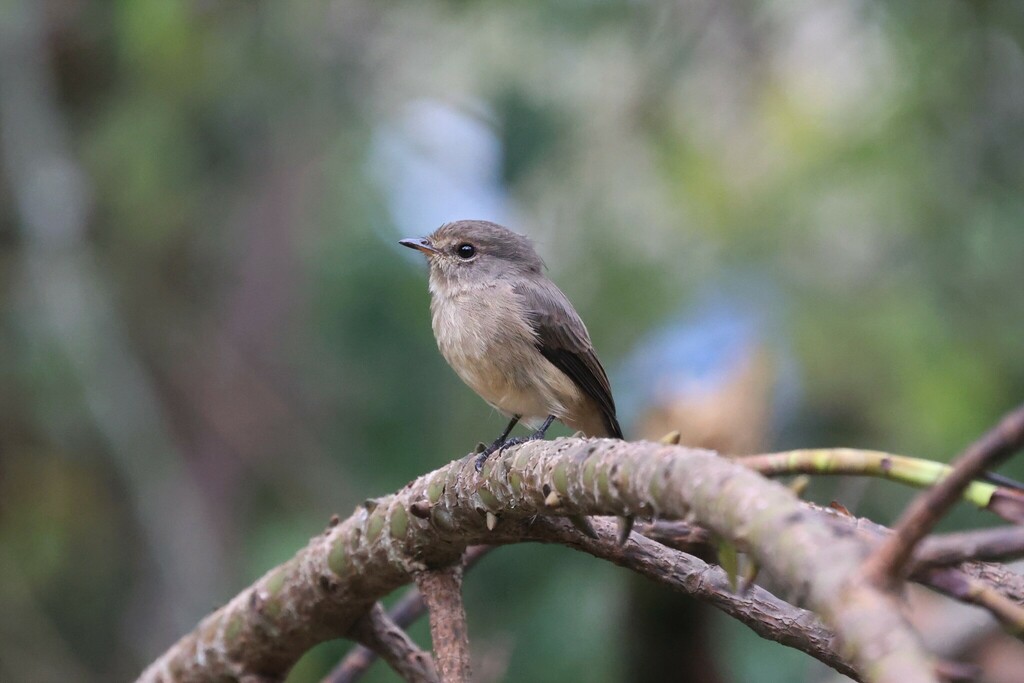
African Dusky Flycatcher
Photo © Tommy Andriollo
Photo © Tommy Andriollo — CC BY 4.0 — Source: iNaturalist photo #258521067Identification
The African dusky flycatcher is a small passerine, measuring just 13 cm in length and weighing around 11 g. This diminutive bird is characterized by plain brown upperparts with minimal facial markings—only an indistinct narrow eye-ring breaks the uniformity. The underparts are grey-brown with subtle streaking, while the chin is plain pale grey. Its short, straight bill is black, and the legs and feet are grey, with brown eyes completing the portrait.
Separating this species from the similar spotted flycatcher requires careful observation. The African dusky flycatcher is noticeably smaller and darker, particularly on the underparts. Most helpfully, it lacks the streaked forehead that distinguishes its migrant relative. Juveniles are spotted with buff above and whitish spotted with brown below, offering a distinctly different appearance from adults. The bird's soft, high-pitched calls—"tzeeet" and tsirit notes—provide another identification clue for alert listeners.
Range & Habitat
This species is an endemic resident breeder in elevated areas of Sub-Saharan Africa, with populations found across the Bié and Western High plateaus. Its range spans 2,300,000 km², making it widely distributed throughout suitable terrain across the region.
The African dusky flycatcher thrives in diverse woodland habitats, showing particular affinity for riverine forests, evergreen forest edges, and clearings—especially those near water bodies. Lakes, dams, and streams attract this species reliably, and it has adapted well to human-modified landscapes, becoming very common in well-wooded suburban gardens. This habitat flexibility has aided its conservation success.
Behaviour & Diet
The African dusky flycatcher is typically observed singly or in pairs rather than in flocks. True to its flycatcher family name, it forages from open perches, sallying out in short flights to capture insects mid-air—a characteristic hunting technique that makes it relatively easy to spot once you know where to look. It employs a sit-and-wait strategy that expends minimal energy while maximizing feeding efficiency.
This species is monogamous, mating for life with a single partner. During breeding season, pairs construct cup-shaped nests in tree cavities a few metres above ground, typically laying two or three green eggs. A convenient aspect of their breeding ecology is their habit of reusing the same tree hole in subsequent breeding seasons, creating predictable nesting sites from year to year.
Best Time & Places to See It
As a resident breeder rather than a migrant, the African dusky flycatcher is present year-round throughout its elevated Sub-Saharan range. This eliminates seasonal uncertainty—the species can be sought reliably at any time of year. Look for it in riverine forests, along forest edges and in clearings, particularly near water sources. Well-wooded suburban gardens within its range offer accessible viewing opportunities.
The species' preference for open perches makes it relatively visible compared to skulking forest birds. Early mornings typically offer the best activity levels and lighting for observation.
Photography Tips
The African dusky flycatcher's small size and preference for woodland habitats present technical challenges. A telephoto lens of at least 300 mm is recommended to fill the frame adequately. The bird's habit of perching openly while foraging provides opportunities—position yourself with the sun behind or to the side to avoid backlighting the subtle plumage details.
Early morning light will best reveal the plain brown tones and grey underparts. Since the species is often solitary or found in pairs rather than flocks, patience and persistent scanning of suitable habitat are essential. The contrast between the black bill and grey face can be emphasized with careful exposure metering to ensure facial details remain visible.
Bwindi Impenetrable National Park
Lake Mburo National Park
Mabamba Swamp
Murchison Falls National Park
Queen Elizabeth National Park
Aberdare National Park
Abijata-Shalla Lakes National Park
Addo Elephant National Park
Amboseli National Park
Nothing matches these filters.
No community photos yet. Log in to add the first one.
No community observations of this species yet.