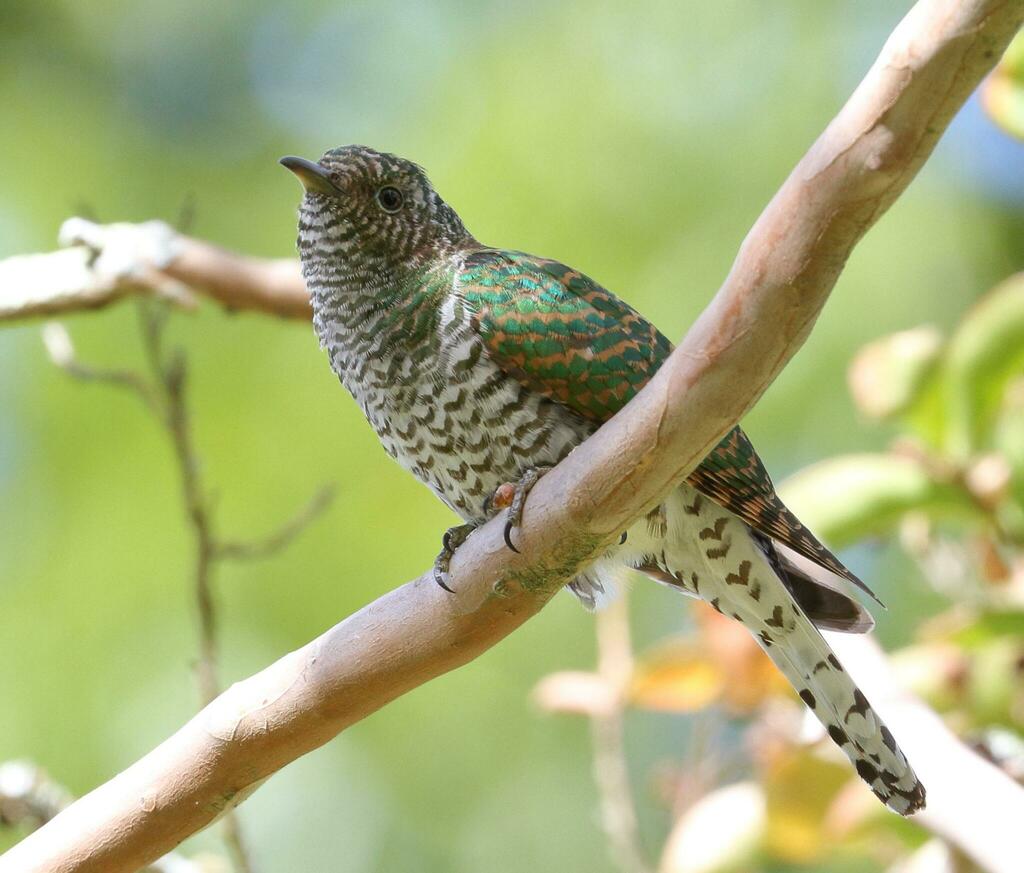
African Emerald Cuckoo
Photo © Alan Manson
Photo © Alan Manson — CC BY 4.0 — Source: iNaturalist photo #220160046Identification
The African emerald cuckoo is a striking and sexually dimorphic species that is relatively easy to identify in the field. Males are instantly recognizable with their brilliant green back and head contrasting sharply with a bright yellow breast, creating a jewel-like appearance that justifies the "emerald" in their name. Females are more subdued, displaying barred green and brown plumage on their backs with green and white barring on their breasts, making them blend more effectively into forest foliage.
Beyond visual identification, the African emerald cuckoo is best known for its distinctive four-note whistle call, which can be remembered by the mnemonic device "Hello Ju-dy." This memorable vocalization is often the first indication of the bird's presence, as it can be heard echoing through the canopy even when the bird itself remains hidden among the leaves. Familiarity with this call is invaluable for locating and identifying this species in the field.
Range & Habitat
The African emerald cuckoo is widespread across sub-Saharan Africa, with its range covering an impressive distribution of 11,400,000 square kilometers. The species occurs throughout most of the continent, from West Africa through the Congo Basin to East and Southern Africa, with populations documented in countries including Nigeria, Ghana, the Democratic Republic of Congo, Kenya, Tanzania, South Africa, and many others. Four subspecies are recognized: the nominate C. c. cupreus ranges across Africa south of the Sahara, while C. c. intermedius is endemic to Bioko in the Gulf of Guinea, and C. c. insularum inhabits São Tomé, Príncipe, and Annobón.
This species favors forested habitats, particularly riparian areas and lowland forests where it can forage among the canopy. The bird's preference for the middle and upper layers of forest vegetation means it is often found in areas with dense, undisturbed tree cover. However, habitat reduction and fragmentation of riparian and lowland forest environments pose some concern for the species' future, despite its currently secure conservation status.
Behaviour & Diet
Like all true cuckoos, the African emerald cuckoo is an obligate brood parasite, meaning it does not build its own nests or raise its own young. Instead, females lay their eggs—typically between 19 and 25 per breeding season—in the nests of other bird species, which then become unwitting foster parents. Despite this parasitic breeding strategy, male African emerald cuckoos maintain territories during the breeding season, not for feeding purposes but to display themselves to potential mates and secure breeding opportunities.
The African emerald cuckoo is primarily an insectivore, with caterpillars and ants forming the mainstay of its diet. It supplements these protein-rich insects with fruit when available. The bird forages actively in the middle and upper layers of the forest canopy, methodically searching foliage for prey. Breeding activity is timed to coincide with the rainy seasons, occurring generally between September and March, when insect availability peaks and food for growing chicks is most abundant.
Best Time & Places to See It
The best opportunities to encounter the African emerald cuckoo occur during the rainy seasons, from September through March, when breeding activity increases and males vocalize more frequently to establish territories and attract mates. During this period, the bird's distinctive "Hello Ju-dy" call becomes more frequent and easier to detect. Listen carefully in riparian forests, lowland forest patches, and areas with mature canopy cover across sub-Saharan Africa.
Given the species' vast range across the continent, numerous locations offer potential viewing opportunities. Forest reserves and national parks in countries such as Uganda, Kenya, Tanzania, the Democratic Republic of Congo, and South Africa represent promising destinations. Guided forest birding expeditions in regions with intact lowland and riparian forest habitat offer the best chances of locating this canopy-dwelling species.
Photography Tips
Photographing the African emerald cuckoo presents distinct challenges and opportunities. The male's brilliant emerald and yellow plumage is highly photogenic when well-lit, but the bird's preference for the upper canopy and dense foliage makes obtaining clear shots difficult. Early morning hours often provide the best light and the greatest vocal activity, improving your chances of locating a bird to photograph.
Use the bird's call as your primary locating tool, then position yourself with the early sun behind you to illuminate the male's striking plumage. A telephoto lens of at least 400mm is essential, as these birds typically remain high in the canopy and maintain a safe distance from observers. Patience and persistence are crucial—waiting quietly once you have located a calling bird often yields the best photographic results.
Serengeti National Park
Tanzania
+558 birds+57 mammals
Across Tanzania's northern plateau, where volcanic soils meet acacia woodland and open grassland, unfolds one of Earth's most dynamic ecosystems. The Serengeti National Park sprawls across…
VIEW NATIONAL PARKArusha National Park
Tanzania
+555 birds+16 mammals
Where the slopes of Mount Mawenzi rise above the Arusha region, a compact yet ecologically rich national park unfolds across montane forest, moorland, and alpine zones.…
VIEW NATIONAL PARKRubondo Island National Park
Tanzania
+99 birds+8 mammals
Across the waters of Lake Victoria's northeastern arm, Rubondo Island rises as a freshwater wilderness where papyrus swamps grade into acacia woodlands and dense thickets of…
VIEW NATIONAL PARKChobe National Park
Botswana
+446 birds+45 mammals
Where the Chobe River cuts a sinuous path through northern Botswana, the landscape transforms into one of Africa's most dynamic wetland-savanna mosaics. This national park encompasses…
VIEW NATIONAL PARKVirunga National Park
Uganda
+418 birds+13 mammals
Where the Western Rift Valley fractures the landscape of North Kivu, Virunga National Park sprawls across terrain as geologically dramatic as it is ecologically vital. Volcanic…
VIEW NATIONAL PARKBwindi Impenetrable National Park
Kanyashogi, Uganda
+603 birds+26 mammals
Steep ridges cloaked in montane forest rise from Uganda's southwestern borderlands, where the landscape grows so dense and tangled that early explorers named it impenetrable. At…
VIEW NATIONAL PARKKidepo Valley National Park
Uganda
+478 birds+24 mammals
Where the Narus and Kidepo rivers carve through northeastern Uganda's semi-arid lowlands, a landscape of sparse acacia woodland, grassland, and riverine thickets creates one of East…
VIEW NATIONAL PARKMurchison Falls National Park
Uganda
+608 birds+33 mammals
Where the Victoria Nile compresses through a narrow gorge and explodes across a 45-meter precipice, the landscape speaks in thunder. Murchison Falls National Park sprawls across…
VIEW NATIONAL PARKMgahinga Gorilla National Park
Cyanika, Uganda
+429 birds+6 mammals
Where the Virunga Mountains rise steeply from the Uganda–Rwanda–Democratic Republic of Congo frontier, montane forest cloaks the volcanic slopes in a dense, moisture-laden embrace. Mgahinga Gorilla…
VIEW NATIONAL PARKLake Mburo National Park
Uganda
+505 birds+24 mammals
Rolling acacia woodland and scattered lakes define this intimate savanna preserve in southwestern Uganda, where the rift valley's geological drama shapes every water source and grassland.…
VIEW NATIONAL PARKTsavo East National Park
Athi ward, Kenya
+468 birds+50 mammals
Across the semi-arid lowlands of southeastern Kenya, where acacia woodland fragments into scrubland and the landscape rolls toward the Indian Ocean horizon, lies one of Africa's…
VIEW NATIONAL PARKTsavo West National Park
Mwatate, Kenya
+513 birds+49 mammals
Where volcanic ridges and weathered lava flows meet the semi-arid lowlands of south-central Kenya, Tsavo West National Park unfolds across a landscape sculpted by fire and…
VIEW NATIONAL PARKMount Elgon National Park
Matumbei ward, Kenya
+164 birds+7 mammals
Where the volcanic slopes of Mount Elgon rise above the Trans-Nzoia landscape, a montane wilderness unfolds across multiple ecological zones, each harbouring distinct communities adapted to…
VIEW NATIONAL PARKKilimanjaro National Park
Kenya
+207 birds+16 mammals
Africa's highest mountain rises not in isolation but as the centerpiece of a vast national park that sweeps across the borderlands of northern Tanzania, where savanna…
VIEW NATIONAL PARKMount-Kenya National Park
Abothuguchi west ward, Kenya
+334 birds+11 mammals
Where the slopes of Kenya's second-highest mountain rise steeply from the Meru County foothills, a landscape of profound ecological richness unfolds across Mount Kenya National Park.…
VIEW NATIONAL PARKTarangire National Park
Tanzania
+527 birds+50 mammals
Acacia woodland and grassland sweep across the Manyara Region where the Tarangire River carves through low hills and volcanic soils, creating one of East Africa's most…
VIEW NATIONAL PARKNgorongoro Conservation Area
Tanzania
+626 birds+55 mammals
Volcanic calderas and open grassland dominate this high plateau in northern Tanzania, where the landscape rises above 2,000 metres and ancient geological forces have shaped both…
VIEW WILDLIFE MANAGEMENT AREAToro-Semliki Proposed National Park
Uganda
+474 birds+5 mammals
Where the Albertine Rift's western escarpment rises above the Semliki River valley, a vast mosaic of forest, savanna and wetland converges to create one of East…
VIEW NATIONAL PARKQueen Elizabeth National Park
Uganda
+672 birds+30 mammals
Across the southwestern escarpment of Uganda, where the Western Rift Valley descends through ancient volcanic terrain, Queen Elizabeth National Park sprawls across more than 8,300 square…
VIEW NATIONAL PARKMabamba Swamp
Memere, Uganda
+464 birds+2 mammals
Across the Central Region of Uganda spreads one of Africa's most biodiverse freshwater wetlands, a sprawling nature reserve of roughly 283 square kilometres where papyrus swamps…
VIEW NATURE RESERVEGarden Route National Park
George, South Africa
+353 birds+54 mammals
Sweeping across the Western Cape's coastal and mountainous terrain, this sprawling national park encompasses over five thousand square kilometers of extraordinarily diverse landscape—from coastal limestone cliffs…
VIEW NATIONAL PARKKruger National Park
Ba-Phalaborwa Local Municipality, South Africa
+540 birds+91 mammals
Across the low-lying savanna of northeastern South Africa unfolds one of Africa's largest and most ecologically intact protected areas, where acacia woodlands merge into mopane scrub…
VIEW NATIONAL PARKAddo Elephant National Park
Sundays River Valley Local Municipality, South Africa
+388 birds+55 mammals
Where the Eastern Cape's semi-arid scrublands meet transitional woodland, Addo sprawls across 13,478 square kilometres of one of southern Africa's most biodiverse landscapes. The terrain rises…
VIEW NATIONAL PARKIthala Game Reserve
uPhongolo Local Municipality, South Africa
+328 birds+26 mammals
Rolling thornbush savanna and acacia woodland dominate the landscape of this 494-square-kilometre national park in KwaZulu-Natal's uPhongolo Local Municipality, where granite outcrops punctuate grassland plateaus and…
VIEW NATIONAL PARKZiwa Rhino and Wildlife Ranch
Nakasongola, Uganda
+359 birds+11 mammals
Where papyrus wetlands merge into sprawling savanna, Uganda's central landscape opens into one of East Africa's most vital rhino recovery zones. Ziwa Rhino and Wildlife Ranch…
VIEW WILDLIFE SANCTUARYBwabwata National Park
Namibia
+377 birds+35 mammals
Where the Kavango River winds through northeastern Namibia, vast floodplains and dense riparian woodland create one of southern Africa's most ecologically dynamic protected landscapes. Spanning 14,249…
VIEW NATIONAL PARKBale Mountains National Park
Ethiopia
+397 birds+20 mammals
Where the Ethiopian highlands rise above 4,000 metres, the Bale Mountains create a landscape of stunning ecological extremes—from afroalpine grasslands swept by wind and mist to…
VIEW NATIONAL PARKAwash National Park
Didiga, Ethiopia
+473 birds+23 mammals
Where the Ethiopian Rift Valley carves through volcanic plateaus, a ribbon of riverine forest winds through acacia scrubland and grassland, creating a mosaic of habitats that…
VIEW NATURAL PARKNairobi National Park
Nairobi, Kenya
+515 birds+35 mammals
Just minutes from Kenya's capital, where the Nairobi River winds through acacia woodland and open grassland, lies one of Africa's most paradoxical wildlife sanctuaries. The park's…
VIEW NATIONAL PARKLake Nakuru National Park
Nakuru West, Kenya
+494 birds+32 mammals
Alkaline waters ringed by acacia woodland and grassland create one of East Africa's most distinctive wetland ecosystems, where the interplay of geology and climate sustains a…
VIEW NATIONAL PARKAberdare National Park
Mweiga ward, Kenya
+394 birds+30 mammals
Where the central highlands of Kenya rise to their elemental grandeur, the Aberdare range unfolds across Nyeri County as a montane stronghold of cool, misty forest…
VIEW NATIONAL PARKMeru National Park
Igembe Central, Kenya
+408 birds+38 mammals
Granite outcrops and acacia woodland rise across the northern reaches of Meru, where semi-arid savanna transitions into drier scrubland under the fierce equatorial sun. The park's…
VIEW NATIONAL PARKHell’s Gate National Park
Olkaria ward, Kenya
+388 birds+18 mammals
Volcanic scarps and geothermal vents dominate the floor of Hell's Gate, where the East African Rift has carved a dramatic gorge through crystalline rock formations. The…
VIEW NATIONAL PARKRuma National Park
Suba, Kenya
+250 birds+8 mammals
Where the Winam Gulf narrows toward the Kenyan mainland, Ruma National Park rises as a sanctuary of evergreen woodland set within the humid tropics of Homa…
VIEW NATIONAL PARKSaiwa Swamp National Park
Sinyerere ward, Kenya
+255 birds+4 mammals
Where papyrus and sedge marshes stretch across a highland plateau in western Kenya, Saiwa Swamp National Park shelters one of East Africa's most productive freshwater wetland…
VIEW NATIONAL PARKChyulu Hills National Park
Kibwezi East, Kenya
+232 birds+30 mammals
Volcanic cones rise abruptly from the Kenyan savanna floor, their flanks clothed in dense acacia woodland and grassland that transforms the Chyulu Hills into an ecological…
VIEW NATIONAL PARKOl Donyo Sabuk National Park
Matungulu North ward, Kenya
+200 birds
Granite peaks rise abruptly from the highland plateau of Matungulu North, their weathered slopes clothed in scattered woodland and montane grassland that shifts between verdant and…
VIEW NATIONAL PARKNo community photos yet. Log in to add the first one.
No community observations of this species yet.