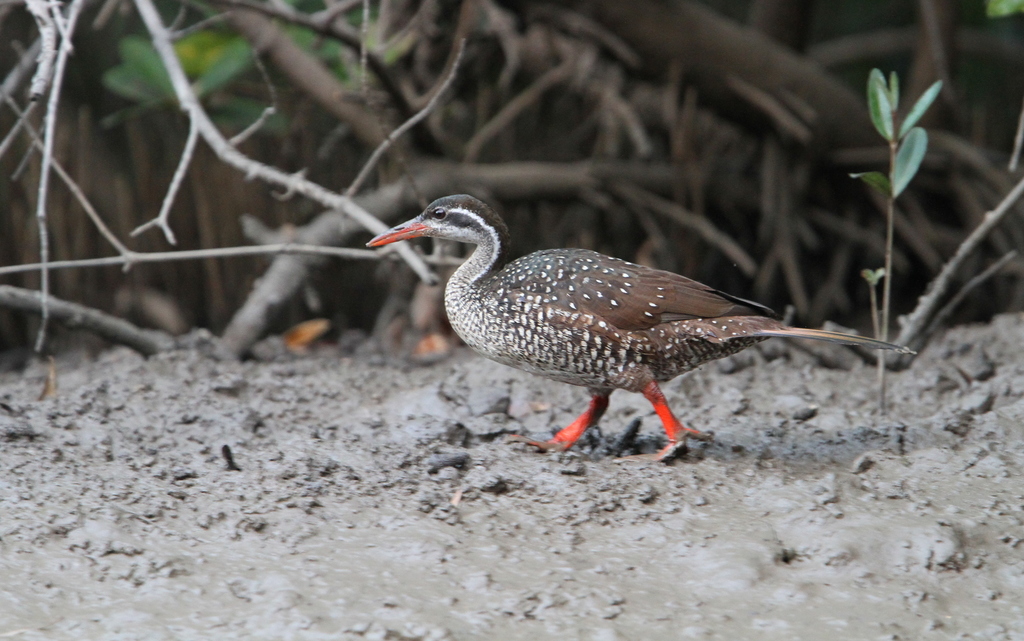
African Finfoot
Photo © Christoph Moning
Photo © Christoph Moning — CC BY 4.0 — Source: iNaturalist photo #95519571Identification
The African finfoot is a striking aquatic specialist with a long neck, sharp pointed beak, and distinctive bright red, lobed feet—features that immediately set it apart from other waterbirds. The plumage varies somewhat between subspecies but generally shows darker upperparts contrasting with paler underparts. Males are typically darker than females, making sex identification possible in good viewing conditions.
Range & Habitat
This elusive species is distributed across western, central, and southern Africa, wherever suitable wetland habitats exist. African finfoots favour rivers, streams, and lakes bordered by dense vegetation that provides essential cover. They adapt to diverse environments including forest waterways, wooded savannah, flooded forests, and even mangrove swamps—anywhere water and bankside concealment combine.
Behaviour & Diet
African finfoots are highly secretive birds, usually encountered singly or in pairs. Unlike grebes (which they superficially resemble but are unrelated to), they are surprisingly adept on land and will forage along banks as well as in water. Their diet consists of aquatic invertebrates—mayfly nymphs and adults, dragonfly larvae, crustaceans, and snails—supplemented by small fish and amphibians, often plucked directly from the water's surface. They are opportunistic feeders, taking whatever prey presents itself.
Due to their elusive nature, even experienced ornithologists rarely observe them, making any sighting a prized moment for birders. Whether they spend more time in water or on land remains poorly understood. Breeding season varies by region but typically coincides with local rains. Pairs build minimal nests of twigs and reeds on fallen trees overhanging water, where females alone incubate two eggs. Chicks fledge within days of hatching.
Best Time & Places to See It
Finding an African finfoot requires patience, persistence, and luck. Search along quiet stretches of forest rivers, wooded streams, and lake edges with good riparian vegetation, particularly during breeding season when birds are more active. Early morning is often productive. Given their secretive habits and wide but scattered distribution across Africa, local guides familiar with specific waterways offer the best chance of locating this prize sighting.
Photography Tips
Photograph African finfoots from a distance using a telephoto lens, as they are extremely wary and tolerate only minimal disturbance. Position yourself quietly along the bank at dawn and remain motionless; movement will cause them to vanish into dense cover. The bright red feet and sharp beak are key features to capture, along with their characteristic posture in the water. Overcast conditions reduce glare on water and may make birds slightly less skittish. Any photograph of this species represents a genuine achievement.
Bwindi Impenetrable National Park
Lake Mburo National Park
Murchison Falls National Park
Queen Elizabeth National Park
Addo Elephant National Park
Arusha National Park
Chobe National Park
Garden Route National Park
Kafue National Park
Nothing matches these filters.
No community photos yet. Log in to add the first one.
No community observations of this species yet.