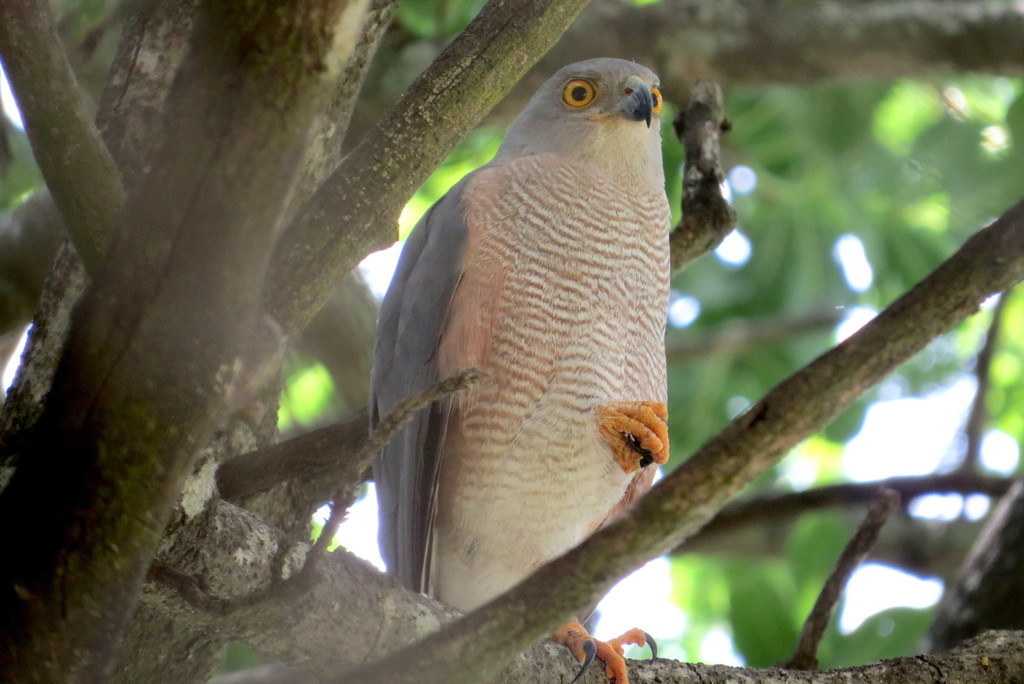
The African goshawk (Aerospiza tachiro) is an African species of bird of prey in the genus Aerospiza. It was formerly placed in the genus Accipiter. The African goshawk was previously sometimes split with the red-chested goshawk (Aerospiza toussenelii) of west Africa treated as a separate species. == Taxonomy == The African goshawk was formally described in 1800 by the French zoologist François Marie Daudin under the binomial name Falco tachiro. Daudin based his account on "Le Tachiro" that had been described and illustrated in 1799 by the French naturalist François Levaillant. His specimen had been collected near the town of Knysna, in Cape Province of South Africa. Levaillant coined the French name for the species by combining the French word tache meaning "spot" or "blotch" with rond meaning "round". The African goshawk was formerly placed in the genus Accipiter but a large molecular phylogenetic study published in 2024 found that this genus was polyphyletic. As part of the rearrangement to create monophyletic genera the African goshawk was moved together with the chestnut-flanked sparrowhawk to the resurrected genus Aerospiza that had been introduced in 1922 by the South African zoologist Austin Roberts. Eight subspecies are recognised: A. t. macroscelides (Hartlaub, 1855)…
Kruger National Park
Ba-Phalaborwa Local Municipality, South Africa
+540 birds+91 mammals
Across the low-lying savanna of northeastern South Africa unfolds one of Africa's largest and most ecologically intact protected areas, where acacia woodlands merge into mopane scrub…
VIEW NATIONAL PARKAddo Elephant National Park
Sundays River Valley Local Municipality, South Africa
+388 birds+55 mammals
Where the Eastern Cape's semi-arid scrublands meet transitional woodland, Addo sprawls across 13,478 square kilometres of one of southern Africa's most biodiverse landscapes. The terrain rises…
VIEW NATIONAL PARKArabuko Sokoke Forest Reserve
Kilifi, Kenya
+383 birds+29 mammals
Coastal forest rises from the Indian Ocean plains of Kilifi County, where sandy soils and seasonal rainfall have sculpted a woodland ecosystem unlike anywhere else on…
VIEW NATURE RESERVENo community photos yet. Log in to add the first one.
No community observations of this species yet.