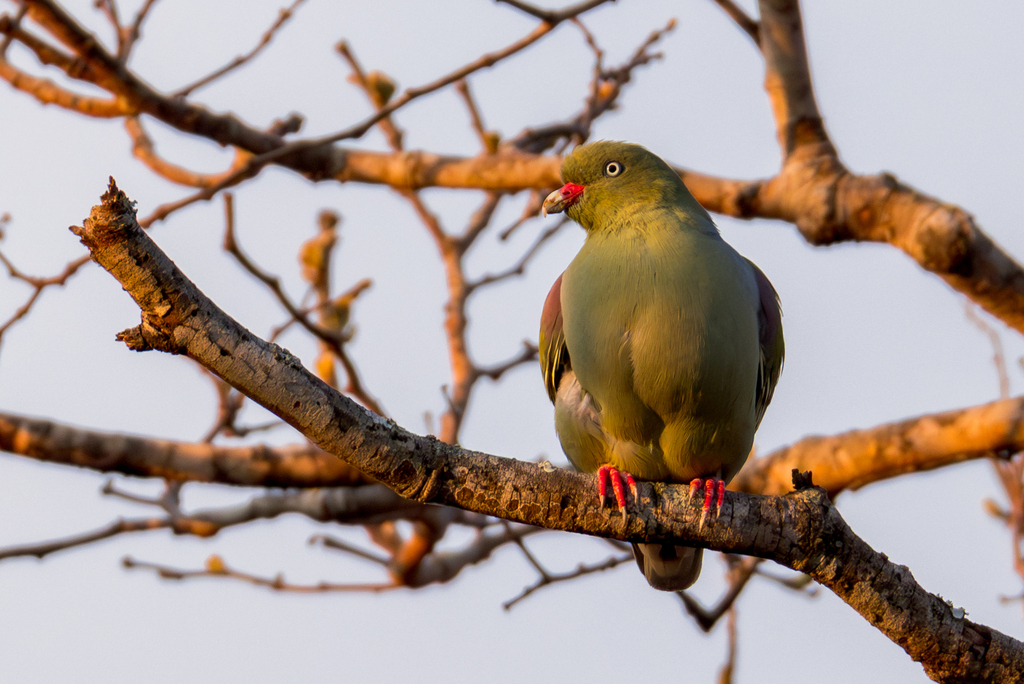
African Green Pigeon
Photo © William Stephens
Photo © William Stephens — CC BY 4.0 — Source: iNaturalist photo #444650968Identification
The African Green Pigeon is a distinctive member of the pigeon family, immediately recognizable by its predominantly grayish-green to yellowish-green upperparts. Adults display striking maroon patches on the upper wings, while juveniles show olive coloration instead. The thighs are bright yellow, and the bird's most characteristic feature is its red bill tipped with white, complemented by red feet. These features, combined with their medium pigeon size, make them unmistakable in their African range.
Range & Habitat
This species boasts one of the widest distributions of any African pigeon, occurring across Sub-Saharan Africa from Senegal and Sierra Leone in the west to South Africa in the south, with approximately 17 recognized subspecies adapted to different regions. They inhabit riparian forests, woodlands, and savanna environments wherever fruiting trees are abundant. Rather than being uniformly distributed, they show a strong association with specific food sources and may occur in high densities locally, though they undertake regular movements in response to fruit availability.
Behaviour & Diet
African Green Pigeons are highly specialized fruit-eaters that spend much of their time in tree canopies, where their parrot-like climbing ability allows them to access fruits that other birds cannot reach. They show a particular preference for wild fig species, especially Ficus sycomorus and Ficus sur, and will also visit ornamental Chinese banyans in urban areas. Their diet includes fruits from Saffrons, Jacket plum, Cordia africana, Buffalo thorn, Water berry, and Jackalberry, supplemented by exotic fruits like loquats and mulberries when available. They are vocal birds, producing a characteristic series of flowing whistles described as 'thweeeloo, thweeeoo'. Ground foraging is uncommon, though occasionally they may feed on carrion.
Best Time & Places to See It
African Green Pigeons are best located by finding fruiting fig trees and other productive fruit-bearing species during seasons of abundance. Their movements are dictated by fruit phenology, so local timing varies across their vast range. They may occur in high densities at particularly productive feeding sites. Forest reserves, woodland areas, and riparian zones throughout Sub-Saharan Africa offer opportunities, with the specific subspecies depending on location. Patient observation around known fruiting trees, particularly during morning feeding periods, offers the best chances of encounter.
Photography Tips
The African Green Pigeon's canopy-dwelling habits and preference for feeding high in trees present the primary photographic challenge. Wide-angle lenses may be necessary when shooting upward into foliage, and fast shutter speeds are essential to freeze movement as birds climb and maneuver among branches. The strong maroon wing patches and yellow thighs provide excellent identification markers to capture. Early morning light often illuminates canopy feeders better than midday sun, and positioning yourself beneath productive fig trees offers predictable opportunities for repeated shots. The red bill and feet provide striking detail in close-up images.
Bwindi Impenetrable National Park
Lake Mburo National Park
Mabamba Swamp
Murchison Falls National Park
Queen Elizabeth National Park
Aberdare National Park
Addo Elephant National Park
Amboseli National Park
Arabuko Sokoke Forest Reserve
Nothing matches these filters.
No community photos yet. Log in to add the first one.
No community observations of this species yet.