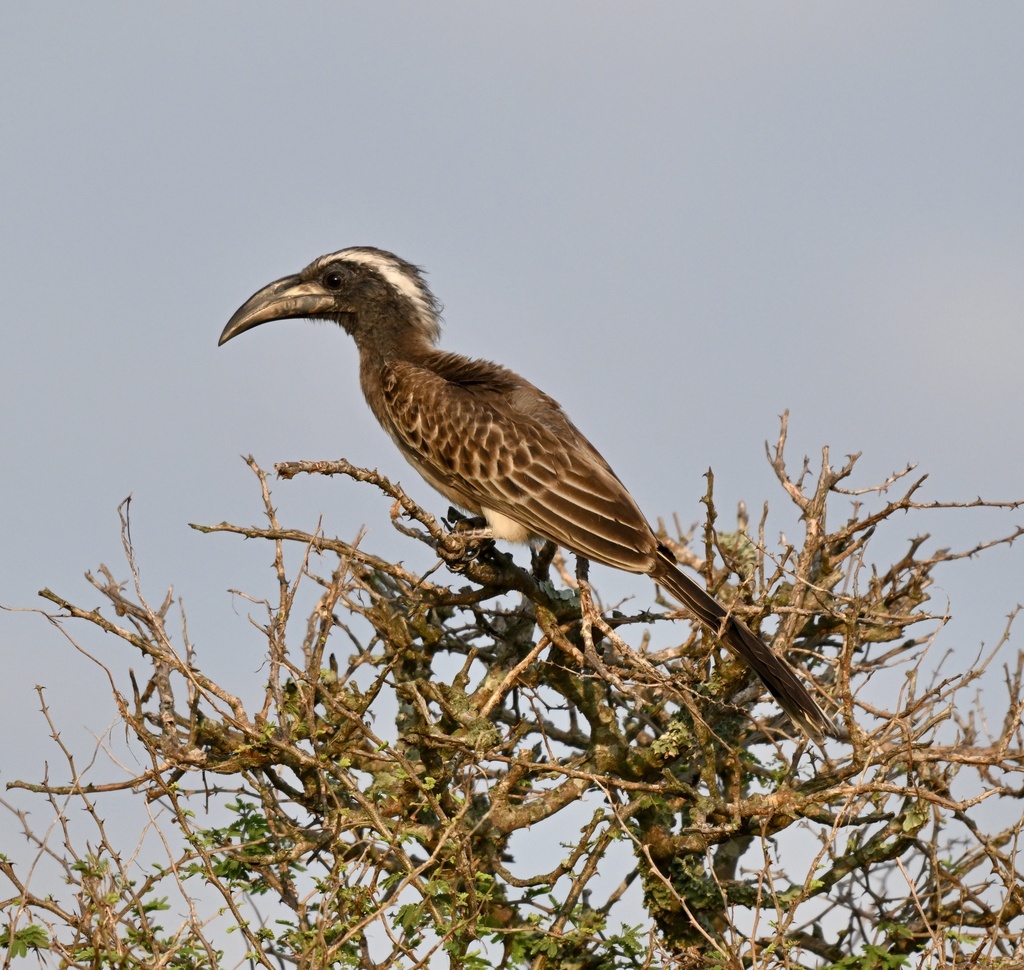
African Grey Hornbill
Photo © Lukas Zangl
Photo © Lukas Zangl — CC BY 4.0 — Source: iNaturalist photo #548786260Identification
The African grey hornbill is a large bird measuring 45–51 cm in length, making it one of the smaller members of the hornbill family. Its plumage is predominantly grey and brown, with a darker head, flight feathers, and long tail. Two distinctive white lines are visible on the crown and back, though the latter is only apparent in flight. The bird's most striking feature is its long, curved bill with a small casque along the upper culmen—more prominent in males than females. Males are identifiable by their dark upper mandible with a creamy-yellow mark or horizontal stripe, while females display tricoloured, red-tipped mandibles. Juveniles resemble adults but have uniformly blackish bills initially. In flight, the African grey hornbill exhibits an undulating pattern and can be distinguished from similarly sized red-billed hornbills by its grey-and-brown plumage rather than pied markings.
Range & Habitat
The African grey hornbill is a widespread resident breeder across much of sub-Saharan Africa and extends into the southwest of the Arabian Peninsula. Two subspecies are recognized: one ranging from Senegal and Gambia through to Ethiopia, central Kenya, and southwest Arabia, while the other occurs from south Uganda and south Kenya southward to northern South Africa. The species shows a strong preference for open woodland and savannah environments. Small populations have also appeared in Florida, USA, following escapes or deliberate releases, though breeding is not established there.
Behaviour & Diet
This conspicuous bird advertises its presence with a distinctive piping call of "pee-o pee-o pee-o." The African grey hornbill is omnivorous, feeding mainly in trees on a varied diet of insects, fruit, and reptiles. During breeding season, the female lays two to four white eggs in a tree hollow. Using a cement made of mud, droppings, and fruit pulp, she seals herself inside with only a narrow aperture through which the male passes food to her and the developing chicks. Climate change and rising temperatures can affect the species' reproductive success and hatching rates. As the chicks and female outgrow the nest cavity, the mother breaks out and rebuilds the wall, after which both parents share the responsibility of feeding the fledglings.
Best Time & Places to See It
The African grey hornbill's widespread distribution across sub-Saharan African savannahs and open woodlands makes it accessible to wildlife travellers throughout much of the continent. The bird's conspicuous nature and loud, distinctive calls make it relatively easy to locate during daylight hours. For the best viewing opportunities, focus on open woodland and savannah habitats where the species forages in trees. Given its breeding behaviour, late spring and early summer months typically offer chances to observe nesting activity and parental feeding behaviour.
Photography Tips
The African grey hornbill's large size, distinctive markings, and habit of feeding in trees make it an excellent photography subject. The contrast between the grey-brown plumage and the bird's prominent curved bill provides strong visual appeal. In-flight shots will reveal the white lines on the back that are hidden when the bird is perched, so attempting to photograph both perched and flying individuals will yield varied compositions. The sexual dimorphism in bill coloration—creamy-yellow in males versus red-tipped in females—offers opportunities to capture identifying details. The bird's conspicuous behaviour and piping calls make locating individuals relatively straightforward for photographers working in suitable savannah and woodland habitats.
Bwindi Impenetrable National Park
Mabamba Swamp
Murchison Falls National Park
Queen Elizabeth National Park
Abijata-Shalla Lakes National Park
Amboseli National Park
Arabuko Sokoke Forest Reserve
Arusha National Park
Awash National Park
Nothing matches these filters.
No community photos yet. Log in to add the first one.
No community observations of this species yet.