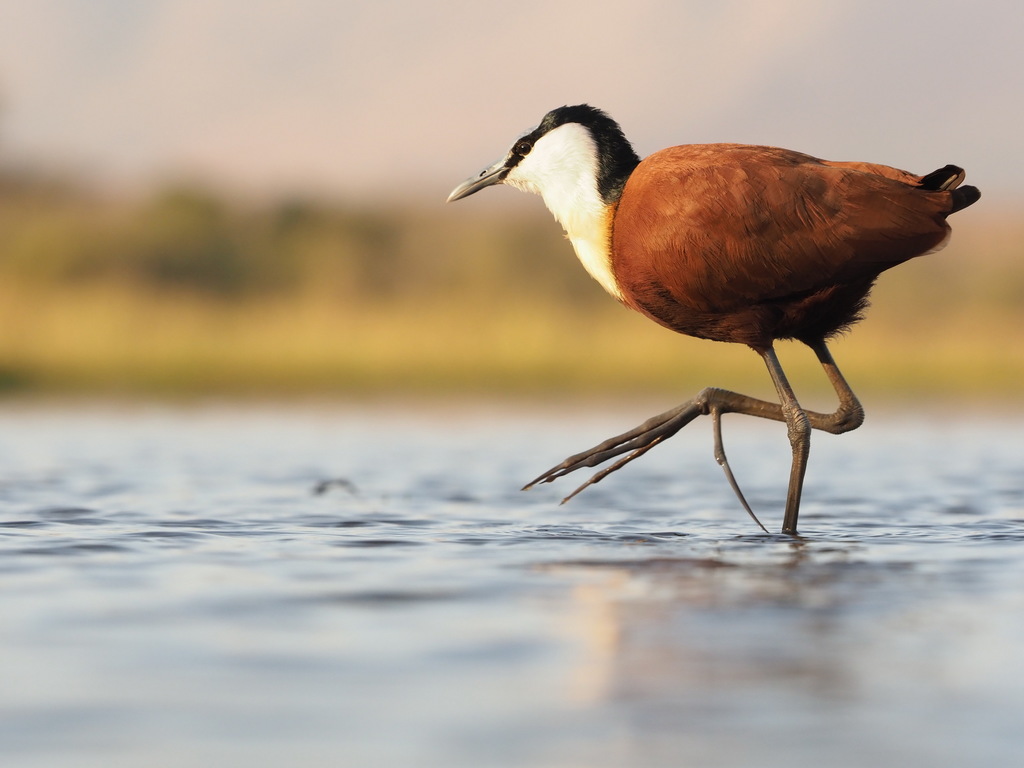
African Jacana
Photo © Peter Archdale
Photo © Peter Archdale — CC BY 4.0 — Source: iNaturalist photo #153907679Identification
The African jacana is a conspicuous and unmistakable wader, measuring 23 to 31 cm in length. Females are noticeably larger than males, with females averaging 261 g compared to males at 137 g on average. The species is striking in appearance: adults display rich chestnut upperparts and underparts, with black wingtips, rear neck, and an eyestripe. Juveniles differ notably, showing white underparts with a chestnut belly patch. The most distinctive feature is the bright blue bill, which extends upward as a coot-like head shield. The legs and characteristically long toes are grey—adaptations essential to the bird's lifestyle.
Range & Habitat
The African jacana is widely distributed throughout sub-Saharan Africa. It is sedentary across most of its range, though it undergoes seasonal dispersion. The species has a strong preference for shallow lakes and other freshwater wetlands where floating vegetation abounds. Its remarkable long toes and sharp claws are perfectly adapted to walking across these floating plants, which form its preferred habitat. These morphological features allow the jacana to access food and nesting sites that are unavailable to other waders.
Behaviour & Diet
African jacanas feed primarily on insects and other invertebrates, which they pick from floating vegetation and the water's surface. The species exhibits one of the animal kingdom's most unusual breeding systems: polyandry, in which a single female mates with multiple males. In this remarkable arrangement, individual males alone are responsible for incubating eggs and caring for chicks. This system has evolved because the resource-rich lakes support such abundant food that egg production is energetically inexpensive for females, while male parental care becomes the breeding bottleneck. Each female forms a harem of males, with each male tending his own nest of chicks. Male African jacanas have evolved extraordinary parental adaptations, including the ability to carry chicks beneath their wings.
Best Time & Places to See It
The African jacana is a year-round resident throughout sub-Saharan Africa, making it accessible to travellers any time of year. The species breeds throughout the region, offering opportunities to observe breeding behaviour and family groups. Look for them on shallow lakes and freshwater wetlands where floating vegetation is present. Their conspicuous appearance and preference for open water make them relatively easy to locate once you visit suitable wetland habitats.
Photography Tips
Photograph African jacanas in early morning light when reflections on the water enhance the scene and when birds are most active. The bird's striking chestnut and black plumage contrasts beautifully against floating vegetation and water. Patience will reward you with images of their characteristic behaviour: walking delicately across lily pads and other floating plants on their impossibly long toes. If observing during breeding season, you may capture the remarkable sight of a male carrying chicks beneath its wings, one of nature's most unusual parental strategies.
Private Half-Day Wake Up With Birds & Breakfast
Nothing matches these filters.
Bwindi Impenetrable National Park
Lake Mburo National Park
Mabamba Swamp
Murchison Falls National Park
Queen Elizabeth National Park
Aberdare National Park
Abijata-Shalla Lakes National Park
Addo Elephant National Park
Amboseli National Park
Nothing matches these filters.
No community photos yet. Log in to add the first one.
No community observations of this species yet.