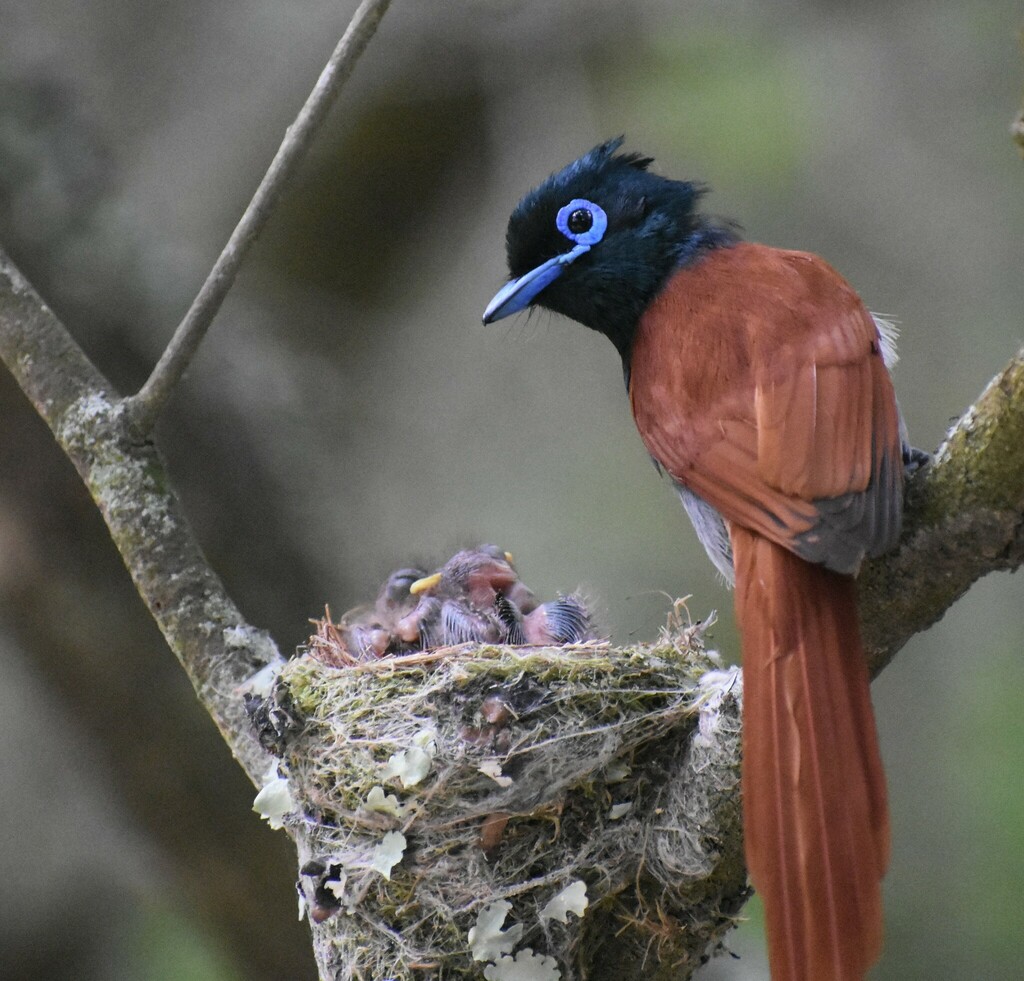
African Paradise Flycatcher
Photo © Justin Ponder
Photo © Justin Ponder — CC BY 4.0 — Source: iNaturalist photo #250245590Identification
The African Paradise Flycatcher is a striking medium-sized passerine, instantly recognizable by the male's extraordinary tail streamers—the two central feathers extend to more than twice the bird's body length, creating an unmistakable silhouette in flight. Adult males display bold chestnut or rusty coloration on the upper parts, wings, and tail, contrasting sharply with variably grey to blue-gray underparts and a darker, glossy black head with greenish highlights. A prominent white wingbar further distinguishes males. The beak and wattle ring around the eye match the surrounding plumage colors. Females lack the dramatic tail streamers and sport similar but less showy coloration, with paler heads and browner-tinted underparts. Young birds resemble females but appear duller. Males show considerable plumage variation across their range; some populations feature white instead of chestnut on wings and tail, while others display black tail streamers.
Range & Habitat
This flycatcher is found across most of Africa south of the Sahara Desert, with populations also occurring on the Arabian Peninsula. Ten recognized subspecies occupy different regions, from West African populations in Senegal and Gambia to southern African races found in South Africa and Mozambique. The species is a locally common resident breeder throughout its range. African Paradise Flycatchers favor open woodland and savanna habitats, including savannah woodland, open grassland with scattered trees, plantations, and scrubland. They typically inhabit open forest environments where they can perch prominently while hunting.
Behaviour & Diet
This is a noisy, conspicuous bird with a harsh scolding call that betrays its presence even when perched high in trees. It has characteristically short legs and sits very upright on prominent perches, a posture reminiscent of shrikes. The African Paradise Flycatcher is insectivorous, actively hunting flies on the wing while also consuming insect eggs, larvae, and adults. It supplements its diet with spiders and occasionally berries. Breeding birds construct neat cup-shaped nests in trees and typically lay clutches of two or three eggs. The species readily hybridizes with the genetically similar Rufous-vented Paradise Flycatcher, and hybrids also occur with the closely related Red-bellied Paradise Flycatcher.
Best Time & Places to See It
As a locally common resident breeder, the African Paradise Flycatcher can be encountered year-round throughout its African range in suitable habitat. Open woodland and savanna regions across sub-Saharan Africa offer the best opportunities for sightings. The species' noisy calls and habit of perching prominently make it relatively conspicuous once you know where to look. The bird's conservation status is listed as "Least Concern" by the International Union for Conservation of Nature.
Photography Tips
The male's extraordinary tail streamers present a compelling photographic subject, particularly in flight when the full grace of the extended feathers becomes apparent. Position yourself with good backlighting to capture the glossy highlights on the male's head and the contrast between chestnut and black plumage. The bird's habit of sitting upright on exposed perches makes photography relatively straightforward compared to many woodland species. Early morning light will enhance the colors of the plumage and make the white wingbar stand out distinctly. Patient observers waiting near open perches are rewarded with opportunities to photograph this stunning flycatcher in characteristic poses.
Private Full-Day Kotu Birdwatching Experience: An Introduction to Kotu’s Diverse Birdlife
Nothing matches these filters.
Nothing matches these filters.
Bwindi Impenetrable National Park
Lake Mburo National Park
Mabamba Swamp
Murchison Falls National Park
Queen Elizabeth National Park
Aberdare National Park
Abijata-Shalla Lakes National Park
Addo Elephant National Park
Amboseli National Park
Nothing matches these filters.
No community photos yet. Log in to add the first one.
No community observations of this species yet.