African Penguin
Photo © Leonardo Rapisarda
Photo © Leonardo Rapisarda — CC BY 4.0 — Source: iNaturalist photo #510126816Identification
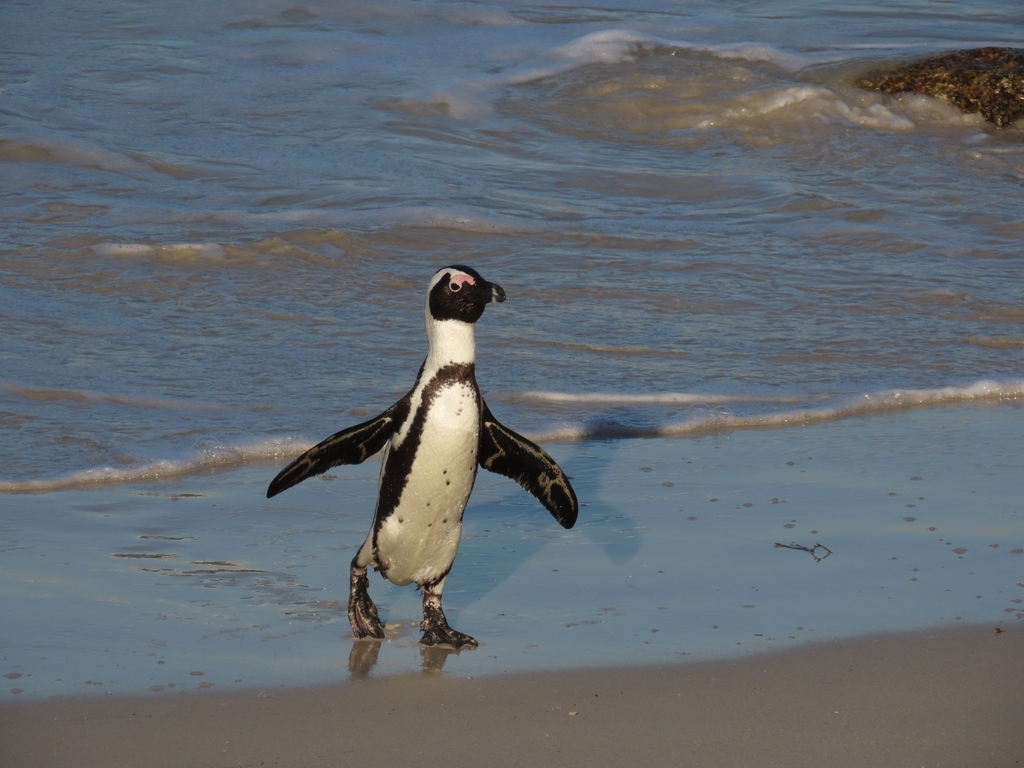
The African penguin is unmistakable among African wildlife, standing 60–70 cm tall and weighing 2.2–3.5 kg. Adults display striking plumage with jet-black upperparts sharply contrasting against white underparts marked with distinctive black spots and a single black band across the chest—a pattern unique to each individual, like a fingerprint. The most characteristic feature is the bold pink patches of bare skin above the eyes, which intensify in colour as blood flow increases with rising temperature. A thick black facial mask completes the dramatic appearance.
The species exhibits countershading, camouflaging the white underside from underwater predators and the black back from above. Juveniles lack the bold adult markings, instead displaying greyish-blue to brown upperparts and pale, unmarked underparts. Males are slightly larger than females with proportionally longer beaks. African penguins can be distinguished from their South American relatives by their single chest bar; Magellanic penguins, by contrast, possess a double bar.
Range & Habitat
The African penguin is confined to southern African waters and stands as the only penguin species found in the Old World. Its range is restricted to the southwestern coast of Africa, with breeding colonies established on 27 islands between Namibia and Algoa Bay near Port Elizabeth, South Africa. This is Africa's sole penguin species and the only one that breeds on the continent.
In recent decades, mainland colonies have emerged, most notably at Boulders Beach near Simon's Town and Stony Point in Betty's Bay, both established in the 1980s near Cape Town. A mainland colony also exists in Namibia. Boulders Beach has become a renowned tourist destination, where penguins tolerate human approach to within a meter, offering exceptional opportunities for observation and photography.
Behaviour & Diet
African penguins are pursuit divers, hunting primarily on fish and squid beneath the waves. Like all penguins, they are flightless but supremely adapted to marine life, with streamlined bodies and wings evolved into powerful flippers for underwater propulsion. The species possesses supraorbital salt glands located above the eyes, enabling them to excrete excess salt ingested while feeding at sea—a critical adaptation for maintaining osmotic balance during extended foraging expeditions.
These penguins are notably vocal birds, producing loud, donkey-like braying noises that earned them the vernacular name "jackass penguin." This charismatic and recognizable behaviour, combined with their striking appearance, has made them popular with wildlife enthusiasts and tourists.
Best Time & Places to See It
African penguins are best observed at established mainland colonies, particularly Boulders Beach near Simon's Town and Stony Point in Betty's Bay, both near Cape Town, South Africa. These accessible locations offer reliable sightings and the unique opportunity to approach penguins closely—sometimes to within a meter—making them ideal for both casual visitors and dedicated wildlife watchers.
The species also inhabits 27 island breeding colonies scattered between Namibia and Algoa Bay, though these are less accessible to tourists. The critically endangered status of African penguins makes every sighting precious; the population has declined catastrophically from roughly 4 million in the early 19th century to a fraction of that number today, driven by habitat loss, overfishing, and climate change.
Photography Tips
Boulders Beach offers exceptional photographic opportunities due to the penguins' remarkable tolerance of human proximity. The distinctive pink patches above the eyes, bold facial masks, and unique chest markings provide striking compositional elements. The sharp contrast between black and white plumage renders well in varied lighting, though morning light often accentuates the pink orbital patches most vividly.
Capture behavioural shots of penguins diving, waddling, or vocalizing to showcase their charismatic nature. The individual variation in chest spot patterns offers opportunities for detailed portraiture. Given their critically endangered status, photographing these birds also serves as documentation of an increasingly rare species, making every image potentially valuable for conservation awareness.
Garden Route National Park
George, South Africa
+353 birds+54 mammals
Sweeping across the Western Cape's coastal and mountainous terrain, this sprawling national park encompasses over five thousand square kilometers of extraordinarily diverse landscape—from coastal limestone cliffs…
VIEW NATIONAL PARKAgulhas National Park
Cape Agulhas Local Municipality, South Africa
+224 birds+13 mammals
Where the Atlantic and Indian Oceans meet at Africa's southernmost tip, Agulhas National Park stretches across 892 square kilometres of windswept coastal landscape and rugged limestone…
VIEW NATIONAL PARKAddo Elephant National Park
Sundays River Valley Local Municipality, South Africa
+388 birds+55 mammals
Where the Eastern Cape's semi-arid scrublands meet transitional woodland, Addo sprawls across 13,478 square kilometres of one of southern Africa's most biodiverse landscapes. The terrain rises…
VIEW NATIONAL PARKSperrgebiet National Park
Barcelona, Namibia
+181 birds+18 mammals
Where the Namib's ancient gravel plains meet the Atlantic coast, one of Africa's most remote and geologically austere landscapes unfolds across more than 56,000 square kilometres.…
VIEW NATIONAL PARKDorob National Park
Henties Bay, Namibia
+230 birds+13 mammals
Where the Skeleton Coast meets the Namib Desert's inland reaches, Dorob National Park sprawls across 34,021 square kilometres of one of southern Africa's most austere and…
VIEW NATIONAL PARKNamib-Naukluft National Park
Namibia
+217 birds+33 mammals
Across nearly 94,000 square kilometers of southwestern Namibia, a landscape of extremes unfolds where towering sand dunes meet rugged mountain ranges, and ancient riverbeds carve through…
VIEW NATIONAL PARKNo community photos yet. Log in to add the first one.
No community observations of this species yet.