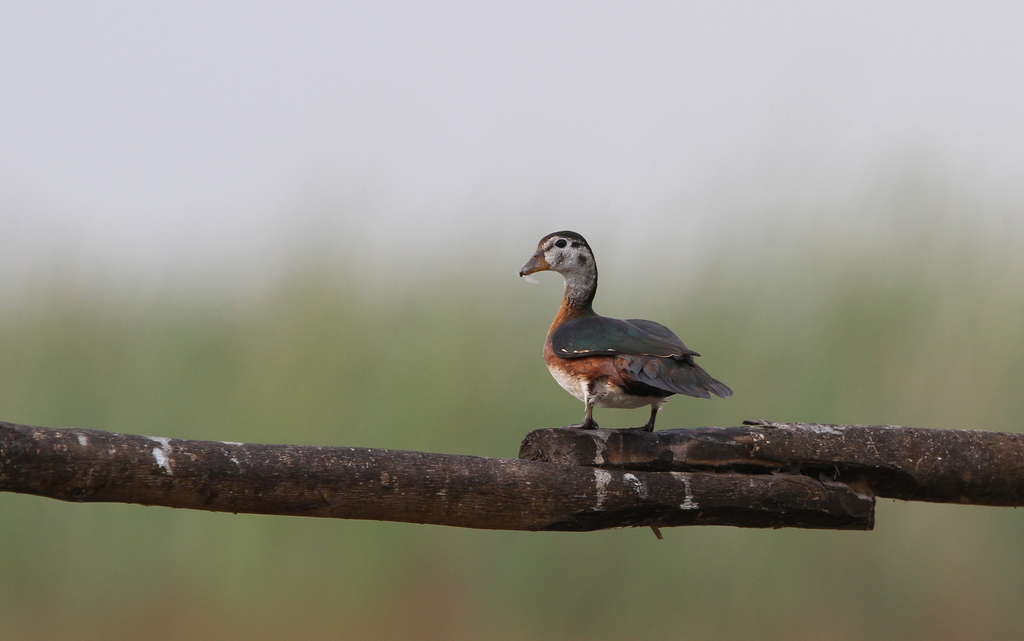
African Pygmy Goose
Photo © Christoph Moning
Photo © Christoph Moning — CC BY 4.0 — Source: iNaturalist photo #95167200Identification
The African pygmy goose is one of the world's smallest waterfowl, weighing only around 285 grams for males and 260 grams for females. Despite having a bill that resembles a goose's, it is more closely related to dabbling ducks. Males are strikingly patterned with a white face and distinctive black eye patches, an iridescent black crown extending down the back of the neck, and powder-green ear patches. The upper neck is white, forming an open collar, while the base of the neck and breast are light chestnut, intensifying to deeper chestnut on the flanks. The back is metallic green, and the wings are black with metallic green iridescence on the coverts, except for a white bar on the distal secondaries. The belly is white, the bill is yellow with a black tip, and the feet are dark-gray to black.
Females are more subdued in appearance, with a gray face marked by a dark brown eye stripe and smudged brown patches on the cheeks and nape. They have a dark-brown forehead, crown, and back of the neck with slight iridescence, and dark chestnut coloration on the breast and flanks. Their back is dark brown, and like males, they feature a white bar on the distal secondaries. Ducklings display a white face with black and dark-gray patterning similar to females, with a distinctive black crown extending in a V-shape from the bill base to the back of the neck.
Range & Habitat
The African pygmy goose is a nomadic species found across sub-Saharan Africa and Madagascar. It favors slow-flowing or stagnant water bodies with dense water lily coverage, including inland wetlands, open swamps, farm dams, river pools, and estuaries. The bird's dependence on water lilies as its primary habitat makes it particularly associated with these shallow, vegetation-rich waterways throughout its range.
Behaviour & Diet
The African pygmy goose feeds predominantly on the seeds of water lilies (Nymphaea spp.), supplementing its diet with other floating seeds, small insects, and small invertebrates. This specialized feeding preference ties the species closely to water lily-covered wetlands. The species exhibits strong pair bonds that may persist over several seasons, and breeding is triggered by rainfall patterns. In captivity, successful breeding is rare, suggesting that these birds have specific environmental requirements for reproduction that are difficult to replicate outside their natural habitat.
Best Time & Places to See It
As a nomadic species, the African pygmy goose's movements are closely tied to rainfall patterns and water availability across sub-Saharan Africa and Madagascar. The best viewing opportunities occur during or shortly after rainy seasons when water bodies are full and water lily growth is abundant. Look for this species in inland wetlands, open swamps, river pools, and estuaries across its range, paying particular attention to areas with thick water lily coverage.
Photography Tips
The African pygmy goose's small size and preference for dense water lily vegetation make it a challenging but rewarding photographic subject. Position yourself quietly along the margins of water lily-covered wetlands, as the birds feed among the floating vegetation. Early morning light is ideal for capturing the iridescent black plumage of males and the subtle detail of their facial markings. The contrast between males' striking white faces and dark plumage, and females' more subdued coloration, offers different compositional opportunities. A telephoto lens is essential, as these wary birds will flush easily if approached too closely.
Serengeti National Park
Tanzania
+558 birds+57 mammals
Across Tanzania's northern plateau, where volcanic soils meet acacia woodland and open grassland, unfolds one of Earth's most dynamic ecosystems. The Serengeti National Park sprawls across…
VIEW NATIONAL PARKMapungubwe National Park
Musina Local Municipality, South Africa
+358 birds+29 mammals
Where the Limpopo River cuts through sandstone ridges at the convergence of South Africa, Botswana, and Zimbabwe, Mapungubwe National Park preserves a landscape of profound ecological…
VIEW NATIONAL PARKChobe National Park
Botswana
+446 birds+45 mammals
Where the Chobe River cuts a sinuous path through northern Botswana, the landscape transforms into one of Africa's most dynamic wetland-savanna mosaics. This national park encompasses…
VIEW NATIONAL PARKKhaudum National Park
Botswana
+213 birds+13 mammals
Where the Okavango's northern tributaries meander through miombo woodland and riverine forest, Khaudum National Park unfolds across a landscape of profound ecological richness and isolation. This…
VIEW NATIONAL PARKMurchison Falls National Park
Uganda
+608 birds+33 mammals
Where the Victoria Nile compresses through a narrow gorge and explodes across a 45-meter precipice, the landscape speaks in thunder. Murchison Falls National Park sprawls across…
VIEW NATIONAL PARKLake Mburo National Park
Uganda
+505 birds+24 mammals
Rolling acacia woodland and scattered lakes define this intimate savanna preserve in southwestern Uganda, where the rift valley's geological drama shapes every water source and grassland.…
VIEW NATIONAL PARKTsavo West National Park
Mwatate, Kenya
+513 birds+49 mammals
Where volcanic ridges and weathered lava flows meet the semi-arid lowlands of south-central Kenya, Tsavo West National Park unfolds across a landscape sculpted by fire and…
VIEW NATIONAL PARKAmboseli National Park
Etonet/Lenkism ward, Kenya
+501 birds+43 mammals
Where the Amboseli basin opens toward the Tanzanian frontier, a shallow alkaline lake mirrors vast skies across one of East Africa's most iconic savanna landscapes. The…
VIEW NATIONAL PARKTarangire National Park
Tanzania
+527 birds+50 mammals
Acacia woodland and grassland sweep across the Manyara Region where the Tarangire River carves through low hills and volcanic soils, creating one of East Africa's most…
VIEW NATIONAL PARKNgorongoro Conservation Area
Tanzania
+626 birds+55 mammals
Volcanic calderas and open grassland dominate this high plateau in northern Tanzania, where the landscape rises above 2,000 metres and ancient geological forces have shaped both…
VIEW WILDLIFE MANAGEMENT AREAQueen Elizabeth National Park
Uganda
+672 birds+30 mammals
Across the southwestern escarpment of Uganda, where the Western Rift Valley descends through ancient volcanic terrain, Queen Elizabeth National Park sprawls across more than 8,300 square…
VIEW NATIONAL PARKMabamba Swamp
Memere, Uganda
+464 birds+2 mammals
Across the Central Region of Uganda spreads one of Africa's most biodiverse freshwater wetlands, a sprawling nature reserve of roughly 283 square kilometres where papyrus swamps…
VIEW NATURE RESERVEKruger National Park
Ba-Phalaborwa Local Municipality, South Africa
+540 birds+91 mammals
Across the low-lying savanna of northeastern South Africa unfolds one of Africa's largest and most ecologically intact protected areas, where acacia woodlands merge into mopane scrub…
VIEW NATIONAL PARKAddo Elephant National Park
Sundays River Valley Local Municipality, South Africa
+388 birds+55 mammals
Where the Eastern Cape's semi-arid scrublands meet transitional woodland, Addo sprawls across 13,478 square kilometres of one of southern Africa's most biodiverse landscapes. The terrain rises…
VIEW NATIONAL PARKKhaudum National Park
Namibia
+221 birds+13 mammals
Where the Kavango River flows through northeastern Namibia, vast miombo woodlands and riverine forests create one of southern Africa's most remote and biodiverse wilderness corridors. Khaudum…
VIEW NATIONAL PARKNkasa Rupara National Park
Namibia
+283 birds+17 mammals
Where the Zambezi's floodplains spill across the border between Namibia and Botswana, Nkasa Rupara National Park unfolds across 518 square kilometers of wetland and woodland mosaic.…
VIEW NATIONAL PARKBwabwata National Park
Namibia
+377 birds+35 mammals
Where the Kavango River winds through northeastern Namibia, vast floodplains and dense riparian woodland create one of southern Africa's most ecologically dynamic protected landscapes. Spanning 14,249…
VIEW NATIONAL PARKAbijata-Shalla Lakes National Park
Ethiopia
+438 birds+7 mammals
Two crater lakes of contrasting chemistry define this remote corner of Ethiopia's Rift Valley, where soda lakes and freshwater basins create a mosaic of distinct aquatic…
VIEW NATIONAL PARKBale Mountains National Park
Ethiopia
+397 birds+20 mammals
Where the Ethiopian highlands rise above 4,000 metres, the Bale Mountains create a landscape of stunning ecological extremes—from afroalpine grasslands swept by wind and mist to…
VIEW NATIONAL PARKMakgadikgadi Pans National Park
Gucta, Botswana
+272 birds+27 mammals
Where salt-crusted flatlands stretch endlessly toward a shimmering horizon, one of Africa's most extraordinary ecosystems awakens with the rains. The Makgadikgadi Pans comprise vast mineral-rich basins…
VIEW NATIONAL PARKArabuko Sokoke Forest Reserve
Kilifi, Kenya
+383 birds+29 mammals
Coastal forest rises from the Indian Ocean plains of Kilifi County, where sandy soils and seasonal rainfall have sculpted a woodland ecosystem unlike anywhere else on…
VIEW NATURE RESERVEWatamu Marine National Park
Dabaso ward, Kenya
+328 birds+12 mammals
Where mangrove channels meet coral gardens and sandy shallows blend into the warm waters of the Indian Ocean, Watamu Marine National Park unfolds across the Kilifi…
VIEW NATIONAL PARKNo community photos yet. Log in to add the first one.
No community observations of this species yet.