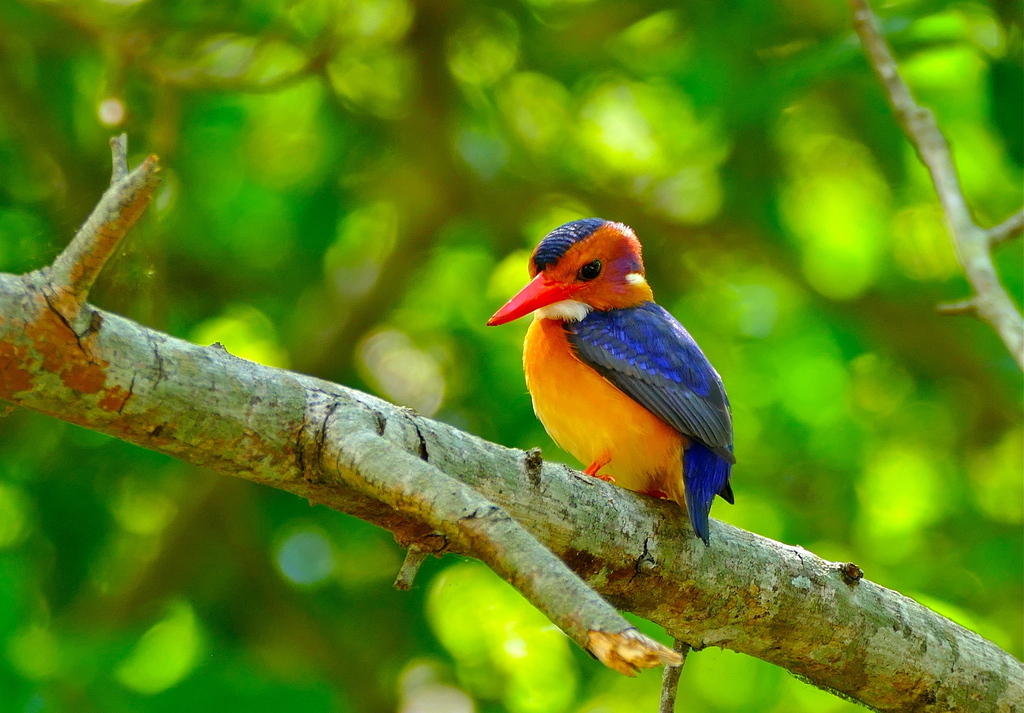
African Pygmy Kingfisher
Photo © Bernard DUPONT
Photo © Bernard DUPONT — CC BY 4.0 — Source: iNaturalist photo #251932987Identification
The African Pygmy Kingfisher is a diminutive kingfisher, measuring just 12 cm in length, making it one of Africa's smallest members of this family. It is unmistakable once seen: the bird features a distinctive dark blue crown, a bright blue back extending to the tail, and rufous underparts. The violet wash on the ear coverts is a key identifying feature that separates it from the similar Malachite Kingfisher, while its smaller overall size and dark crown distinguish it clearly from the African Dwarf Kingfisher. The sexes are alike in plumage. The southern natalensis subspecies shows paler underparts and a blue spot above the white ear patch. Juveniles are duller, with less extensive violet on the ear coverts and a black rather than orange bill. In flight, listen for the bird's distinctive high-pitched, insect-like "tsip-tsip" call.
Range & Habitat
This species is widely distributed across sub-Saharan Africa as a common resident and intra-African migrant. Three subspecies occupy different ranges: the nominate picta from Senegal and Gambia to Ethiopia and Uganda; ferrugina from Guinea-Bissau to western Uganda and southward to Angola and northern Tanzania; and natalensis from southern Angola to central Tanzania and into South Africa. The bird is absent from much of the Horn of Africa and the drier western regions of Southern Africa. Unlike many kingfishers, the African Pygmy Kingfisher is not bound to water, instead favouring woodland, savanna, and coastal forest habitats where it can hunt insects from low perches.
Behaviour & Diet
The African Pygmy Kingfisher is an insectivore with a diverse diet that reflects its small size and hunting prowess. It feeds on grasshoppers, praying mantises, crickets, dragonflies, cockroaches, moths, and worms. Spiders comprise a surprisingly large portion of its diet, while it also takes small geckos, lizards, tiny frogs, and occasionally small crabs—prey items often matching its own length. The bird hunts from low perches, capturing prey that it either crushes in its beak or smashes against the perch before consuming.
African Pygmy Kingfishers are usually encountered singly or in pairs and are notably secretive and unobtrusive. They nest in burrows excavated by both sexes in sandy soil banks or into ground termite nests, with burrow lengths ranging from 30 to 60 cm. Clutches comprise four to six white eggs, and both parents share chick-rearing duties. Multiple broods per year are possible. The southern subspecies undertakes a regular migration, with birds leaving breeding grounds in March and April to overwinter as far north as 2°N in the DRC, Uganda, South Sudan, and Kenya, returning in September and October.
Best Time & Places to See It
Year-round residents can be found throughout the species' range in suitable woodland and savanna habitats. For visitors targeting the southern subspecies (natalensis), the best time to encounter breeding birds is September to March, after their return from northerly wintering grounds. The bird's secretive nature and preference for low, dense vegetation make it challenging to locate, so patience and careful observation of likely perches are essential. Listen for the distinctive high-pitched call to help pinpoint individuals.
Photography Tips
The African Pygmy Kingfisher's small size and unobtrusive behaviour present genuine photographic challenges. Position yourself quietly near suitable hunting perches at dawn or dusk when the bird is most active. The rufous underparts and blue upperparts provide good colour contrast, so work with natural light to capture these details. A telephoto lens is essential given the bird's tendency to keep its distance. Patience is paramount—many birding sessions may yield only brief glimpses before the kingfisher flits away.
Nothing matches these filters.
Bwindi Impenetrable National Park
Lake Mburo National Park
Mabamba Swamp
Murchison Falls National Park
Queen Elizabeth National Park
Addo Elephant National Park
Amboseli National Park
Arabuko Sokoke Forest Reserve
Arusha National Park
Nothing matches these filters.
No community photos yet. Log in to add the first one.