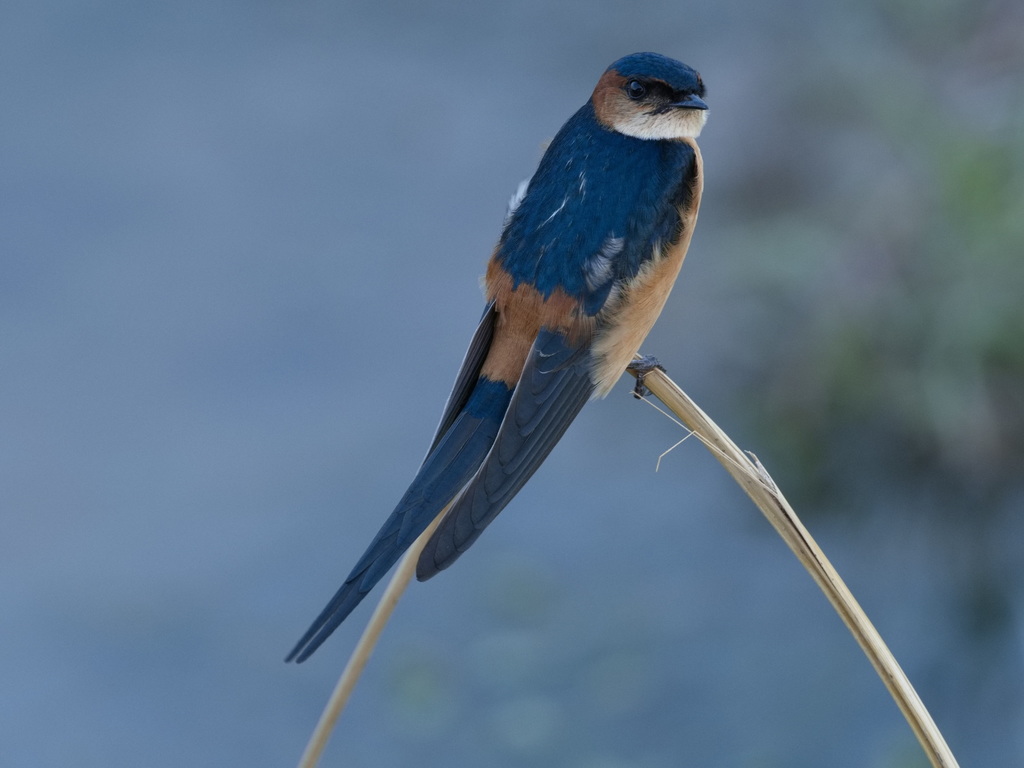
African Red-rumped Swallow
Photo © Peter Archdale
Photo © Peter Archdale — CC BY 4.0 — Source: iNaturalist photo #174121234The African red-rumped swallow (Cecropis melanocrissus) is small passerine bird in the swallow family Hirundinidae. It is found in north tropical areas of Africa south of the Sahara. == Taxonomy == The African red-rumped swallow was formally described and illustrated in 1845 by the German naturalist Eduard Rüppell based on a specimen collected in the Tembien region of northern Ethiopia. He coined the binomial name Cecropis melanocrissus where the specific epithet combines the Latin melas, melanos meaning "black" with Modern Latin crissum meaning "vent". Four subspecies are recognised: C. m. domicella (Heuglin, 1869) – west Africa from Senegambia to east Sudan C. m. melanocrissus Rüppell, 1845 – Ethiopia and Eritrea C. m. kumboensis (Bannerman, 1923) – Sierra Leone and west Cameroon C. m. emini (Reichenow, 1892) – southeast Sudan, Uganda and Kenya to Malawi and north Zambia The subspecies C. m. domicella was formerly treated as a separate species, the West African swallow, while the subspecies C. m. melanocrissus, C. m. kumboensis and C. m. emini were formerly placed in the red-rumped swallow C. daurica complex. The taxa were re-arranged based on differences in morphology and genetics. As part of the rearrangement, the red-rumped swallow complex was additionally split into…
Serengeti National Park
Tanzania
+558 birds+57 mammals
Across Tanzania's northern plateau, where volcanic soils meet acacia woodland and open grassland, unfolds one of Earth's most dynamic ecosystems. The Serengeti National Park sprawls across…
VIEW NATIONAL PARKBwindi Impenetrable National Park
Kanyashogi, Uganda
+603 birds+26 mammals
Steep ridges cloaked in montane forest rise from Uganda's southwestern borderlands, where the landscape grows so dense and tangled that early explorers named it impenetrable. At…
VIEW NATIONAL PARKAmboseli National Park
Etonet/Lenkism ward, Kenya
+501 birds+43 mammals
Where the Amboseli basin opens toward the Tanzanian frontier, a shallow alkaline lake mirrors vast skies across one of East Africa's most iconic savanna landscapes. The…
VIEW NATIONAL PARKKitulo National Park
Tanzania
+59 birds+1 mammals
Where the southern highlands of Tanzania rise above two thousand metres, rolling grasslands and montane meadows create a landscape rarely encountered in East Africa—a sweeping plateau…
VIEW NATIONAL PARKNgorongoro Conservation Area
Tanzania
+626 birds+55 mammals
Volcanic calderas and open grassland dominate this high plateau in northern Tanzania, where the landscape rises above 2,000 metres and ancient geological forces have shaped both…
VIEW WILDLIFE MANAGEMENT AREAQueen Elizabeth National Park
Uganda
+672 birds+30 mammals
Across the southwestern escarpment of Uganda, where the Western Rift Valley descends through ancient volcanic terrain, Queen Elizabeth National Park sprawls across more than 8,300 square…
VIEW NATIONAL PARKNairobi National Park
Nairobi, Kenya
+515 birds+35 mammals
Just minutes from Kenya's capital, where the Nairobi River winds through acacia woodland and open grassland, lies one of Africa's most paradoxical wildlife sanctuaries. The park's…
VIEW NATIONAL PARKLake Nakuru National Park
Nakuru West, Kenya
+494 birds+32 mammals
Alkaline waters ringed by acacia woodland and grassland create one of East Africa's most distinctive wetland ecosystems, where the interplay of geology and climate sustains a…
VIEW NATIONAL PARKAberdare National Park
Mweiga ward, Kenya
+394 birds+30 mammals
Where the central highlands of Kenya rise to their elemental grandeur, the Aberdare range unfolds across Nyeri County as a montane stronghold of cool, misty forest…
VIEW NATIONAL PARKHell’s Gate National Park
Olkaria ward, Kenya
+388 birds+18 mammals
Volcanic scarps and geothermal vents dominate the floor of Hell's Gate, where the East African Rift has carved a dramatic gorge through crystalline rock formations. The…
VIEW NATIONAL PARKNo community photos yet. Log in to add the first one.
No community observations of this species yet.