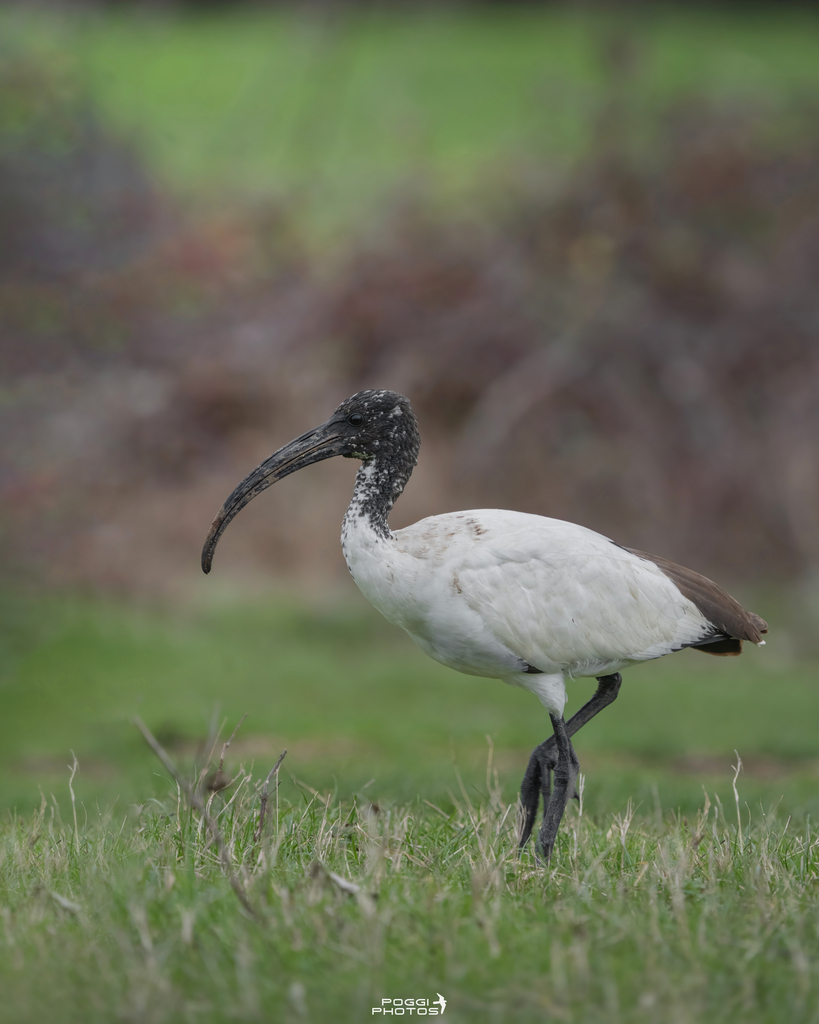
African Sacred Ibis
Photo © Andrea Poggi
Photo © Andrea Poggi — CC BY 4.0 — Source: iNaturalist photo #347158814Identification
The African sacred ibis is a distinctive wading bird measuring 68 cm in length with a wingspan of 112 to 124 cm. Adults are instantly recognisable by their predominantly white plumage contrasted with dark plumes on the rump, and most strikingly, a completely bald head and neck rendered in glossy black. The thick, curved black bill is a characteristic feature of all ibises, as are the long black legs. In flight, the white wings reveal a bold black rear border. The eyes are brown, framed by a distinctive dark red orbital ring. Males tend to be slightly larger than females, though the sexes are otherwise similar in appearance. Juveniles are noticeably different, with dirty white plumage, a smaller bill, some feathering still present on the neck, greenish-brown scapulars, and more black on the primary coverts. This bird is typically silent, occasionally uttering puppy-like yelping calls, making it quieter than its close relative, the hadada ibis.
Range & Habitat
The African sacred ibis is native to much of Africa, as well as small parts of Iraq, Iran and Kuwait. The species breeds across Sub-Saharan Africa and southeastern Iraq. Notably, it is currently extirpated from Egypt, despite its profound historical significance in that region. Many populations are migratory, moving with seasonal rains. South African birds undertake particularly impressive journeys, migrating as far north as Zambia—a distance of some 1,500 km—while African populations north of the equator migrate in the opposite direction. The Iraqi population typically migrates to southwestern Iran, with occasional wandering vagrants recorded as far south as Oman and remarkably, as far north as the Caspian coasts of Kazakhstan and Russia.
Behaviour & Diet
As a wading bird, the African sacred ibis forages in wetland habitats, using its distinctive curved bill to probe for food. The species is highly adaptable and often found in flocks. Interestingly, the African sacred ibis is closely related to both the black-headed ibis and the Australian white ibis—the three species are so similar that some ornithologists consider them conspecific. In mixed flocks, these ibises readily hybridise, demonstrating their genetic compatibility.
Best Time & Places to See It
To locate the African sacred ibis, focus on Sub-Saharan Africa where the species is widely distributed and relatively common. The best viewing opportunities align with local conditions and migration patterns; consult regional guides for seasonal movements in your target area. Wetland habitats are your primary focus. The species' historical abundance in Egypt—where it was venerated and mummified by the thousands as votive offerings to the god Thoth—makes its current extirpation from that region a poignant reminder of changing distributions.
Photography Tips
The African sacred ibis's striking contrast between white body plumage and black head, neck, and bill makes for compelling photography. The bold dark red orbital ring around the eye is a detailed feature worth capturing in close-ups. In-flight shots are particularly rewarding, as the black rear border of the white wings creates strong visual definition. Look for opportunities to photograph birds in flocks, as they often congregate in their native wetland habitats. The bird's typical silence means you can approach relatively quietly; however, patience and a telephoto lens will yield the best results for capturing detail of the distinctive bald head and facial features.
Queen Elizabeth National Park
Bwindi Impenetrable National Park
Lake Mburo National Park
Mabamba Swamp
Murchison Falls National Park
Aberdare National Park
Abijata-Shalla Lakes National Park
Addo Elephant National Park
Agulhas National Park
Nothing matches these filters.
No community photos yet. Log in to add the first one.