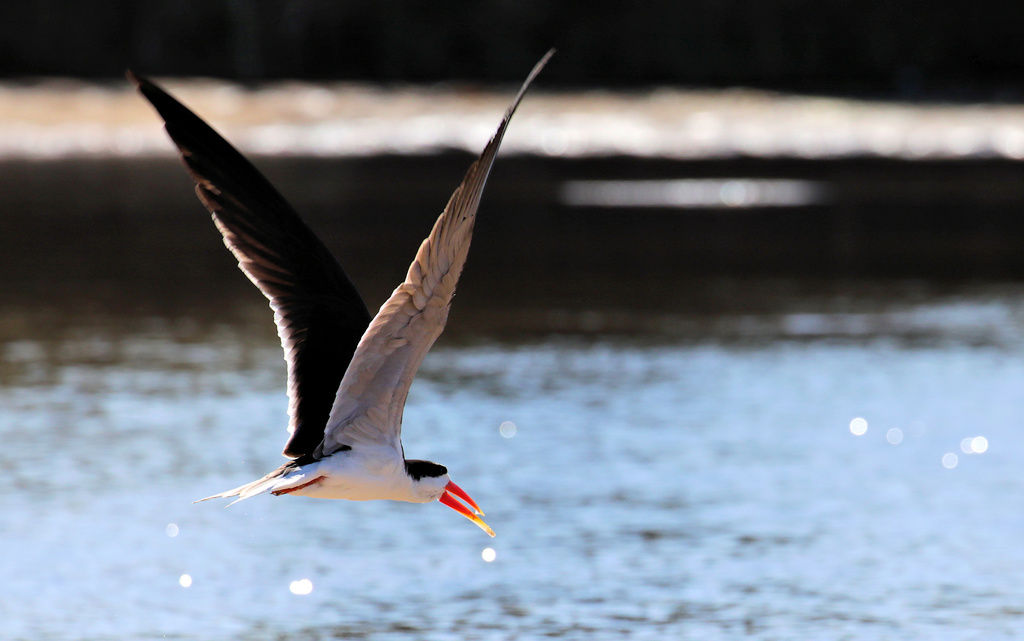
African Skimmer
Photo © Wynand Uys
Photo © Wynand Uys — CC BY 4.0 — Source: iNaturalist photo #49668009Identification
The African skimmer is a striking and unmistakable bird, measuring approximately 38 cm in length. Its plumage is boldly patterned with a black back, hindneck, and crown contrasting sharply against a white forehead and underparts. Most distinctive is its bright orange beak with a yellow tip (black when immature), which gives the species its scientific name flavirostris, meaning "yellow-beak." The short forked tail is white, and the legs are bright red. The bird's most remarkable feature is its unique bill structure: the lower mandible is considerably longer than the upper mandible and flattened sideways like scissor blades, an adaptation perfectly suited to its specialized feeding technique. In flight, skimmers produce a sharp "kip-kip" call.
Range & Habitat
The African skimmer is distributed across Sub-Saharan Africa, with populations ranging from Senegal to the northern Congo River and southern Nile Valley, southern Tanzania to the Zambezi Valley, and south to KwaZulu-Natal Province in South Africa and Angola. This species is generally uncommon throughout its range, with a total population estimated at 15,000–25,000 individuals. African skimmers are dependent on specific waterside habitats: they favour large tropical rivers with sandbanks suitable for nesting and roosting, as well as lake shores and coastal lagoons where they can hunt and breed undisturbed.
Behaviour & Diet
African skimmers have evolved a remarkable hunting technique perfectly adapted to their specialized bill structure. They fly in coordinated lines low over calm water surfaces, dipping their elongated lower mandibles into the water as they travel. When the mandible contacts a fish, the bird snaps its mouth shut with impressive precision. Skimmers feed primarily at dawn and dusk, taking advantage of their exceptional night vision during these low-light periods. Their diet comprises various freshwater fish species including Micralestes, Tilapia, Barbus, Marcusenius, Hepsetus, Aplocheilichthys, and Petrocephalus.
Best Time & Places to See It
African skimmers are partial intra-African migrants with predictable seasonal movements. In southern Africa, they arrive as water levels begin falling at the start of the dry season (April–June), then breed and return northwards after the rains commence (November–January). Your best opportunities to observe them are along large river systems, particularly at sites with extensive sandbanks and calm water conditions. Look for them in the early morning or late afternoon hours when they are most active. Mixed colonies of skimmers and other sandbank-nesting birds such as collared pratincoles, pied avocets, and white-fronted plovers can be particularly rewarding to visit.
Photography Tips
The African skimmer's striking colour contrasts and unique silhouette make it a rewarding photographic subject. Position yourself along riverbanks or lakeshores during dawn or dusk when skimmers are actively feeding—the low-angle hunting behaviour provides excellent photo opportunities with interesting backdrops of water and sky. Use a fast shutter speed to freeze the dynamic flying patterns as they move in coordinated lines. The bird's bold black and white plumage with bright orange-red bill stands out well against natural backgrounds. Patience is essential; visit active feeding sites repeatedly to capture the characteristic water-dipping feeding behaviour that makes this species so distinctive.
Serengeti National Park
Tanzania
+558 birds+57 mammals
Across Tanzania's northern plateau, where volcanic soils meet acacia woodland and open grassland, unfolds one of Earth's most dynamic ecosystems. The Serengeti National Park sprawls across…
VIEW NATIONAL PARKChobe National Park
Botswana
+446 birds+45 mammals
Where the Chobe River cuts a sinuous path through northern Botswana, the landscape transforms into one of Africa's most dynamic wetland-savanna mosaics. This national park encompasses…
VIEW NATIONAL PARKBwindi Impenetrable National Park
Kanyashogi, Uganda
+603 birds+26 mammals
Steep ridges cloaked in montane forest rise from Uganda's southwestern borderlands, where the landscape grows so dense and tangled that early explorers named it impenetrable. At…
VIEW NATIONAL PARKMurchison Falls National Park
Uganda
+608 birds+33 mammals
Where the Victoria Nile compresses through a narrow gorge and explodes across a 45-meter precipice, the landscape speaks in thunder. Murchison Falls National Park sprawls across…
VIEW NATIONAL PARKTsavo West National Park
Mwatate, Kenya
+513 birds+49 mammals
Where volcanic ridges and weathered lava flows meet the semi-arid lowlands of south-central Kenya, Tsavo West National Park unfolds across a landscape sculpted by fire and…
VIEW NATIONAL PARKAmboseli National Park
Etonet/Lenkism ward, Kenya
+501 birds+43 mammals
Where the Amboseli basin opens toward the Tanzanian frontier, a shallow alkaline lake mirrors vast skies across one of East Africa's most iconic savanna landscapes. The…
VIEW NATIONAL PARKNgorongoro Conservation Area
Tanzania
+626 birds+55 mammals
Volcanic calderas and open grassland dominate this high plateau in northern Tanzania, where the landscape rises above 2,000 metres and ancient geological forces have shaped both…
VIEW WILDLIFE MANAGEMENT AREAQueen Elizabeth National Park
Uganda
+672 birds+30 mammals
Across the southwestern escarpment of Uganda, where the Western Rift Valley descends through ancient volcanic terrain, Queen Elizabeth National Park sprawls across more than 8,300 square…
VIEW NATIONAL PARKMabamba Swamp
Memere, Uganda
+464 birds+2 mammals
Across the Central Region of Uganda spreads one of Africa's most biodiverse freshwater wetlands, a sprawling nature reserve of roughly 283 square kilometres where papyrus swamps…
VIEW NATURE RESERVEKruger National Park
Ba-Phalaborwa Local Municipality, South Africa
+540 birds+91 mammals
Across the low-lying savanna of northeastern South Africa unfolds one of Africa's largest and most ecologically intact protected areas, where acacia woodlands merge into mopane scrub…
VIEW NATIONAL PARKNkasa Rupara National Park
Namibia
+283 birds+17 mammals
Where the Zambezi's floodplains spill across the border between Namibia and Botswana, Nkasa Rupara National Park unfolds across 518 square kilometers of wetland and woodland mosaic.…
VIEW NATIONAL PARKBwabwata National Park
Namibia
+377 birds+35 mammals
Where the Kavango River winds through northeastern Namibia, vast floodplains and dense riparian woodland create one of southern Africa's most ecologically dynamic protected landscapes. Spanning 14,249…
VIEW NATIONAL PARKMakgadikgadi Pans National Park
Gucta, Botswana
+272 birds+27 mammals
Where salt-crusted flatlands stretch endlessly toward a shimmering horizon, one of Africa's most extraordinary ecosystems awakens with the rains. The Makgadikgadi Pans comprise vast mineral-rich basins…
VIEW NATIONAL PARKNairobi National Park
Nairobi, Kenya
+515 birds+35 mammals
Just minutes from Kenya's capital, where the Nairobi River winds through acacia woodland and open grassland, lies one of Africa's most paradoxical wildlife sanctuaries. The park's…
VIEW NATIONAL PARKLake Nakuru National Park
Nakuru West, Kenya
+494 birds+32 mammals
Alkaline waters ringed by acacia woodland and grassland create one of East Africa's most distinctive wetland ecosystems, where the interplay of geology and climate sustains a…
VIEW NATIONAL PARKSibiloi National Park
Kenya
+118 birds
Where the northern deserts of Kenya meet the volcanic Chalbi Plain, Sibiloi National Park sprawls across a landscape shaped by millennia of tectonic upheaval and semi-arid…
VIEW NATIONAL PARKArabuko Sokoke Forest Reserve
Kilifi, Kenya
+383 birds+29 mammals
Coastal forest rises from the Indian Ocean plains of Kilifi County, where sandy soils and seasonal rainfall have sculpted a woodland ecosystem unlike anywhere else on…
VIEW NATURE RESERVEWatamu Marine National Park
Dabaso ward, Kenya
+328 birds+12 mammals
Where mangrove channels meet coral gardens and sandy shallows blend into the warm waters of the Indian Ocean, Watamu Marine National Park unfolds across the Kilifi…
VIEW NATIONAL PARKNo community photos yet. Log in to add the first one.
No community observations of this species yet.