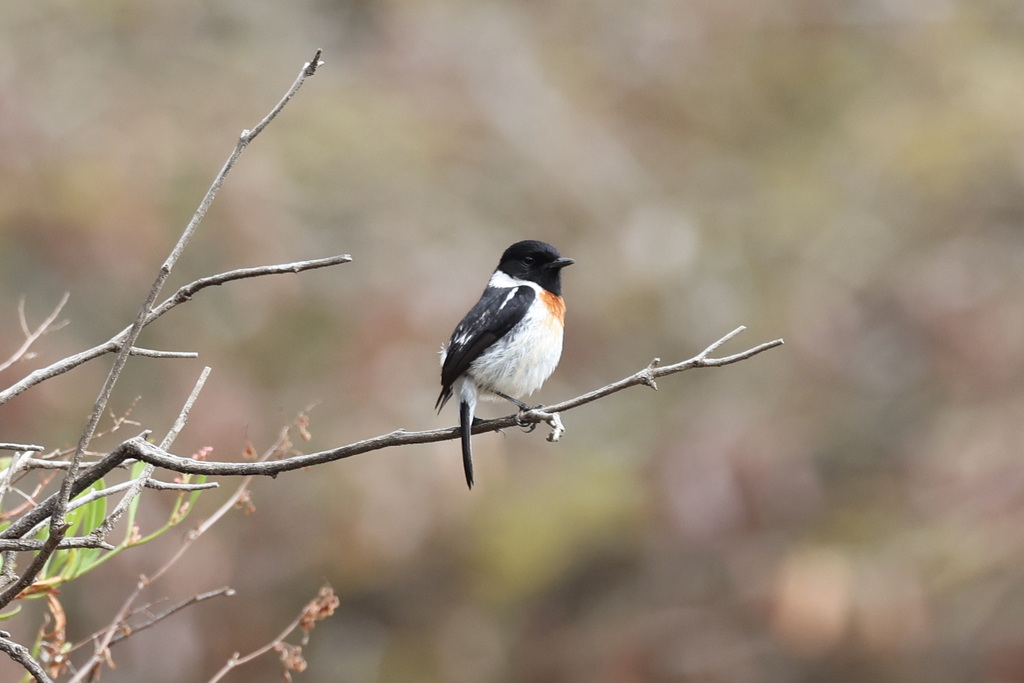
African Stonechat
Photo © Jacky Judas
Photo © Jacky Judas — CC BY 4.0 — Source: iNaturalist photo #478313745Identification
The African stonechat is a striking small flycatcher with strong sexual dimorphism. Males are unmistakable: jet-black head, back, and tail contrasted with a distinctive white half-collar, white rump, and a large white wing patch on the inner wing. The upper breast is typically dark orange-red, transitioning sharply or gradually to white or pale orange below, depending on subspecies. Females are considerably duller, with brown rather than black plumage above, an indistinct pale eyebrow line, chestnut-buff underparts, and reduced white on the wings. Both sexes appear duller and streakier outside the breeding season, and the extent of orange-red on males varies considerably throughout the year, often extending onto the belly in non-breeding months.
Range & Habitat
The African stonechat has a scattered distribution across sub-Saharan Africa, ranging locally as far north as Senegal and Ethiopia. Outlying populations occur in the mountains of southwest Arabia, Madagascar, and Grande Comore. The species is non-migratory, moving only locally if at all. With 16 recognized subspecies showing subtle variations in size and plumage coloration, populations are adapted to their specific regional habitats throughout this broad range.
Behaviour & Diet
As an Old World flycatcher, the African stonechat hunts insects in its typical flycatcher manner, though detailed behavioral and dietary information specific to this species is limited in available sources. Like other members of its family, it likely feeds on small invertebrates caught in flight or gleaned from vegetation, and it is adapted to perch prominently while hunting for prey.
Best Time & Places to See It
Since the African stonechat is non-migratory and maintains year-round territories, it can be encountered throughout the year within its range across sub-Saharan Africa. Specific regional populations are most readily found in their local, preferred habitats. The diversity of 16 subspecies means that individual travelers should research the particular population present in their destination country to understand local plumage variations and seasonal presence.
Photography Tips
The strong contrasts in male plumage—black, white, and orange-red—make them rewarding photographic subjects in good light. Males are more visually distinctive and easier to photograph than females. The species' non-migratory nature means consistent subjects in target locations. Early morning and late afternoon light will enhance the contrast of male plumage. Females and non-breeding birds require careful identification due to their duller, streakier appearance; patience and familiarity with subspecific variations will improve success in documenting the full range of this variable species.
Bwindi Impenetrable National Park
Lake Mburo National Park
Mabamba Swamp
Murchison Falls National Park
Queen Elizabeth National Park
Aberdare National Park
Abijata-Shalla Lakes National Park
Addo Elephant National Park
Agulhas National Park
Nothing matches these filters.
No community photos yet. Log in to add the first one.
No community observations of this species yet.