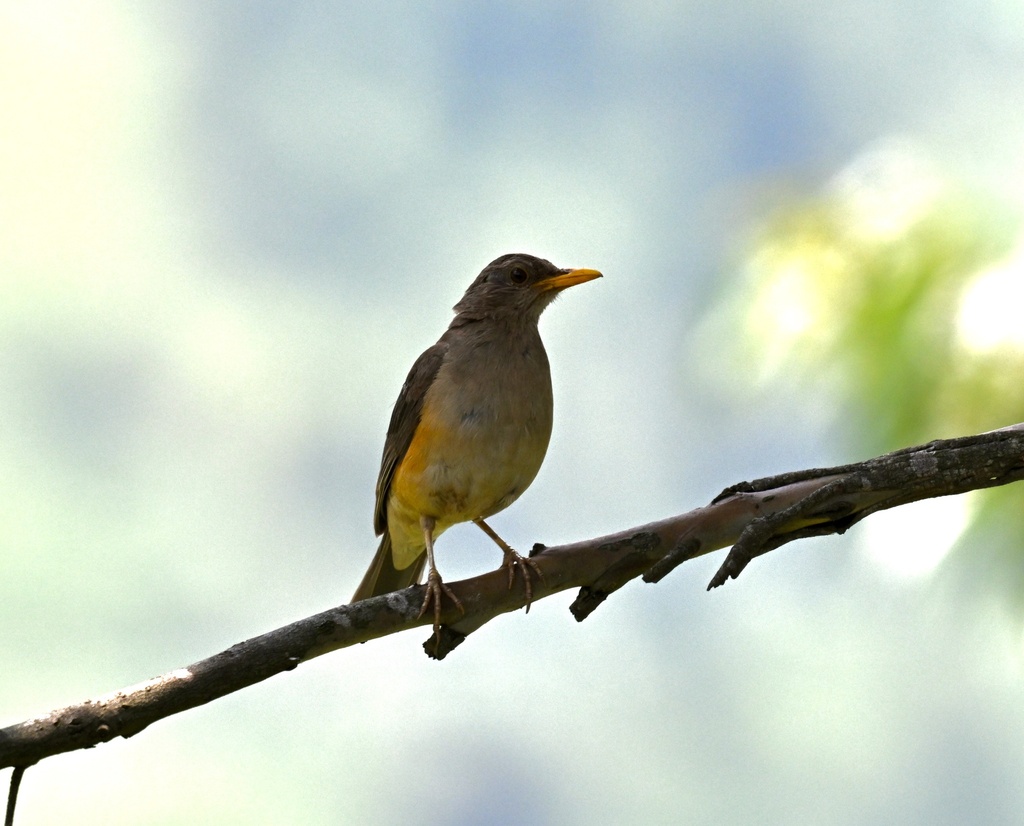
African Thrush
Photo © Lukas Zangl
Photo © Lukas Zangl — CC BY 4.0 — Source: iNaturalist photo #549039965Identification
The African Thrush is a medium-sized passerine measuring 21–23 cm in length and weighing 46–78 g. It is characterized by dark olive-grey upperparts, with underparts showing a whitish throat evenly streaked with brown, a greyish-brown breast, and pale buff-orange flanks that do not extend onto the lower breast. The belly and vent are white, and it displays a distinctive yellow-orange bill. This subtle plumage provides excellent camouflage in woodland settings.
Range & Habitat
The African Thrush is distributed across much of western sub-Saharan Africa, ranging from Senegal and Gambia in the west to South Sudan, Uganda, Ethiopia, and Eritrea, with its range extending south to northwestern Zambia and western Angola. The species is resident and non-migratory throughout its range. It is common in well-wooded habitats including forest edges, riparian woodland, scrub cultivation, parks, and gardens, making it adaptable to various woodland types across its broad African distribution.
Behaviour & Diet
The African Thrush is typically encountered singly or in pairs and is notably shy and retiring, preferring to remain concealed in vegetation. However, it will emerge to gather at fruiting trees. Foraging is primarily crepuscular, with birds methodically working the ground by flicking through leaf litter and searching vegetation. Where undisturbed or habituated to human presence, it feeds openly in the manner of the European Song Thrush and similarly cracks open snails on anvil stones. Fruit forms the bulk of its diet, particularly nim (Azadarichta indica), figs, papaya, berries, and seeds, supplemented by invertebrates and occasional small fish.
Breeding occurs throughout the year with peaks during wet seasons: March to September or October in West Africa, April–July in Ethiopia, and November to March elsewhere in its range. The female constructs a bulky, cup-shaped nest using plant fibres and mud, lined with fine grasses, leaves, and roots, typically positioned below 10 m on horizontal branches, tree forks, or among vines. The species may reuse abandoned nests of other birds. The normal clutch of 2–3 eggs is incubated by the female, while both sexes feed the young. The species is double-brooded.
Best Time & Places to See It
The African Thrush is best located during its crepuscular foraging periods, particularly around dawn and dusk. Fruiting trees, especially those bearing nim fruit or figs, attract birds and provide reliable viewing opportunities. Its shy nature means observers should move quietly and allow time for the bird to emerge from cover. During breeding season peaks—the wet months particular to each region—activity levels increase and birds are more likely to be encountered in open areas. Parks and gardens with mature trees offer accessible viewing points in many parts of its range.
Photography Tips
Photographing the African Thrush requires patience and a keen eye for subtle movements. Its preference for cover and retiring behavior demand a stationary approach; position yourself near fruiting trees during crepuscular hours and wait for birds to emerge. Use a telephoto lens to maintain distance and avoid disturbance, as habituation to your presence increases the likelihood of open feeding. The bird's olive-grey and buff tones blend seamlessly with woodland foliage, so watch for movement rather than relying on bright plumage. Overcast conditions or soft early-morning light will render the subtle coloration more clearly than harsh midday sun.
Bwindi Impenetrable National Park
Lake Mburo National Park
Mabamba Swamp
Murchison Falls National Park
Queen Elizabeth National Park
Aberdare National Park
Abijata-Shalla Lakes National Park
Awash National Park
Bale Mountains National Park
Nothing matches these filters.
No community photos yet. Log in to add the first one.
No community observations of this species yet.