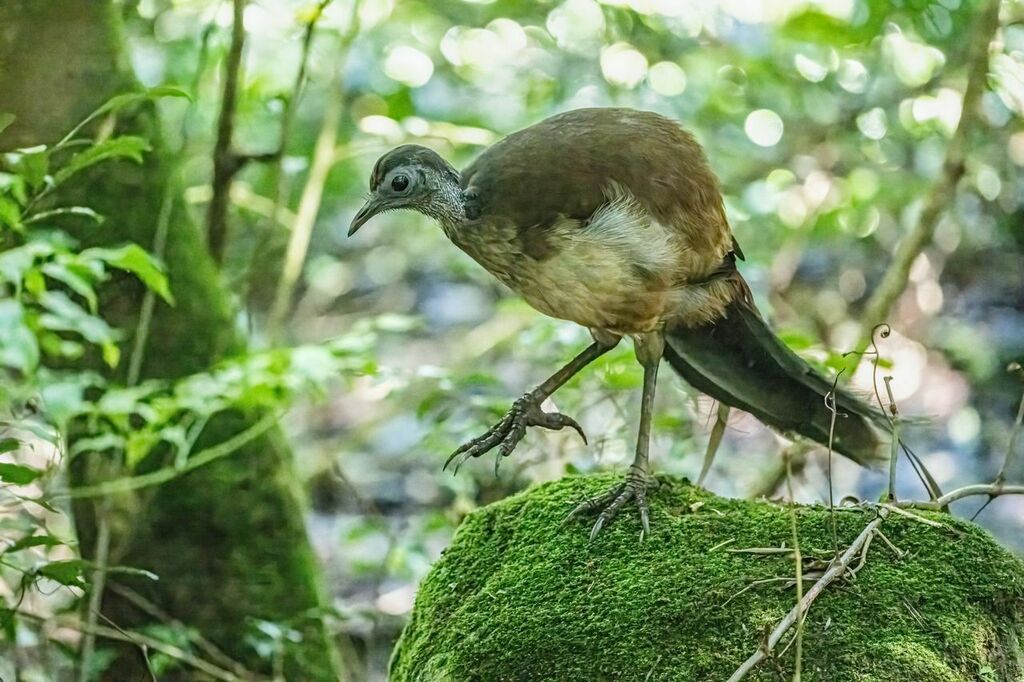
Albert’s Lyrebird
Photo © Alan Bell
Photo © Alan Bell — CC BY 4.0 — Source: iNaturalist photo #375595614Albert's lyrebird (Menura alberti), sometimes known as the northern lyrebird, is a timid, pheasant-sized songbird which is endemic to subtropical rainforests of Australia, in a small area on the state border between New South Wales and Queensland. The rarer of the two species of lyrebirds, Albert's lyrebird is named after Prince Albert, the prince consort of Queen Victoria, queen of the United Kingdom. It lacks the elegant lyre-shaped tail feathers of the superb lyrebird and is found in a much more restricted range. The total population of Albert's lyrebirds was estimated at only 3,500 breeding birds in 2000, with one of the smallest distributional ranges of any bird on the continent. == Naming == Due to its remote habitat, Menura alberti had not been discovered when famous English ornithologist John Gould first published his Birds of Australia in 1848, although he named it (after Prince Albert) and added it in a supplement in 1850. Under taxonomic convention, he would normally have been assigned the credit for describing the species and assigning its scientific name. However, the credit as scientific describer instead went to French naturalist Charles Lucien Bonaparte, nephew of Napoleon, who made reference to Gould's description of the new…
Springbrook National Park
Australia
+195 birds+25 mammals
Subtropical rainforest meets open eucalypt woodland across a mountainous terrain where the McPherson Range rises sharply from the Queensland coast, creating a patchwork of microclimates and…
VIEW NATIONAL PARKLamington National Park
Australia
+227 birds+24 mammals
Where subtropical rainforest rises steeply from the Queensland coast, Lamington National Park spreads across 541 square kilometres of one of Australia's most biodiverse mountain landscapes. The…
VIEW NATIONAL PARKNo community photos yet. Log in to add the first one.
No community observations of this species yet.