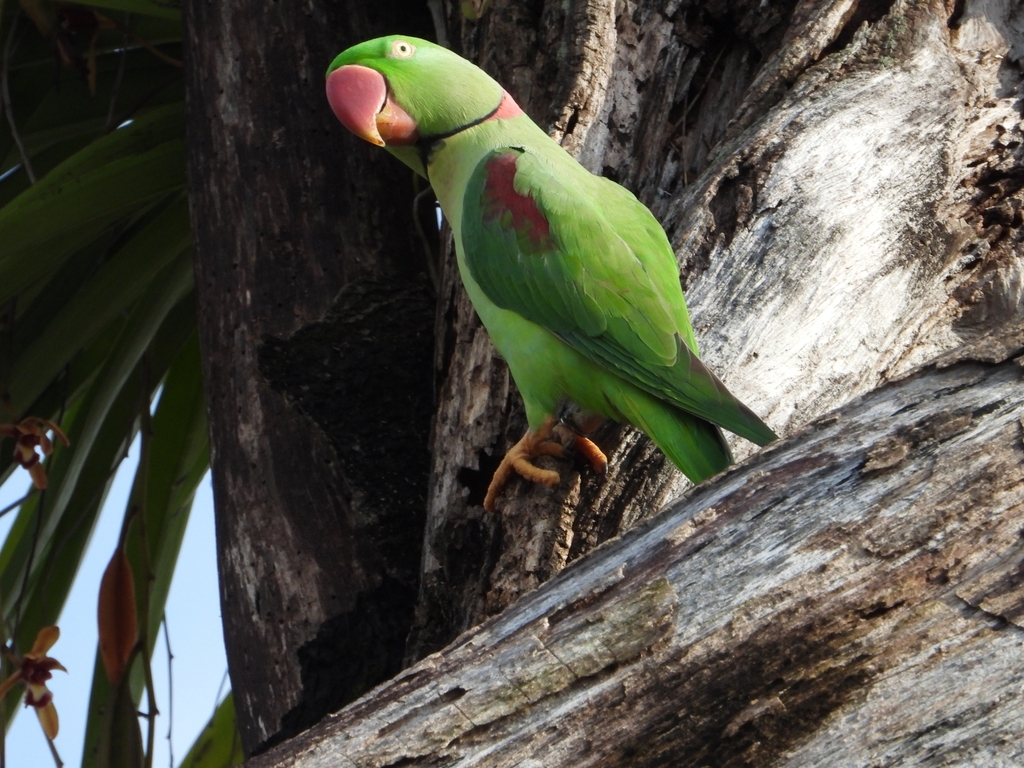
Alexandrine Parakeet
Photo © 許慶棠Ray
Photo © 許慶棠Ray — CC BY 4.0 — Source: iNaturalist photo #444550237Identification
The Alexandrine Parakeet is one of the largest parakeets, measuring 56 to 62 cm from head to tail tip and weighing 200 to 300 grams. Its predominantly green plumage is immediately distinctive: look for a light blue-grey sheen on the cheeks and nape, a yellow-green abdomen, and most striking of all, a prominent red patch on the shoulders paired with a massive red beak tipped with yellow. The tail transitions from green at the base through blue to yellow at the tip, with a yellow underside.
Sexual dimorphism is pronounced in adults. Males display a bold black stripe across their lower cheeks and a pink band on the nape, features completely absent in females. Juveniles resemble females but have noticeably shorter tails, making age determination straightforward for field observers.
Range & Habitat
Native to South Asia and Southeast Asia, the Alexandrine Parakeet inhabits forests, woodlands, agricultural lands and mangrove forests at elevations up to 900 metres. The species has established feral populations across a surprising geographic range, from Turkey and the Middle East (Iraq, Kuwait, Saudi Arabia, Bahrain, Qatar, the UAE and Iran) through to western Europe (Germany, The Netherlands and Belgium), where it coexists with populations of its close relative, the rose-ringed parakeet.
Sadly, the species is experiencing steep population declines across much of its native range. It is sporadic in South India, uncommon in Bangladesh, and declining in North Bengal and parts of Sri Lanka. The greatest declines have occurred in Pakistan's Sindh and Punjab provinces, and across Cambodia, Laos and Thailand.
Behaviour & Diet
Alexandrine Parakeets are highly vocal birds with a repertoire far deeper and harsher than their rose-ringed cousins. Listen for a ringing trrrieuw call, loud kree-aar or keeak notes, deep klak-klak-klak sequences, and resonant gr-aak sounds. When alarmed, their voices become even harsher, and they shriek loudly while mobbing predators. Flocks occasionally vocalize together in exciting cacophonies.
These birds eat a variety of wild and cultivated seeds, buds, fruits and nuts. They typically live in small flocks but gather in larger groups where food is abundant or at communal roosts. Agricultural areas are particularly attractive to them—flocks can cause extensive damage to ripening fruits and grain crops like maize and jowar. Breeding occurs from November to April in their native range, with females laying 2 to 4 white eggs in tree hollows or building crevices. Chicks fledge at about seven weeks and remain dependent on parents for a further 3 to 4 months.
Best Time & Places to See It
The breeding season from November to April offers prime viewing opportunities in native South and Southeast Asian ranges, when pairs are actively nesting and feeding. Look in forest edges, woodlands and agricultural areas, particularly where fruiting trees attract feeding flocks. Early morning and late afternoon typically offer the best activity levels and lighting for observation.
Travellers should be aware that wild populations are declining across most of the native range due to habitat loss and trapping for the illegal pet trade. The species is now uncommon or sporadic across much of South Asia, though it remains more reliable in certain protected forest areas. In introduced ranges across the Middle East and Europe, established feral populations offer alternative viewing opportunities in unexpected locations.
Photography Tips
The Alexandrine's bold colouration makes it visually striking in photographs. The red beak, shoulder patch and nape band of males provide excellent colour contrast against the predominantly green plumage. Frame your shots to capture the distinctive head profile and the colour gradient of the tail, which shifts from green through blue to yellow—a unique field mark among parakeets. The blue-grey cheek patch is particularly diagnostic and photographs well in good light.
Flock behaviour offers dynamic shooting opportunities; capture birds in flight, perched together on fruiting trees, or vocalizing with bills open. Early morning light emphasises the subtle plumage tones, while afternoon photography can highlight the red and yellow markings. Remember that males and females differ significantly in head markings—try to document both sexes to capture the full range of field identification features.
Lunugamvehera National Park
Sri Lanka
+204 birds+14 mammals
Dry scrubland and shallow wetlands converge in Sri Lanka's southeastern lowlands, where Lunugamvehera National Park anchors one of the island's most ecologically vital landscapes. The park's…
VIEW NATIONAL PARKMinneriya National Park
Sri Lanka
+158 birds+9 mammals
Across the dry zone of Sri Lanka's North Central Province spreads a landscape of shallow tanks, grassland margins, and scattered dry forest—a mosaic of water and…
VIEW NATIONAL PARKWasgamuwa National Park
Sri Lanka
+156 birds+8 mammals
Dry deciduous forest and open grassland sweep across the North Central lowlands where Wasgamuwa National Park protects one of Sri Lanka's largest remaining tracts of this…
VIEW NATIONAL PARKMaduru Oya National Park
Sri Lanka
+74 birds+1 mammals
Granite ridges rise abruptly from the humid lowlands of Sri Lanka's Uva Province, their weathered slopes clothed in dry monsoon forest and scattered woodland where deciduous…
VIEW NATIONAL PARKOrang National Park
Rangagarapathar, India
+298 birds+1 mammals
Where the Brahmaputra's floodplains meet the foothills of Assam, Orang National Park unfolds across a mosaic of riverine grasslands, forests and wetlands that pulse with the…
VIEW NATIONAL PARKKhao Yai National Park
Prachantakham District, Thailand
+377 birds+46 mammals
Evergreen dipterocarp forest blankets the rolling terrain of this national park in eastern Thailand, where limestone hills rise abruptly from the forest floor and seasonal streams…
VIEW NATIONAL PARKBribie Island National Park
Brisbane, Australia
+284 birds+20 mammals
Across tidal flats and shallow waterways north of Brisbane, Bribie Island National Park spreads across nearly four hundred square kilometres of subtropical coastal wilderness—a patchwork of…
VIEW NATIONAL PARKKanha Tiger Reserve
Kanha Kisli F.V., India
+321 birds+23 mammals
Where sal forests give way to emerald meadows and crystalline streams carve through ancient valleys, one of India's finest wilderness reserves unfolds across the Maikal Range.…
VIEW NATIONAL PARKTadoba National Park
Palasgaon Singru, India
+270 birds+20 mammals
Where sal forests meet open grasslands and rocky outcrops rise from red laterite soil, central India's landscape unfolds in raw, untamed beauty. Ancient teak woodlands and…
VIEW NATIONAL PARKBandhavgarh National Park
Garhpuri, India
+285 birds+17 mammals
Where granite ridges rise dramatically above sal and bamboo forests, one of India's most pristine tiger reserves unfolds across the Vindhyan plateau. Ancient rock formations tower…
VIEW NATIONAL PARKPanna National Park
Badgadi Kalan, India
+271 birds+17 mammals
Where granite gorges slice through central India's Vindhyan plateau, a landscape of stark beauty unfolds across nearly six hundred square kilometers. The Ken River carves through…
VIEW NATIONAL PARKKaziranga National Park
Kohora, India
+422 birds+26 mammals
Dawn breaks over the floodplains of the Brahmaputra, where tall grasslands stretch endlessly beneath monsoon-heavy skies. This sprawling wilderness of northeastern Assam is a mosaic of…
VIEW NATIONAL PARKKeoladeo National Park
Shreenagar Rural, India
+326 birds+14 mammals
Where shallow wetlands shimmer beneath vast Rajasthani skies, one of Asia's finest bird sanctuaries pulses with extraordinary life. This former maharaja's hunting reserve, now spanning 29…
VIEW NATIONAL PARKBandipur National Park
Hirehalli, India
+302 birds+19 mammals
Where the Western Ghats descend into the Deccan plateau, ancient deciduous forests blanket a landscape carved by the Nugu River. Bandipur unfolds across 880 square kilometres…
VIEW NATIONAL PARKNagarahole Tiger Reserve
Nalkeri Forest, India
+323 birds+23 mammals
Where granite escarpments rise above dense deciduous forests and the Kabini River carves through pristine wilderness, one of India's most biodiverse landscapes unfolds across the Western…
VIEW NATIONAL PARKGaoligong Mountain National Nature Reserve
Nujiang Lisu Autonomous Prefecture, China
+443 birds+13 mammals
VIEW NATURE RESERVENo community photos yet. Log in to add the first one.
No community observations of this species yet.