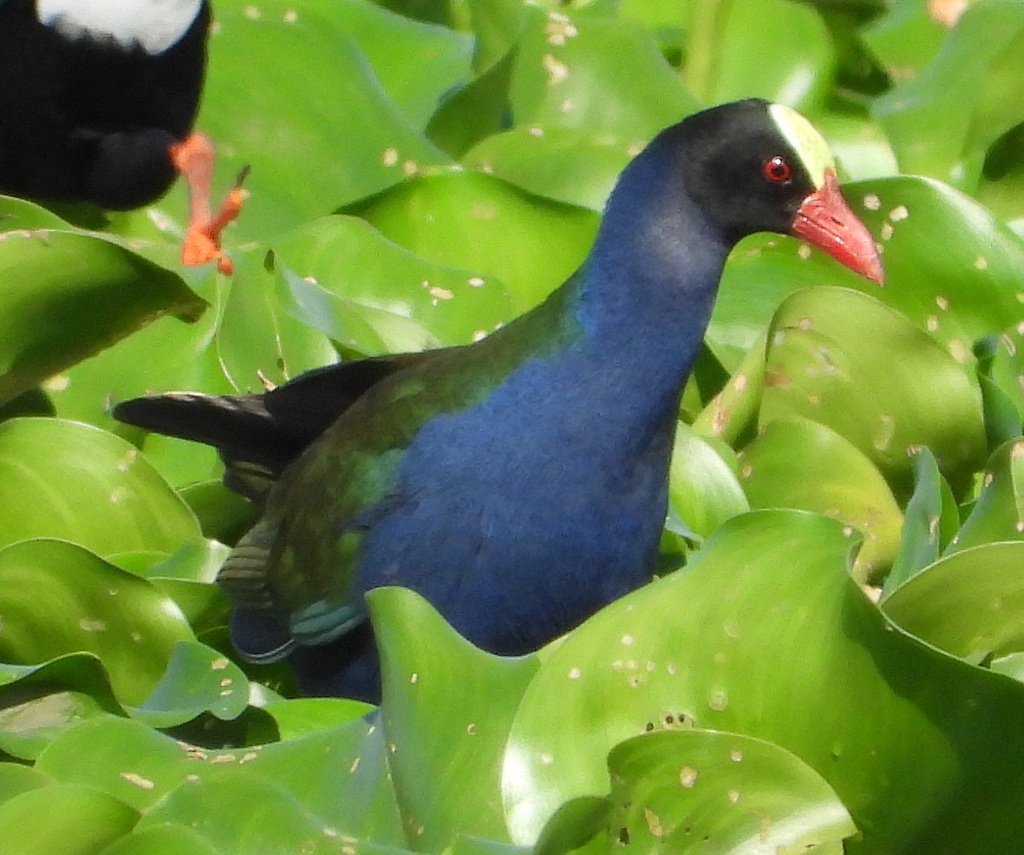
Allen’s Gallinule
Photo © Timothy Whitehead
Photo © Timothy Whitehead — CC BY 4.0 — Source: iNaturalist photo #456646528Identification
Allen's gallinule is a small waterbird with distinctive plumage that makes it recognizable once spotted. The species has a short red bill, greenish back, and striking purple upperparts. Most notably, breeding males display a bright blue frontal shield on the forehead, while females have a green shield instead. Both sexes have red legs with characteristically long toes and a short tail that is white underneath with a dark central bar. When swimming, these birds have a distinctive nodding head motion. Immature birds present a very different appearance, showing sandy brown plumage with buff undertail coverts, which can make them challenging to identify. Downy chicks are black, typical of all rail species. In size, Allen's gallinule is comparable to a water rail, making it a relatively compact waterbird.
Range & Habitat
Allen's gallinule is found across Sub-Saharan Africa, where its breeding habitat consists of marshes and lakes. Remarkably, this apparently weakly flying bird has proven capable of making extraordinary journeys, becoming the only sub-Saharan African species of its family to have reached Great Britain—and notably, it has done so twice. The species has also been recorded as a vagrant in several other European countries, testament to its unexpected migratory capabilities despite its seemingly limited flight abilities.
Behaviour & Diet
Allen's gallinules are notably secretive birds, particularly during the breeding season when they inhabit dense swamps. Their elusive nature means they are often heard rather than seen, as they are rather noisy birds with a distinctive sharp nasal "pruk" call. The species is partially migratory, undertaking seasonal movements that can make them more visible during migration periods or when wintering in areas outside their breeding range. They build floating nests in marshes and swamps, where females lay between 2 and 5 eggs per breeding attempt.
When feeding, Allen's gallinules probe with their bills in mud and shallow water, and also pick up food by sight. Their diet consists mainly of insects and various aquatic animals, which they forage for in their wetland habitats.
Best Time & Places to See It
The best opportunities for observing Allen's gallinule occur during migration and winter periods, when the birds are generally easier to see than during the breeding season. During breeding, their secretive behaviour and preference for dense swamp vegetation make sightings difficult, though their distinctive calls may betray their presence. Sub-Saharan African marshes and lakes are the primary locations to search for this species in its natural range.
Photography Tips
Photographing Allen's gallinule requires patience, particularly during the breeding season. Focus your efforts on migration periods and wintering grounds, when birds are more likely to venture into open water. Look for the species in shallow marshes and along lake margins where they forage. The red bill, colourful head shield, and red legs provide excellent identifying features for the camera. The bird's characteristic head-nodding motion while swimming can make for engaging sequences if you have video capability.
Serengeti National Park
Tanzania
+558 birds+57 mammals
Across Tanzania's northern plateau, where volcanic soils meet acacia woodland and open grassland, unfolds one of Earth's most dynamic ecosystems. The Serengeti National Park sprawls across…
VIEW NATIONAL PARKArusha National Park
Tanzania
+555 birds+16 mammals
Where the slopes of Mount Mawenzi rise above the Arusha region, a compact yet ecologically rich national park unfolds across montane forest, moorland, and alpine zones.…
VIEW NATIONAL PARKMapungubwe National Park
Musina Local Municipality, South Africa
+358 birds+29 mammals
Where the Limpopo River cuts through sandstone ridges at the convergence of South Africa, Botswana, and Zimbabwe, Mapungubwe National Park preserves a landscape of profound ecological…
VIEW NATIONAL PARKChobe National Park
Botswana
+446 birds+45 mammals
Where the Chobe River cuts a sinuous path through northern Botswana, the landscape transforms into one of Africa's most dynamic wetland-savanna mosaics. This national park encompasses…
VIEW NATIONAL PARKKidepo Valley National Park
Uganda
+478 birds+24 mammals
Where the Narus and Kidepo rivers carve through northeastern Uganda's semi-arid lowlands, a landscape of sparse acacia woodland, grassland, and riverine thickets creates one of East…
VIEW NATIONAL PARKMurchison Falls National Park
Uganda
+608 birds+33 mammals
Where the Victoria Nile compresses through a narrow gorge and explodes across a 45-meter precipice, the landscape speaks in thunder. Murchison Falls National Park sprawls across…
VIEW NATIONAL PARKAmboseli National Park
Etonet/Lenkism ward, Kenya
+501 birds+43 mammals
Where the Amboseli basin opens toward the Tanzanian frontier, a shallow alkaline lake mirrors vast skies across one of East Africa's most iconic savanna landscapes. The…
VIEW NATIONAL PARKTarangire National Park
Tanzania
+527 birds+50 mammals
Acacia woodland and grassland sweep across the Manyara Region where the Tarangire River carves through low hills and volcanic soils, creating one of East Africa's most…
VIEW NATIONAL PARKNgorongoro Conservation Area
Tanzania
+626 birds+55 mammals
Volcanic calderas and open grassland dominate this high plateau in northern Tanzania, where the landscape rises above 2,000 metres and ancient geological forces have shaped both…
VIEW WILDLIFE MANAGEMENT AREAQueen Elizabeth National Park
Uganda
+672 birds+30 mammals
Across the southwestern escarpment of Uganda, where the Western Rift Valley descends through ancient volcanic terrain, Queen Elizabeth National Park sprawls across more than 8,300 square…
VIEW NATIONAL PARKMabamba Swamp
Memere, Uganda
+464 birds+2 mammals
Across the Central Region of Uganda spreads one of Africa's most biodiverse freshwater wetlands, a sprawling nature reserve of roughly 283 square kilometres where papyrus swamps…
VIEW NATURE RESERVEGarden Route National Park
George, South Africa
+353 birds+54 mammals
Sweeping across the Western Cape's coastal and mountainous terrain, this sprawling national park encompasses over five thousand square kilometers of extraordinarily diverse landscape—from coastal limestone cliffs…
VIEW NATIONAL PARKKruger National Park
Ba-Phalaborwa Local Municipality, South Africa
+540 birds+91 mammals
Across the low-lying savanna of northeastern South Africa unfolds one of Africa's largest and most ecologically intact protected areas, where acacia woodlands merge into mopane scrub…
VIEW NATIONAL PARKEspacio Natural Remolar-Filipinas
El Prat del Llobregat, Spain
+297 birds+7 mammals
Where the Llobregat River delta meets the Mediterranean, a patchwork of salt marshes, reed beds, and shallow lagoons creates one of Catalonia's most dynamic wetland ecosystems.…
VIEW NATURE RESERVENkasa Rupara National Park
Namibia
+283 birds+17 mammals
Where the Zambezi's floodplains spill across the border between Namibia and Botswana, Nkasa Rupara National Park unfolds across 518 square kilometers of wetland and woodland mosaic.…
VIEW NATIONAL PARKBwabwata National Park
Namibia
+377 birds+35 mammals
Where the Kavango River winds through northeastern Namibia, vast floodplains and dense riparian woodland create one of southern Africa's most ecologically dynamic protected landscapes. Spanning 14,249…
VIEW NATIONAL PARKEtosha National Park
Namibia
+356 birds+58 mammals
Across northern Namibia's stark semi-arid plateau, a vast shallow depression transforms seasonally into one of Africa's most dramatic wildlife theaters. Etosha National Park, encompassing more than…
VIEW NATIONAL PARKAbijata-Shalla Lakes National Park
Ethiopia
+438 birds+7 mammals
Two crater lakes of contrasting chemistry define this remote corner of Ethiopia's Rift Valley, where soda lakes and freshwater basins create a mosaic of distinct aquatic…
VIEW NATIONAL PARKSamburu National Reserve
Samburu, Kenya
+430 birds+42 mammals
Across the arid plains of northern Kenya, where scattered acacia woodland gives way to rocky outcrops and dry riverbeds, Samburu National Park unfolds as one of…
VIEW NATURE RESERVEArabuko Sokoke Forest Reserve
Kilifi, Kenya
+383 birds+29 mammals
Coastal forest rises from the Indian Ocean plains of Kilifi County, where sandy soils and seasonal rainfall have sculpted a woodland ecosystem unlike anywhere else on…
VIEW NATURE RESERVENo community photos yet. Log in to add the first one.
No community observations of this species yet.