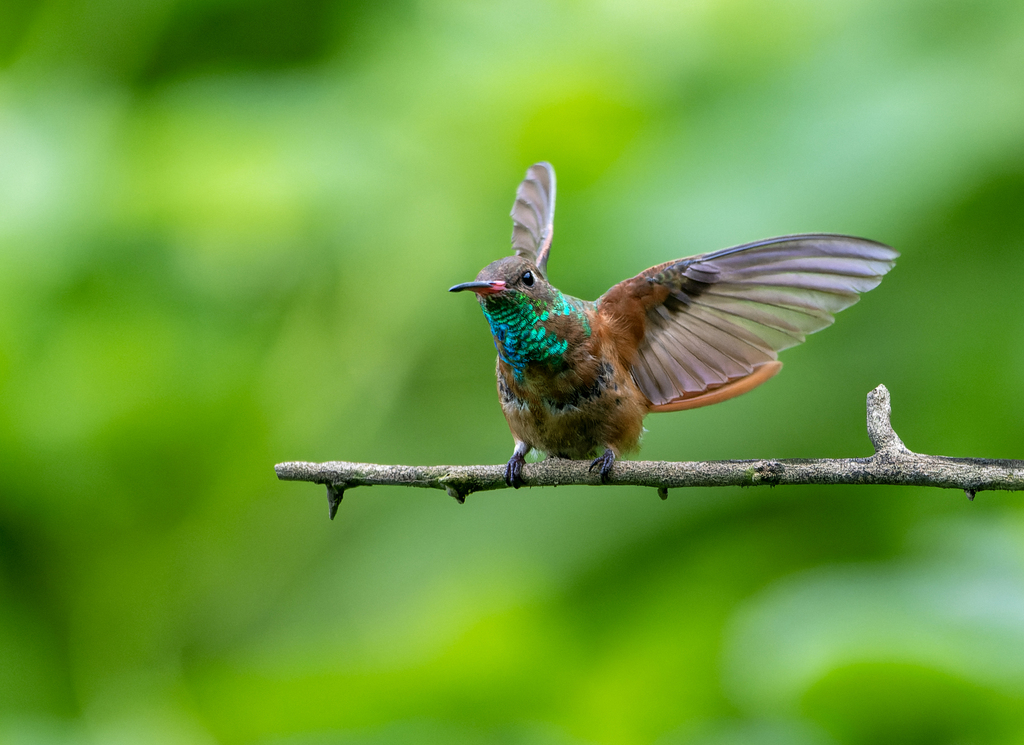
Amazilia Hummingbird
Photo © David F. Belmonte
Photo © David F. Belmonte — CC BY 4.0 — Source: iNaturalist photo #553539338The amazilia hummingbird (Amazilis amazilia) is a hummingbird in the "emeralds", tribe Trochilini of subfamily Trochilinae. It is the only species placed in the genus Amazilis. It is found in Ecuador and Peru. Its six subspecies differ primarily in their throat and belly colors. == Taxonomy == An illustration of the amazilia hummingbird together with the binomial name Orthorynchus amazilia was published in 1827 by the French naturalist René Lesson. In the following year he published a description. The specific epithet is from the name of the Inca heroine in Jean-François Marmontel's novel Les Incas, ou la destruction de l'Empire du Pérou. The amazilia hummingbird was formerly placed in the genus Amazilia. A molecular phylogenetic study published in 2014 found that the genus was polyphyletic. In the revised classification to create monophyletic genera, the amazilia hummingbird was moved by most taxonomic authorities to the resurrected genus Amazilis that had been introduced in 1855 by George Gray. However, BirdLife International's Handbook of the Birds of the World retains it in Amazilia. There are six generally recognized subspecies: A. a. alticola (Gould, 1860) – south Ecuador A. a. azuay (Krabbe & Ridgely, 2010) – southwest Ecuador A. a. dumerilii (Lesson, RP, 1832)…
Cerros de Amotape National Park
District of San Jacinto, Ecuador
+246 birds+1 mammals
Arid mountains rise abruptly from Peru's northwestern frontier, their slopes clothed in xerophytic scrubland and seasonal deciduous forest that transforms these Andean foothills into one of…
VIEW NATIONAL PARKPodocarpus National Park
Zamora, Ecuador
+496 birds+6 mammals
Where the Andes descend toward the Amazon basin, Podocarpus National Park sprawls across nearly 2,800 square kilometres of the most biodiverse terrain in Ecuador's southern highlands.…
VIEW NATIONAL PARKNo community photos yet. Log in to add the first one.
No community observations of this species yet.