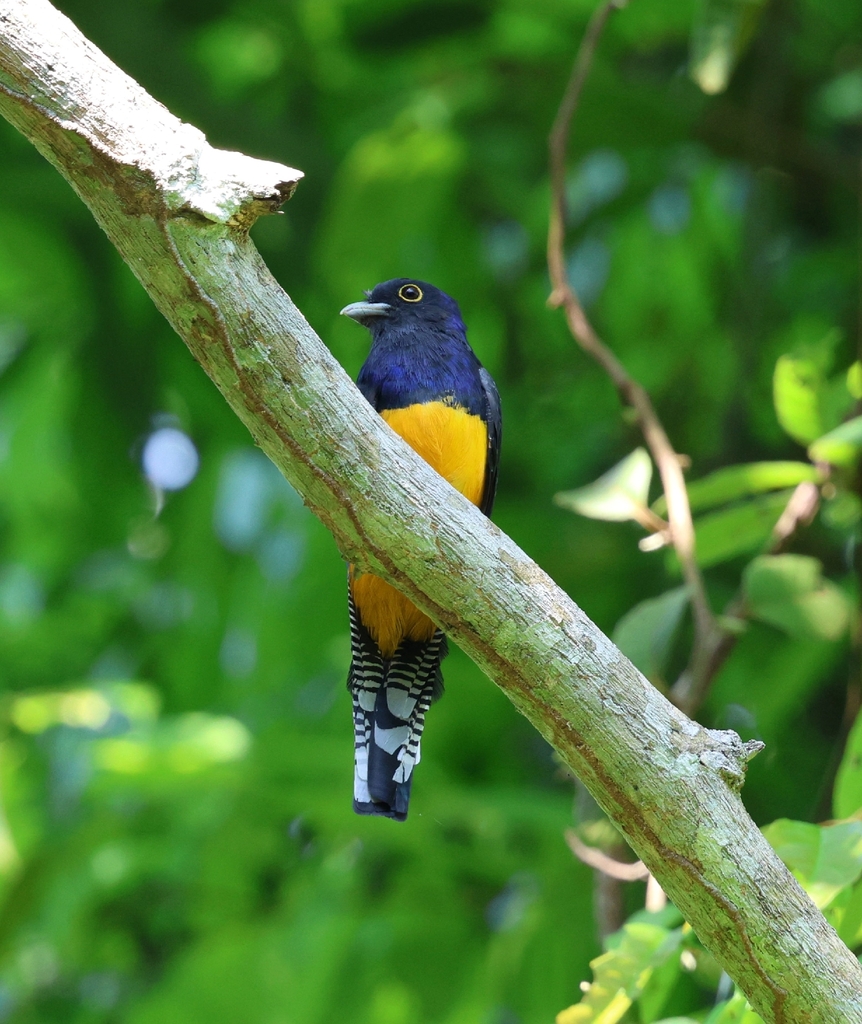
Amazonian Trogon
Photo © Miguel
Photo © Miguel — CC BY-SA 4.0 — Source: iNaturalist photo #584303016Identification
The Amazonian trogon is a small, colorful bird measuring 23 to 25 centimetres in length, with the soft, distinctive plumage characteristic of trogons. Males are striking: their head, neck, and upper breast are deep metallic blue-black, with little contrast between the face and throat. A narrow white band cleanly separates the upper breast from the bright yellow lower breast and belly. The upperparts are metallic green to blue-green, while the tail's upper surface is deep blue with black feather tips; underneath, the tail displays fine black and white barring with broad white tips. The wings are mostly black with some whitish markings.
Females are considerably duller, with dark gray head, face, upper breast, and upperparts, paired with a duller yellow belly. The tail pattern on females differs from males, though follows similar black-and-white barring. The two recognized subspecies are so similar that their plumages differ only minimally, with variations between individuals sometimes exceeding differences between subspecies.
Range & Habitat
The Amazonian trogon inhabits a wide range across the Amazon basin, found in Bolivia, Brazil, Colombia, Ecuador, Peru, and Venezuela. Its distribution extends from the Andean foothills of Colombia, Ecuador, Peru, and Bolivia slightly north into western Venezuela, then eastward across the western and southern Amazon basin of Brazil. The subspecies T. r. crissalis occupies areas generally south of the Amazon River and east of the Tapajós River, though exact range delimitations remain obscure.
This species shows remarkable habitat flexibility, occupying transitional and terra firme forest, palm and bamboo forest, and permanently flooded igapó forest. The Amazonian trogon is typically found below 500 metres elevation but extends to as high as 1,000 metres in Ecuador, making it accessible across diverse lowland and foothill landscapes throughout its range.
Behaviour & Diet
The Amazonian trogon's feeding ecology remains incompletely studied, though it is presumed to follow the hunting strategy of related "violaceous" trogons: sallying from a perch to snatch insects and fruit from vegetation, occasionally hovering to reach food items. The species also supplements its diet with small vertebrates, particularly frogs, demonstrating the dietary flexibility typical of trogons.
Breeding biology is poorly documented, with almost nothing known of its phenology. A single described nest was excavated from an active arboreal termite nest and contained two eggs. The species is vocal, producing "a relatively short, fairly rapid series of clipped cow notes, or 'mewing whistles'" as its song, along with various rolling chatters for communication.
Best Time & Places to See It
The Amazonian trogon is considered fairly common to common throughout portions of its extensive range, making it a realistic sighting for travellers exploring Amazonian forests. Its presence across multiple countries—from Venezuelan lowlands through Colombian and Ecuadorian foothills to the vast Brazilian Amazon and into Peru and Bolivia—means opportunities exist across numerous protected areas and reserves throughout the western and southern Amazon basin.
While no specific seasonal peaks are documented, the species' presence in both terra firme and flooded forests suggests year-round residency in much of its range. Observers should listen for its distinctive vocalizations and watch for movement in mid-storey canopy zones where the bird typically forages, particularly in areas with mixed forest composition.
Photography Tips
The Amazonian trogon's striking male plumage—particularly the deep metallic blue-black head contrasting with bright yellow underparts—offers excellent photographic opportunity. Early morning light best reveals the iridescent qualities of the male's green and blue upperparts and the metallic sheen of the head. Position yourself to capture the distinctive white breast band, a key identifying feature.
Since the species hunts by sallying from relatively exposed perches, patience at promising vantage points may reward photographers. The bird's small size (around 45 grams) and preference for mid-storey foraging require a telephoto lens. Females, being duller and more cryptic, demand extra vigilance but offer opportunity to document plumage differences. Recording the bird's characteristic vocalizations alongside images provides valuable documentation for this incompletely studied species.
Yasuní National Park
Aguarico, Ecuador
+601 birds+43 mammals
Where the western Amazon basin converges with Ecuador's Orellana Province, lowland rainforest reaches toward the horizon in an unbroken canopy of staggering botanical density. Yasuní National…
VIEW NATIONAL PARKNatural Sierra de Chiribiquete National Park
Solano, Colombia
+359 birds+27 mammals
Massive table-top mountains rise abruptly from the lowland rainforest of southeastern Colombia, their sheer sandstone cliffs and isolated summits creating some of the most dramatic topography…
VIEW NATIONAL PARKNatural Sierra de la Macarena National Park
Vista Hermosa, Colombia
+566 birds+15 mammals
Across nearly 20,000 square kilometres of Colombia's Meta Department, the terrain rises from lowland savanna into Andean foothills through a mosaic of gallery forests, palm-fringed wetlands,…
VIEW NATIONAL PARKAmacayacu National Park
Leticia, Colombia
+567 birds+25 mammals
Where the Rio Amazonas curves through the tri-border region where Colombia, Peru, and Brazil converge, Amacayacu National Park sprawls across more than 5,250 square kilometres of…
VIEW NATIONAL PARKSerra do Pardo National Park
Brazil
+153 birds
Vast upland forests and weathered plateaus define this 7,129-square-kilometre protected expanse in the heart of Pará's remote interior, where ancient bedrock and swollen rivers have carved…
VIEW NATIONAL PARKAmazônia National Park
Brazil
+439 birds+6 mammals
Where the Rio Amazonas and its tributaries weave through the heart of Pará state, a vast tapestry of rainforest stretches across 23,611 square kilometers of unbroken…
VIEW NATIONAL PARKMapinguari National Park
Brazil
+354 birds
Vast tracts of western Amazonian rainforest blanket the remote terrain of this 56,827 square kilometre national park in Amazonas state, where seasonal rivers wind through dense…
VIEW NATIONAL PARKJaú National Park
Brazil
+354 birds+3 mammals
Vast floodplain forests and blackwater rivers define this remote corner of western Amazonas, where the Rio Negro and its tributaries have carved an intricate mosaic of…
VIEW NATIONAL PARKPacaás Novos National Park
Brazil
+279 birds+1 mammals
Across the border between Rondônia and Amazonas, vast tracts of humid tropical forest rise and fall in gentle undulations, carved by clear-flowing rivers that feed into…
VIEW NATIONAL PARKAnavilhanas National Park
Brazil
+468 birds+8 mammals
Across the Rio Negro in central Amazonas, an archipelago of over a thousand islands rises from the world's largest rainforest river system, creating a labyrinth of…
VIEW NATIONAL PARKCampos Amazónicos National Park
Amazonas, Brazil
+434 birds+7 mammals
Sprawling across the southwestern Amazon basin in Amazonas state, this 27,263-square-kilometre national park encompasses some of the region's most pristine lowland rainforest, where terra firme forest…
VIEW NATIONAL PARKSerra do Divisor National Park
Brazil
+448 birds+10 mammals
Where the western Amazon meets the Andes foothills, Serra do Divisor National Park sprawls across one of South America's most biodiverse and least accessible frontiers. Spanning…
VIEW NATIONAL PARKManu National Park
Manu, Peru
+892 birds+26 mammals
Across the eastern slopes of the Peruvian Andes, tropical rainforest descends into the Amazon basin with a complexity that few terrestrial ecosystems match. Manu National Park…
VIEW NATIONAL PARKBahuaja Sonene National Park
San Pedro de Putina Punco, Peru
+602 birds+8 mammals
Where the Madre de Dios and Heath rivers converge in southeastern Peru rises one of South America's most biodiverse wilderness regions: a vast protected realm of…
VIEW NATIONAL PARKIchigkat Muja – Cordillera del Cóndor National Park
Río Santiago, Peru
+101 birds
Where the Andes descend into the western Amazon, the Río Santiago carves through a landscape of profound biological complexity. Ichigkat Muja – Cordillera del Cóndor National…
VIEW NATIONAL PARKTingo Maria National Park
Mariano Dámaso Beraún, Peru
+423 birds
Where the eastern slopes of the Peruvian Andes descend toward the Amazon basin, the landscape fractures into a maze of limestone ridges, humid gorges, and cloud-wrapped…
VIEW NATIONAL PARKNo community photos yet. Log in to add the first one.
No community observations of this species yet.