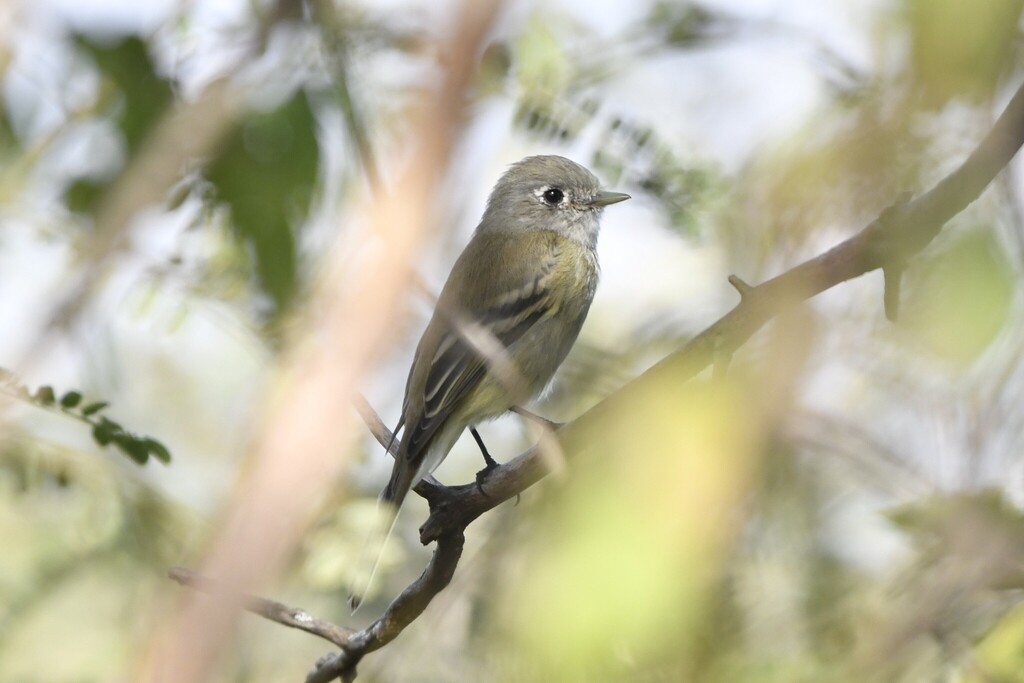
American Dusky Flycatcher
Photo © Zac Peterson
Photo © Zac Peterson — CC BY 4.0 — Source: iNaturalist photo #596790507Identification
The American dusky flycatcher is a small insectivorous songbird with olive-gray upperparts that darken toward the wings and tail, contrasting with whitish underparts washed lightly with olive-gray on the breast. A distinctive medium-width white eye ring, white wing bars, and a medium-length tail are key field marks. The bill is predominantly dark. Within the notoriously similar Empidonax genus, the dusky flycatcher is slightly smaller than the American grey flycatcher but slightly larger than Hammond's flycatcher—making size alone an unreliable identifier.
Voice, breeding habitat, and range are the most reliable characteristics for separating this species from its close relatives. The male's three-part song, along with a distinctive dry whit call and the less common sad dew-hic vocalization, offer experienced birders valuable identification clues.
Range & Habitat
The American dusky flycatcher breeds across mountain slopes and foothills in western North America, favoring habitats with brush and scattered trees, particularly ponderosa pine. During migration and winter, these birds travel to southern Arizona and Mexico, passing through the southwestern deserts—including the Mojave, Sonoran, and Chihuahuan Deserts—where they pause along established flyways as passage migrants.
Behaviour & Diet
True to its insectivorous nature, the dusky flycatcher employs two primary foraging techniques. It frequently perches openly and sallies out to hawk insects in flight—a classic flycatcher behavior—while also gleaning insects from foliage by hovering. This flexibility in hunting strategy allows the species to exploit a variety of food sources across different habitats and seasons.
Best Time & Places to See It
Breeding birds are found on western mountain slopes during the breeding season, where their presence among ponderosa pines and brushy foothills makes them a rewarding find for travelers exploring the interior West. During migration, the southwestern deserts become the best location to encounter dusky flycatchers as they move between breeding and wintering grounds. Observers in southern Arizona, the Mojave Desert region, and other southwestern habitats during spring and fall migration stand the best chance of adding this species to their trip list.
Photography Tips
The dusky flycatcher's small size and quick movements present a challenge for photographers. Focus on capturing the distinctive white eye ring and wing bars, which are key identification features. The bird's habit of perching openly while foraging offers opportunities for clean shots, though patience and a telephoto lens are essential. Early morning light on mountain slopes illuminates the olive-gray plumage beautifully, revealing subtle color variation often lost in harsh midday sun.
Alaska Maritime National Wildlife Refuge
Arches National Park
Banff National Park
Bear River Migratory Bird Refuge
Big Bend National Park
Bitter Lake National Wildlife Refuge
Black Canyon of the Gunnison National Park
Bosque del Apache National Wildlife Refuge
Bryce Canyon National Park
Nothing matches these filters.
No community photos yet. Log in to add the first one.
No community observations of this species yet.