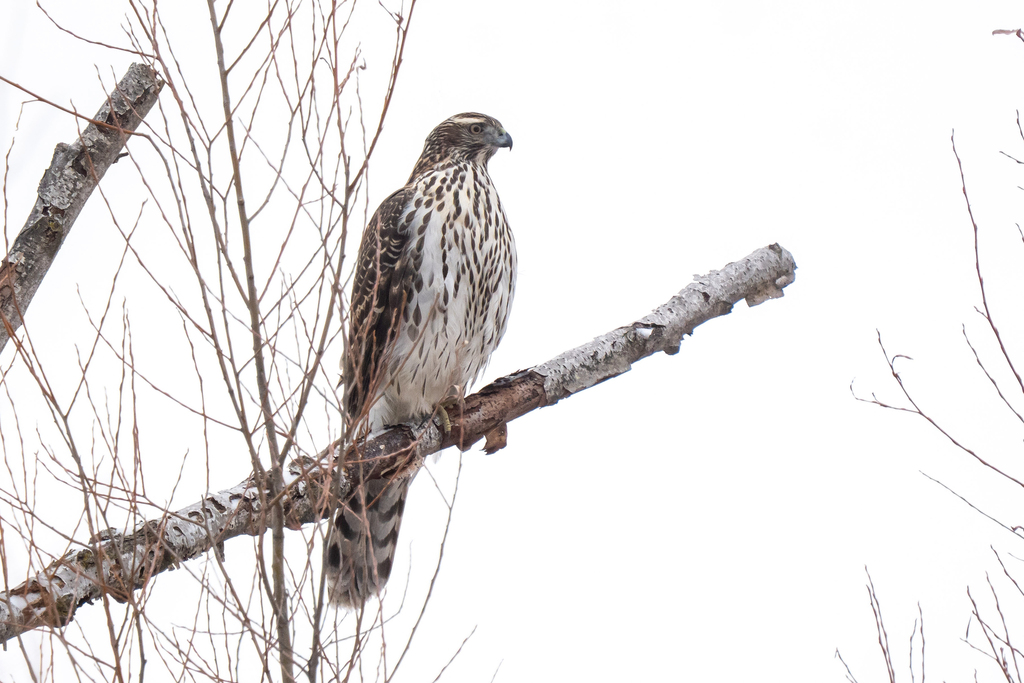
American Goshawk
Photo © Andrew Lai
Photo © Andrew Lai — CC BY 4.0 — Source: iNaturalist photo #603466062Identification
The American goshawk is a powerful raptor belonging to the family Accipitridae. Until 2023, it was considered conspecific with the Eurasian goshawk, but genetic analysis and differences in morphology and vocalizations have since established it as a separate species. Adult American goshawks are distinguished by their lack of rusty underside barring, unlike some related northern species. Their wing beats are notably deeper, more deliberate, and slower on average than those of other North American relatives.
Identification can be challenging, particularly with juveniles, which may be confused with several other raptor species including Cooper's hawks, gray hawks, and various buteonine hawks. Key distinguishing features include the goshawk's proportions—shorter wings and longer tail relative to size compared to many similar species. Even wintering gyrfalcons have occasionally been mistaken for goshawks when observed from a distance.
Range & Habitat
In North America, American goshawks are most broadly distributed across the Western United States, Alaska, and western Canada. Their breeding range in the western contiguous United States centers on the wooded foothills of the Rocky Mountains and other large mountain ranges from Washington to southern California, extending east to central Colorado and westernmost Texas. Populations also breed in the Great Lakes region, New England, New York, central Pennsylvania, and northwestern New Jersey, with discontinuous populations in the Sierra Madre Occidental of western Mexico extending as far south as Jalisco and Guerrero.
These raptors inhabit both deciduous and coniforous forests, with the critical habitat requirement being tall, old-growth stands with intermediate to heavy canopy coverage (often exceeding 40%) and minimal undergrowth density—conditions that favor hunting. Proximity to forest openings is also important for executing hunts. While American goshawks can be found at almost any altitude, they are now typically located at higher elevations due to the loss of extensive lowland forests across much of their range, ascending to the tree line, usually around 3,000 meters.
Behaviour & Diet
The American goshawk is primarily resident throughout most of its range, though birds from colder regions migrate south during winter months. Migratory populations are often observed in fall migrating south along mountain ridge tops, with timing varying depending on latitude. A majority of goshawks worldwide remain sedentary year-round, though northern and high-mountain populations move to warmer forests at lower elevations during winter.
Best Time & Places to See It
Fall migration along mountain ridge tops offers excellent opportunities to observe American goshawks, with sightings possible at nearly any time depending on latitude. The Great Lakes region provides reliable viewing during breeding season, particularly in northern Minnesota, Illinois, and Michigan. Western mountain ranges, especially the Rocky Mountains and associated ranges from Washington to Colorado, offer consistent sightings year-round, while southwestern mountain populations in Arizona and New Mexico may be encountered seasonally.
Photography Tips
Photographing American goshawks requires patience and attention to their hunting behavior and flight characteristics. The species' preference for tall, old-growth forests with dense canopy coverage means birds may remain difficult to detect except during migration. Capturing their distinctive slower, deeper wing beats can help document identification. During fall migration along mountain ridges, positioning yourself along known flight corridors at appropriate times of day increases opportunities for photography. Be prepared for distant perched birds, as goshawks are often observed from afar, particularly in winter.
Glacier National Park
Glacier, Canada
+162 birds+12 mammals
Where granite peaks pierce the clouds above the Columbia River valley, Glacier National Park protects one of the most dramatic mountain wilderness areas in western Canada.…
VIEW NATIONAL PARKKootenay National Park
Area G (Forster Creek/Mount Assiniboine), Canada
+181 birds+23 mammals
Where the spine of the Canadian Rockies rises above 3,000 metres, the high alpine realm around Forster Creek and Mount Assiniboine reveals one of the continent's…
VIEW NATIONAL PARKFrontenac National Park
Sainte-Praxède, Canada
+178 birds+11 mammals
Where the Canadian Shield's ancient granite ridges meet coniferous forest and freshwater lakes, Frontenac National Park embraces a landscape carved by millennia of glacial movement. The…
VIEW NATIONAL PARKBanff National Park
Improvement District No. 9, Canada
+264 birds+33 mammals
Where the Canadian Rockies thrust skyward in a cathedral of limestone and ice, Banff National Park preserves a wilderness of astounding vertical drama. Glacier-carved valleys cradle…
VIEW NATIONAL PARKMont-Saint-Bruno National Park
Saint-Bruno-de-Montarville, Canada
+200 birds+13 mammals
Hardwood forests rise steeply from the suburbs of Montreal to crown a distinctive peak in the Monterégian Hills, their ancient geology pushing through mixed deciduous woodland…
VIEW NATIONAL PARKLassen Volcanic National Park
Shasta County, United States
+239 birds+18 mammals
Volcanic peaks and geothermal upheaval have sculpted 545 square kilometers of Northern California into a landscape where fire and water engage in perpetual dialogue. Lassen Peak…
VIEW NATIONAL PARKGlacier Bay National Park
Unorganized Borough, United States
+221 birds+15 mammals
Tidewater glaciers calving into fjords of impossible blue, where temperate rainforest rises steeply from the water's edge and alpine peaks pierce the clouds—this is the ecological…
VIEW NATIONAL PARKGreat Basin National Park
White Pine County, United States
+170 birds+19 mammals
Where the Great Basin's high desert plateaus rise above 10,000 feet, ancient bristlecone pines endure on moonscape ridges of limestone and quartzite, creating one of North…
VIEW NATIONAL PARKZion National Park
Washington County, United States
+244 birds+30 mammals
Towering sandstone cliffs in shades of crimson, rust, and cream rise abruptly from the Virgin River's winding canyon floor, their sculpted faces bearing witness to millions…
VIEW NATIONAL PARKMesa Verde National Park
Montezuma County, United States
+166 birds+10 mammals
Across the high desert plateau of southwestern Colorado, where sandstone mesas rise abruptly from piñon-juniper scrubland, Mesa Verde National Park preserves one of North America's most…
VIEW NATIONAL PARKGates of the Arctic National Park
Unorganized Borough, United States
+112 birds+12 mammals
Where granite gorges pierce the Brooks Range and alpine tundra stretches endlessly beneath the Alaskan sky, Gates of the Arctic National Park unfolds across nearly 50,000…
VIEW NATIONAL PARKDenali National Park
Denali Borough, United States
+144 birds+18 mammals
Across nearly 31,000 square kilometres of interior Alaska, subarctic boreal forest gives way to alpine tundra, where the raw architecture of mountains—including the continent's tallest peak—shapes…
VIEW NATIONAL PARKYosemite National Park
Mariposa County, United States
+224 birds+28 mammals
Granite cliffs soar nearly a kilometer above the valley floor in this expanse of high Sierra wilderness, where glacial U-shaped valleys sculpt a landscape of dramatic…
VIEW NATIONAL PARKGrand Teton National Park
Teton County, United States
+247 birds+38 mammals
Where the Teton Range tears skyward in a dramatic escarpment above the Snake River valley, nearly 2,550 square kilometers of montane wilderness unfolds across Teton County,…
VIEW NATIONAL PARKYellowstone National Park
Park County, United States
+253 birds+43 mammals
Across nearly 11,400 square kilometres of the Rocky Mountain plateau, geothermal fury and pristine wilderness converge in one of Earth's most dynamic landscapes. Hot springs, geysers…
VIEW NATIONAL PARKMount Rainier National Park
Pierce County, United States
+187 birds+25 mammals
A volcanic colossus dominates the Cascade Range in western Washington, its 4,392-meter summit crowned year-round with glacial ice that cascades down toward temperate rainforest and subalpine…
VIEW NATIONAL PARKCrater Lake National Park
Klamath County, United States
+174 birds+13 mammals
At 1,949 metres above sea level, a volcanic caldera of impossible clarity holds one of North America's deepest and most pristine alpine lakes, ringed by pumice-and-ash…
VIEW NATIONAL PARKRedwood National Park
Humboldt County, United States
+343 birds+43 mammals
Where the Pacific fog rolls deep into northern California's coastal valleys, some of the tallest trees on Earth rise from a landscape shaped by tectonic forces…
VIEW NATIONAL PARKSequoia National Park
Tulare County, United States
+187 birds+27 mammals
Granite peaks rising above 3,600 meters dominate the southern Sierra Nevada, where Sequoia National Park sprawls across one of North America's most vertically compressed wilderness zones.…
VIEW NATIONAL PARKKings Canyon National Park
Fresno County, United States
+186 birds+20 mammals
Where granite peaks fracture the Sierra Nevada skyline and the Kings River has carved one of North America's most dramatic canyons, a landscape of extreme relief…
VIEW NATIONAL PARKBadlands National Park
Wall, United States
+200 birds+14 mammals
Eroded badlands rise in jagged formations across northwestern South Dakota, where the White River has carved deep canyons through layers of sedimentary rock spanning millions of…
VIEW NATIONAL PARKNo community photos yet. Log in to add the first one.
No community observations of this species yet.