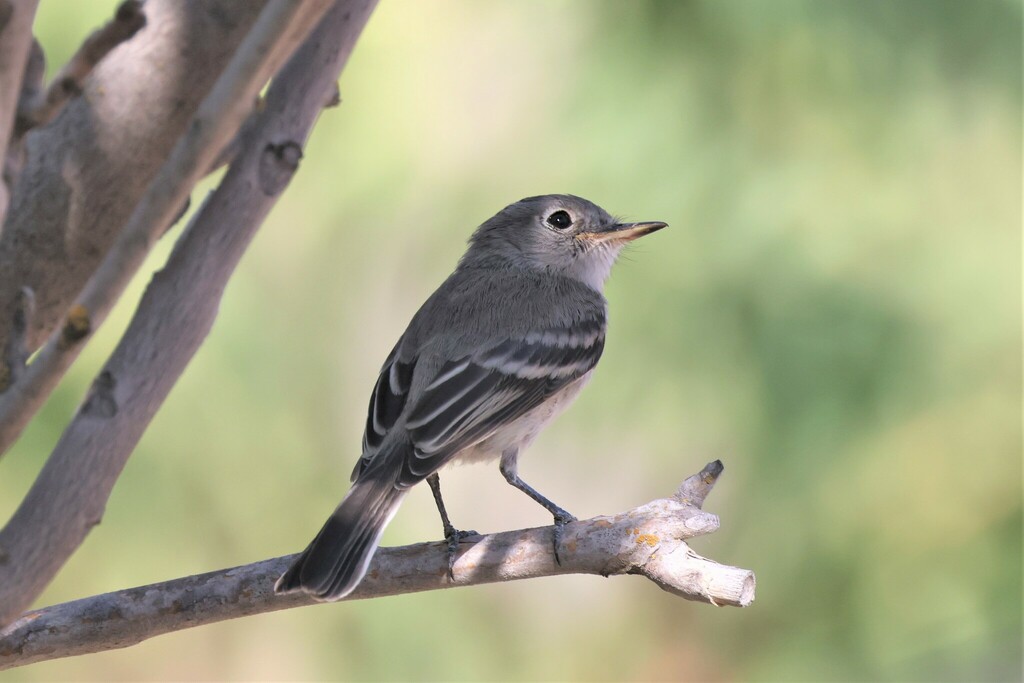
American Grey Flycatcher
Photo © russnamitz
Photo © russnamitz — CC0 1.0 — Source: iNaturalist photo #418650690Identification
The Gray Flycatcher is a small passerine, larger than most Empidonax flycatchers but still compact at 15 cm in length. Adults display pale gray upperparts with a faint olive tinge after fall molt, darker wings and tail, and whitish underparts washed with yellow in fresh plumage. Look for white wing bars, an inconspicuous white eye ring, and a pale supraloral band above the bill base. Relative to other North American Empidonax species, this flycatcher has a notably long, narrow bill, an elongated tail, and a paler mandible.
The most reliable field mark is the bird's unique downward tail wag—unlike other Empidonax species that flick their tails upward. Males deliver a strong two-syllable song described as "chuwip" or "wilip," often with inserted higher-pitched "teeap" or "seep" notes. Both sexes give dry "pit" or "wit" calls. Juveniles are similar to adults but show stronger olive and yellow tones with buffy wing bars and brownish breasts.
Range & Habitat
The Gray Flycatcher breeds across the arid regions of western North America, from southernmost British Columbia through central Washington, eastern Oregon and California, east across Nevada, southern Idaho, Utah, and northern Arizona to southwestern Wyoming, western Colorado, and northwestern New Mexico. It winters in Baja California Sur, southeastern Arizona, and central Sonora to central Oaxaca, with small numbers in western Texas and southern California. Migration takes approximately seven weeks each direction, with birds arriving on breeding grounds from mid-April to mid-May and departing between mid-August and mid-September.
The species favors sagebrush steppes and open woodlands, commonly associating with bitterbrush, rabbitbrush, mountain-mahogany, juniper, pinyon pine, and ponderosa pine forests. Breeding habitat requires shrubland, open woodland, or forest with a bare understory. During migration, birds exploit riparian areas with willows, oaks, and mesquite. Winter habitat consists of arid open and semi-open areas with scrub and scattered trees.
Behaviour & Diet
This insectivorous flycatcher forages by waiting on an open perch—typically a shrub or low tree branch—and flying out to snatch passing insects mid-flight. Less commonly, it hovers to glean prey from foliage or bark. Most food is taken in flight or from the ground, though fruit may supplement the diet in winter. The diet presumably consists entirely of insects and other small invertebrates.
Gray Flycatchers are territorial during breeding season. Males establish territories and attract females through vocalizations and displays. The species appears monogamous, though extra-pair copulations may occur. Females build bulky, less-compact nests from grass stalks and bark strips, lined with wool, hair, feathers, or soft grasses. Nests are typically placed 1–6 meters above ground in the crotch of branches or on larger limbs in sagebrush, bitterbrush, junipers, or pines.
Best Time & Places to See It
Visit the Great Basin and surrounding arid regions during the breeding season from mid-May through August for the best viewing opportunities. Key areas include sagebrush steppes throughout Nevada, Utah, and Idaho, as well as pinyon-juniper and ponderosa pine woodlands in Arizona, New Mexico, and Colorado. Early morning is ideal, as males are most vocal during establishment and courtship.
During migration in spring (late April to mid-May) and autumn (mid-August to mid-September), search riparian corridors with willows and oaks, where birds concentrate during stopover. Winter birders in the southwestern United States should check scrubby arid areas in Arizona and southern California, though the species is less common in winter.
Photography Tips
The Gray Flycatcher's small size and preference for exposed perches make it an accessible subject compared to many flycatchers. Position yourself with morning light to capture the pale gray plumage and subtle olive tones. Focus on open-perch foraging behavior—the bird's habit of waiting conspicuously before sallying for insects provides excellent photographic opportunities. Use a fast shutter speed to freeze mid-flight insect captures.
The distinctive downward tail wag is a diagnostic behavioral photograph worth capturing. This behavior, unique among Empidonax flycatchers, separates the Gray Flycatcher from confusing species in the field and makes for compelling documentation. Patience at a productive sagebrush patch will reward you with multiple opportunities to capture this subtle but characteristic movement.
Big Bend National Park
Brewster County, United States
+345 birds+34 mammals
Where the Chisos Mountains rise abruptly from the Sonoran Desert floor, Big Bend National Park spans over 7,300 square kilometers of one of North America's most…
VIEW NATIONAL PARKCanyonlands National Park
Wayne County, United States
+186 birds+15 mammals
Where the Colorado River has carved an intricate labyrinth through the high desert plateau of southeastern Utah, Canyonlands National Park sprawls across nearly 3,030 square kilometres…
VIEW NATIONAL PARKSaguaro National Park
Rincon Valley, United States
+354 birds+40 mammals
Where the Sonoran Desert meets sky-island mountains, two geographically separated districts of Saguaro National Park sprawl across nearly two thousand square kilometers of Arizona's most iconic…
VIEW NATIONAL PARKLassen Volcanic National Park
Shasta County, United States
+239 birds+18 mammals
Volcanic peaks and geothermal upheaval have sculpted 545 square kilometers of Northern California into a landscape where fire and water engage in perpetual dialogue. Lassen Peak…
VIEW NATIONAL PARKPinnacles National Park
San Benito County, United States
+197 birds+33 mammals
Jagged volcanic spires thrust from chaparral-covered ridges across 222 square kilometers of central California's inner Coast Ranges, their pale stone crowns catching the afternoon light like…
VIEW NATIONAL PARKJoshua Tree National Park
Riverside County, United States
+221 birds+23 mammals
Across 5,610 square kilometers of Riverside County's high desert, a landscape of geological drama unfolds where granite monoliths pierce through bajadas of creosote scrub and Joshua…
VIEW NATIONAL PARKGreat Basin National Park
White Pine County, United States
+170 birds+19 mammals
Where the Great Basin's high desert plateaus rise above 10,000 feet, ancient bristlecone pines endure on moonscape ridges of limestone and quartzite, creating one of North…
VIEW NATIONAL PARKCarlsbad Caverns National Park
Eddy County, United States
+309 birds+18 mammals
Beneath the Chihuahuan Desert floor of southern New Mexico lies one of North America's most spectacular subterranean landscapes. Carlsbad Caverns National Park encompasses over 518 square…
VIEW NATIONAL PARKArches National Park
Grand County, United States
+185 birds+20 mammals
Where rust-red sandstone fins rise abruptly from high desert scrubland, Arches National Park spans 548 square kilometers of one of North America's most sculptural landscapes. The…
VIEW NATIONAL PARKZion National Park
Washington County, United States
+244 birds+30 mammals
Towering sandstone cliffs in shades of crimson, rust, and cream rise abruptly from the Virgin River's winding canyon floor, their sculpted faces bearing witness to millions…
VIEW NATIONAL PARKMesa Verde National Park
Montezuma County, United States
+166 birds+10 mammals
Across the high desert plateau of southwestern Colorado, where sandstone mesas rise abruptly from piñon-juniper scrubland, Mesa Verde National Park preserves one of North America's most…
VIEW NATIONAL PARKGreat Sand Dunes National Park
Saguache County, United States
+193 birds+14 mammals
Where the Colorado high plains collide with one of North America's most extraordinary geological anomalies, nearly 600 square kilometres of windswept sand rise abruptly from the…
VIEW NATIONAL PARKCapitol Reef National Park
Garfield County, United States
+196 birds+22 mammals
Wrinkled ridges of crimson and gold sandstone rise from the floor of south-central Utah, their weathered faces carved by the Fremont River into one of the…
VIEW NATIONAL PARKYosemite National Park
Mariposa County, United States
+224 birds+28 mammals
Granite cliffs soar nearly a kilometer above the valley floor in this expanse of high Sierra wilderness, where glacial U-shaped valleys sculpt a landscape of dramatic…
VIEW NATIONAL PARKGrand Teton National Park
Teton County, United States
+247 birds+38 mammals
Where the Teton Range tears skyward in a dramatic escarpment above the Snake River valley, nearly 2,550 square kilometers of montane wilderness unfolds across Teton County,…
VIEW NATIONAL PARKCrater Lake National Park
Klamath County, United States
+174 birds+13 mammals
At 1,949 metres above sea level, a volcanic caldera of impossible clarity holds one of North America's deepest and most pristine alpine lakes, ringed by pumice-and-ash…
VIEW NATIONAL PARKBlack Canyon of the Gunnison National Park
Montrose County, United States
+169 birds+13 mammals
Where the Gunnison River has carved one of North America's steepest and most dramatic canyons, ancient metamorphic rock walls plunge nearly 2,000 feet in places, creating…
VIEW NATIONAL PARKRocky Mountain National Park
Larimer County, United States
+259 birds+33 mammals
Where granite peaks rise above 12,000 feet and alpine tundra gives way to subalpine forest, Rocky Mountain National Park spans the Continental Divide across nearly 1,600…
VIEW NATIONAL PARKRedwood National Park
Humboldt County, United States
+343 birds+43 mammals
Where the Pacific fog rolls deep into northern California's coastal valleys, some of the tallest trees on Earth rise from a landscape shaped by tectonic forces…
VIEW NATIONAL PARKSequoia National Park
Tulare County, United States
+187 birds+27 mammals
Granite peaks rising above 3,600 meters dominate the southern Sierra Nevada, where Sequoia National Park sprawls across one of North America's most vertically compressed wilderness zones.…
VIEW NATIONAL PARKKings Canyon National Park
Fresno County, United States
+186 birds+20 mammals
Where granite peaks fracture the Sierra Nevada skyline and the Kings River has carved one of North America's most dramatic canyons, a landscape of extreme relief…
VIEW NATIONAL PARKDeath Valley National Park
Inyo County, United States
+339 birds+25 mammals
Across nearly 3.5 million acres of southeastern California's Inyo County, vast salt flats meet sculpted badlands and alluvial fans in a landscape so extreme it defines…
VIEW NATIONAL PARKEl Vizcaíno
Laguna San Ignacio, Mexico
+317 birds+29 mammals
Where the Baja California peninsula thins into a tapestry of salt lagoons and coastal desert, one of Mexico's most biodiverse reserves sprawls across half a million…
VIEW BIOSPHERE RESERVEParque Nacional Cerro de la Estrella
Mexico
+126 birds+4 mammals
Where volcanic peaks rise sharply above Mexico City's sprawling metropolis, Parque Nacional Cerro de la Estrella offers a rare glimpse of high-altitude terrain within one of…
VIEW NATIONAL PARKParque Nacional Benito Juárez
San Andrés Huayápam, Mexico
+128 birds+4 mammals
High in the Sierra Madre del Sur of Oaxaca, where cloud forest mingles with pine woodland and the terrain climbs steeply through ravines carved by mountain…
VIEW NATIONAL PARKTutuaca
Tosanachi, Mexico
+147 birds+13 mammals
Where copper canyons plunge deeper than the Grand Canyon itself, Mexico's remote Sierra Madre Occidental unfolds in dramatic vertical relief. Tutuaca anchors this wilderness realm, a…
VIEW PROTECTED LANDSCAPEBryce Canyon National Park
Tropic, United States
+202 birds+20 mammals
Hoodoos rise like a forest of stone pillars from an amphitheater carved into Utah's high plateau, where the Paunsaugunt elevates the landscape to over 9,000 feet…
VIEW NATIONAL PARKChannel Islands National Park
Santa Barbara County, United States
+330 birds+15 mammals
A chain of eight volcanic islands rises from the cold Pacific waters off the California coast, their rugged sea cliffs and windswept terrain shaped by millions…
VIEW NATIONAL PARKGrand Canyon National Park
United States
+277 birds+35 mammals
A mile-deep chasm of rust-red rock and purple shadow cuts through the high desert plateau of northern Arizona, revealing nearly two billion years of geological history…
VIEW NATIONAL PARKGuadalupe Mountains National Park
Culberson County, United States
+262 birds+14 mammals
Where fossil-laden limestone ridges thrust skyward above the Chihuahuan Desert floor, Guadalupe Mountains National Park reveals a landscape sculpted by ancient seas and relentless aridity. These…
VIEW NATIONAL PARKNorth Cascades National Park
Whatcom County, United States
+120 birds+18 mammals
Jagged peaks rise abruptly from the western foothills of Washington's Cascade Range, where glaciers cling to elevations above 10,000 feet and meltwater feeds a landscape of…
VIEW NATIONAL PARKPetrified Forest National Park
Apache County, United States
+206 birds+23 mammals
Across the high desert plateau of northeastern Arizona, where the climate swings between scorching summer days and frost-laden winters, badlands of raw earth and timber-turned-to-stone dominate…
VIEW NATIONAL PARKWhite Sands National Park
Otero County, United States
+178 birds+6 mammals
Across the Tularosa Basin in south-central New Mexico sprawls an otherworldly landscape of gypsum dunes—the largest gypsum field on Earth and a stark desert playground shaped…
VIEW NATIONAL PARKBosque del Apache National Wildlife Refuge
Socorro County, United States
+345 birds+17 mammals
Where the Rio Grande emerges from its desert canyon in central New Mexico, a narrow ribbon of riparian woodland defies the arid landscape that surrounds it.…
VIEW WILDLIFE SANCTUARYCabeza Prieta National Wildlife Refuge
United States
+155 birds+6 mammals
Across southwestern Arizona's harshest terrain, where the Colorado River marks the border with Mexico, lies a sanctuary shaped entirely by heat and aridity. Cabeza Prieta National…
VIEW WILDLIFE SANCTUARYKofa National Wildlife Refuge
Yuma County, United States
+142 birds+10 mammals
Desert mountains rise in sculptured ridges across northwestern Arizona, where the Colorado River's distant influence fades into some of the most austere terrain in the American…
VIEW WILDLIFE SANCTUARYHavasu National Wildlife Refuge
Lake Havasu City, United States
+291 birds+8 mammals
Where the Colorado River widens into a vast reservoir in the Sonoran Desert, Havasu National Wildlife Sanctuary protects one of the most critical wetland ecosystems in…
VIEW WILDLIFE SANCTUARYImperial National Wildlife Refuge
La Paz County, United States
+222 birds+4 mammals
Where the Colorado River carves through the Sonoran Desert in southwestern Arizona, Imperial National Wildlife Sanctuary unfolds across a landscape shaped by water and aridity. The…
VIEW WILDLIFE SANCTUARYMalheur National Wildlife Refuge
Harney County, United States
+309 birds+24 mammals
Across the high desert plateau of southeastern Oregon, where sagebrush scrubland stretches toward distant ridgelines under an enormous sky, lies a sanctuary shaped by water in…
VIEW WILDLIFE SANCTUARYKlamath Marsh National Wildlife Refuge
Klamath County, United States
+219 birds+7 mammals
Where the volcanic plateau of south-central Oregon slopes into a broad, shallow basin lies one of the Pacific Northwest's most underappreciated wetland sanctuaries. Klamath Marsh National…
VIEW WILDLIFE SANCTUARYUpper Klamath National Wildlife Refuge
Klamath County, United States
+217 birds
Where shallow marshes and open water meet the high desert of south-central Oregon, the Upper Klamath National Wildlife Sanctuary creates a landscape of startling contrasts. Fed…
VIEW WILDLIFE SANCTUARYTule Lake National Wildlife Refuge
Siskiyou County, United States
+255 birds+9 mammals
Across the high volcanic plateau of northeastern California, where summer heat scorches the alkali flats and winter winds sweep unobstructed through open water and marsh, Tule…
VIEW WILDLIFE SANCTUARYSacramento National Wildlife Refuge
Glenn County, United States
+247 birds+13 mammals
Across the flat expanse of Glenn County's Sacramento Valley, shallow pools and seasonal marshes create one of California's most vital wetland sanctuaries—a landscape shaped by water…
VIEW WILDLIFE SANCTUARYSan Luis National Wildlife Refuge
Merced County, United States
+219 birds+14 mammals
Across the floor of California's San Joaquin Valley, where semi-arid grasslands meet shallow seasonal wetlands, San Luis National Wildlife Sanctuary preserves a critical mosaic of habitats…
VIEW WILDLIFE SANCTUARYFarallon National Wildlife Refuge
San Francisco, United States
+384 birds+16 mammals
Windswept granite peaks rising abruptly from the Pacific, the Farallon Islands form a wildlife sanctuary of extraordinary seabird abundance and ecological significance just twenty-seven miles west…
VIEW WILDLIFE SANCTUARYSalton Sea National Wildlife Refuge
Imperial County, United States
+289 birds+4 mammals
Across the floor of California's inland desert, where summer temperatures soar and rainfall is measured in tenths of inches, lies an improbable oasis of shallow water…
VIEW WILDLIFE SANCTUARYBear River Migratory Bird Refuge
Box Elder County, United States
+254 birds+9 mammals
Where the Bear River winds through the semi-arid basin country of northwestern Utah, a sprawling wildlife sanctuary transforms the high desert into a haven for migratory…
VIEW WILDLIFE SANCTUARYSeedskadee National Wildlife Refuge
Sweetwater County, United States
+209 birds+8 mammals
Where the Green River carves through the high-desert basin of southwestern Wyoming, Seedskadee National Wildlife Sanctuary preserves one of the West's most vital riparian corridors. The…
VIEW WILDLIFE SANCTUARYNational Elk Refuge
Jackson, United States
+230 birds+27 mammals
Where the sagebrush flats of northwestern Wyoming rise toward the Gros Ventre Mountains, winter transforms the landscape into a realm of survival and spectacle. The National…
VIEW WILDLIFE SANCTUARYRed Rock Lakes National Wildlife Refuge
Beaverhead County, United States
+216 birds+10 mammals
Where the Greater Yellowstone ecosystem's northern reaches meet the high plateaus of southwestern Montana, a network of glacial lakes and wetlands sustains one of the continent's…
VIEW WILDLIFE SANCTUARYBitter Lake National Wildlife Refuge
Chaves County, United States
+284 birds+10 mammals
Across the high desert floor of southeastern New Mexico, where elevation and aridity shape every living thing, shallow alkaline lakes and marshes form an unexpected oasis…
VIEW WILDLIFE SANCTUARYNo community photos yet. Log in to add the first one.
No community observations of this species yet.