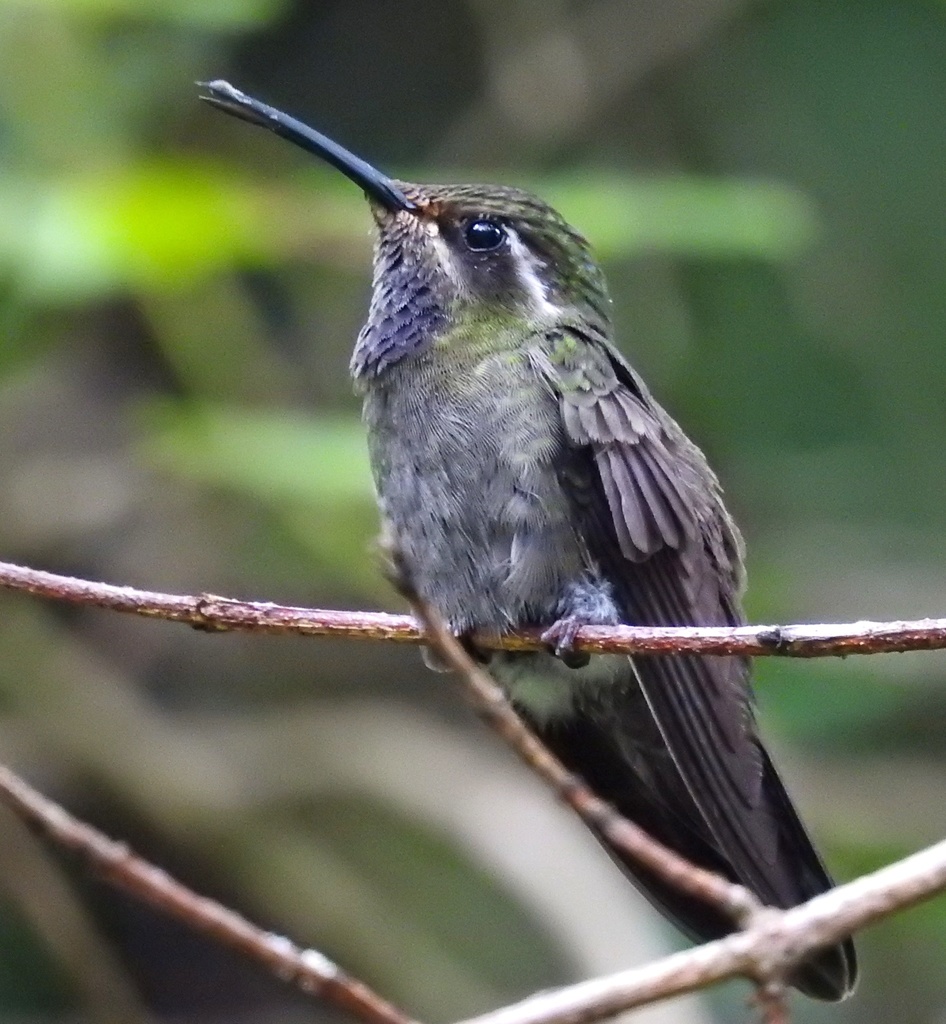
Amethyst-throated Mountaingem
Photo © Matteo Cassella
Photo © Matteo Cassella — CC BY-SA 4.0 — Source: iNaturalist #37509994Identification
The amethyst-throated mountaingem is a small hummingbird measuring 11.5 to 12.5 cm in length, with males weighing 5 to 7.8 grams and females slightly lighter at 5 to 5.8 grams. Both sexes share a medium-length straight black bill, dark ear patches, a distinctive whitish stripe behind the eye, and a broad, slightly forked tail. Adult males of the nominate subspecies display a dark green crown and back with a bronze rump, offset by a brilliant rosy-pink gorget that makes them instantly recognizable. The breast and belly are dusky gray with pale buff undertail coverts. Females are similar in structure but sport a cinnamon throat instead of the vibrant gorget. The plumage varies among the five subspecies: L. a. nobilis shows more bronzy-green upperparts and a purple rump with a reddish-purple gorget, while the distinctly different L. a. margaritae is much darker overall with a violet to royal-blue gorget instead of pink or red.
Range & Habitat
The amethyst-throated mountaingem is found across Mexico, Guatemala, Honduras, and El Salvador, with five subspecies distributed across different regions. The nominate subspecies inhabits central and eastern Mexico from Nuevo León and Tamaulipas south to Veracruz and northern Oaxaca, while L. a. margaritae occupies southwestern Mexico from Nayarit and Jalisco to Michoacán and western Oaxaca. The species ranges through montane evergreen and pine-oak forests, typically at elevations between 900 and 3,000 meters in Mexico, favoring the interior and edges of these forested areas. Vagrant records suggest occasional wandering, with individuals recorded as far north as Quebec and Texas.
Behaviour & Diet
The amethyst-throated mountaingem feeds primarily on nectar from a wide variety of flowering plants, employing a trap-lining strategy whereby it visits a circuit of nectar sources rather than defending feeding territories. It forages in the lower and mid-story levels of the forest canopy and supplements its diet with insects. While generally subordinate to larger hummingbird species, it dominates smaller competitors. These birds are typically non-territorial, though they occasionally defend feeding areas. Males perform elaborate morning and evening aerial displays for females, flying in circles parallel to the ground, diving toward the female, returning to perches, and repeating this sequence up to five times.
Best Time & Places to See It
The amethyst-throated mountaingem can be encountered year-round throughout its range in montane forests of Mexico, Central America, and the highland regions of Guatemala, Honduras, and El Salvador. Morning and evening hours offer the best opportunities to observe males performing their distinctive aerial displays and to hear their complex vocalizations. Montane evergreen and pine-oak forests between 900 and 3,000 meters elevation are the most reliable habitats for finding this species.
Photography Tips
Photographing the amethyst-throated mountaingem requires patience and attention to the species' behavior patterns. The brilliant gorget of males is best captured in direct or angled light that reflects the iridescent rosy-pink coloration. Early morning and late evening when males perform their aerial displays provide excellent opportunities for action shots. Focus on areas where flowering plants attract these birds, positioning yourself to photograph them while trap-lining through the forest understory. The whitish eye-stripe and black bill provide useful reference points for achieving sharp focus on this small, active subject.
Lagunas de Montebello National Park
Laguna de Montebello, Mexico
+360 birds+2 mammals
Where turquoise lagoons pierce the limestone plateau of southeastern Chiapas, the Lagunas de Montebello National Park unfolds across roughly 174 square kilometers of spectral water and…
VIEW NATIONAL PARKParque Nacional Benito Juárez
San Andrés Huayápam, Mexico
+128 birds+4 mammals
High in the Sierra Madre del Sur of Oaxaca, where cloud forest mingles with pine woodland and the terrain climbs steeply through ravines carved by mountain…
VIEW NATIONAL PARKNo community photos yet. Log in to add the first one.
No community observations of this species yet.