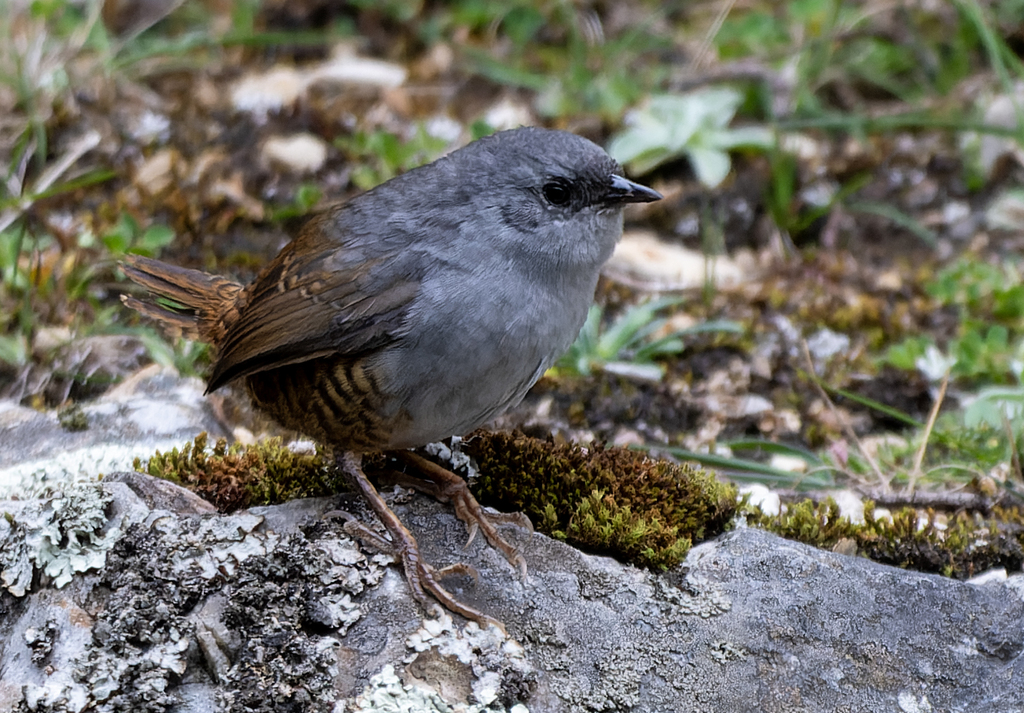
Ancash Tapaculo
Photo © David F. Belmonte
Photo © David F. Belmonte — CC BY 4.0 — Source: iNaturalist photo #593382903Identification
The Ancash tapaculo is a small, cryptic member of the tapaculo family, characterized by subtle plumage differences between sexes and ages. Males display a gray head and upper back contrasting with dark brown upper parts, while the underparts are pale gray with buffy, barred flanks and vent. Females are similar but show browner upper parts overall. Juveniles present a more uniform brownish appearance, with brownish-gray heads and olive-brown upper parts heavily barred throughout; their underparts are gray with olive-brown, dusky-barred flanks and vent.
Range & Habitat
Endemic to Peru, the Ancash tapaculo occurs in the high-altitude regions of the departments of Ancash, La Libertad, Huánuco, and Lima, at elevations between 3,000 and 4,600 meters (9,800–15,100 ft). The species favors tussocky high-elevation grasslands and rocky grass-covered areas, particularly where Polylepis woodland or Gynoxys shrubs provide additional cover and structure.
Behaviour & Diet
Like many tapaculos, the Ancash tapaculo is poorly studied in the field. It is presumed to be insectivorous, though detailed information about its diet and foraging ecology remains scarce. The species is vocal, producing a distinctive repetitive "churr" song sustained for 30 or more seconds. A longer, drier "churr" serves as a scold call. Breeding details are limited; two recorded nests were constructed from grass and moss with side entrances, with eggs and nestlings documented in February.
Best Time & Places to See It
The Ancash tapaculo is best encountered during the austral summer breeding season, particularly in February when calling activity and nesting behavior may be more evident. The high-altitude grasslands of Ancash, La Libertad, Huánuco, and Lima departments offer the best opportunities, especially in areas with mixed Polylepis woodland and Gynoxys shrubland where the species regularly forages. Early morning hours, when vocalizations are most frequent, offer the highest probability of detection.
Photography Tips
Patience and early starts are essential when photographing this elusive species. Position yourself in areas with Polylepis or Gynoxys cover where the birds are known to forage, and listen for their characteristic churring song to locate individuals. The species' preference for rocky, tussocky grassland means firm footing and high-altitude acclimatization are necessary. Use a telephoto lens (at least 400mm) to capture details from a distance, as tapaculos are wary. The subtle plumage differences between males, females, and juveniles reward careful observation and documentation, making this endemic a worthy subject for patient wildlife photographers.
No community photos yet. Log in to add the first one.
No community observations of this species yet.